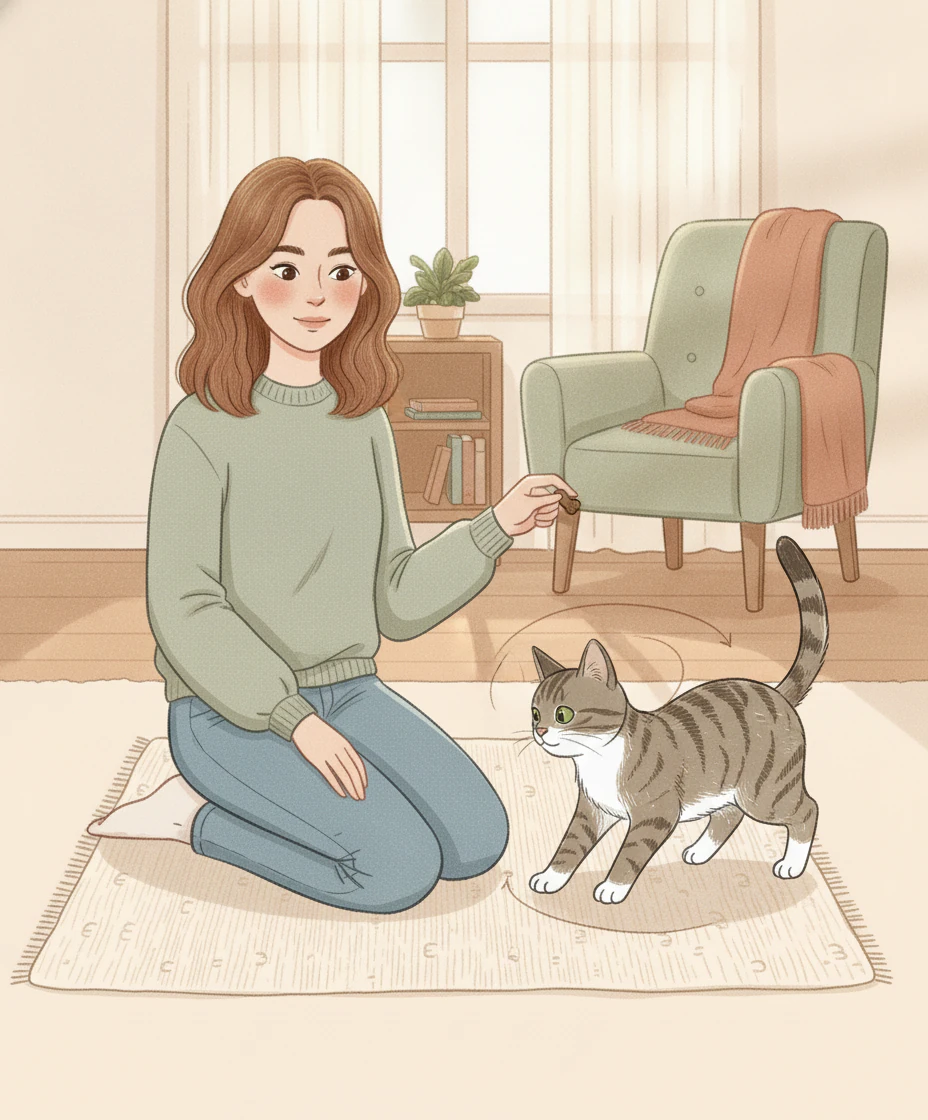
Every cat trick uses the same four steps: get the movement to happen, mark it with a click or the word “yes”, treat within a second, then add a cue once it is reliable. Keep sessions to two minutes. Start with a nose touch to a target, then stand, spin, wave, high five, shake, sit, sit pretty, play dead and fetch.
What you need before the first session
Four things, and none of them cost much: a clicker or a short spoken marker like “yes”, treats your cat actually rates, a quiet spot with a non-slip surface, and two minutes. That is the whole kit. The non-slip part matters more than it sounds, because a cat sliding on a wooden floor will not lift a foot — that foot is holding them up.
Portion the treats out before you begin. Cats Protection suggests setting aside a small portion, stopping when it runs out, and adjusting the rest of the day's food so the calories still add up. A trick session can hand over twenty treats without anyone noticing.
If the clicker startles your cat, Cats Protection recommends muffling it — in a pocket, or behind a cushion — rather than giving up on it. And get your cat checked by a vet before you start training, so you are not shaping around a sore joint or a bad tooth.
Source: Cats Protection: Tips for clicker training a cat (August 11, 2025)
The method behind every trick: 4 steps
- Get the movement to happen. Three ways: lure it with a treat pinched between your fingers, capture it when your cat does it anyway, or shape it by paying for a smaller version first. If a trick stalls, you almost always picked a step that was too big.
- Mark the exact instant. Click, or say “yes”, at the moment the paw lifts or the rear touches down — not when your cat has finished and looked up at you. The marker is what tells your cat which half-second earned the food.
- Treat within a second. Have the treat ready in your other hand so there is no fumbling. Then reset: move your hands away, let your cat come back to neutral, and start the next repetition.
- Add the cue last. Once the movement is reliable without help, say the word, wait about a second, then give the hand signal you were already using. Use the same word every time. Then thin the treats out — Cats Protection suggests moving to every other time, then every fourth time, and keeping the new frequency consistent rather than stopping dead.
Learn this once and all ten tricks below are variations on it. Nothing here is specific to cats being clever or stubborn — it is simply the order the pieces have to go in.
Source: Cats Protection: Tips for clicker training a cat (August 11, 2025)
10 easy cat tricks, easiest first
The order below runs from fastest to slowest, and the timelines come from the Pounce curriculum's own programs. Work down it rather than jumping to the one you want for the group chat — each trick leaves your cat better equipped for the next.
**1. Nose touch (target).** Hold a chopstick, a pen lid or just your fingertip an inch from your cat's face. They sniff it; you mark and treat. That is the whole first session. It becomes the steering wheel for everything else: a cat who follows a target can be moved onto a scale, into a carrier or around in a circle without a hand on them. Reliable in 3 to 4 weeks, with the first win on day one.
**2. Stand.** Hold a treat just above your cat's head, slightly out of reach, and wait for them to rise onto their back legs. Mark at the top. Most cats offer the first rise inside a minute, and the trick is solid in one to three sessions — the fastest return on two minutes you will get.
**3. Spin.** Lure a treat in a slow circle at nose height. Pay the half circle for a few sessions, then the full one, then swap the treat for an empty hand tracing the same shape, then add the word. Two to three weeks, and fading the lure is the part owners find slow.
**4. Wave.** A paw lifted into the air with no contact at all. Easiest built from the high five: offer your palm, then pull it back an inch so the paw reaches and finds nothing, and mark the lift. Most cats have a clean wave inside four short sessions.
**5. High five.** Hold a treat at your cat's shoulder height so the paw has to come up to reach it, mark on contact with your palm, then raise the palm higher and add the words. Two to three weeks, with the first paw lift usually in session one.
**6. Shake hands.** The same paw, lower and slower: a flat palm near the floor, waiting for a paw to land in it, then a one-second rest before the mark. Two to four weeks, because your cat is also deciding your hand is a safe place to put a foot.
**7. Sit.** Pinch a treat an inch above your cat's nose and slide it back over their head, low and level. The nose tips up, the rear folds down. Mark the instant it touches the floor. Two to three weeks to a word cue, though plenty of cats fold into a sit on day one.
**8. Sit pretty.** From a solid sit, raise the lure higher until the front paws leave the floor and tuck — the meerkat. First paw lift in one or two sessions, a held pose in one to two weeks. Big, senior or less athletic cats take longer, and that is a body thing, not a brain thing.
**9. Play dead.** From a lie-down, lure the head back over one shoulder until your cat tips onto their side, then add a finger-gun cue. Two to three weeks: lying on its side leaves a predator exposed, so this moves slower than any paw trick.
**10. Fetch.** Start at the return, not the throw. Reward a mouth on the toy, then a turn back toward you, then two steps, then the carry. Four to eight weeks if your cat is inclined — and plenty of cats simply are not, which is not a failure of yours or theirs.
| Trick | What your cat does | Realistic timeline |
|---|---|---|
| Nose touch | Touches a target with their nose | 3 to 4 weeks (first win day one) |
| Stand | Rises onto their back legs | 1 to 3 sessions |
| Spin | Turns a full circle | 2 to 3 weeks |
| Wave | Lifts a paw in the air, no contact | About 4 short sessions |
| High five | Taps your raised palm | 2 to 3 weeks |
| Shake hands | Rests a paw in your open hand | 2 to 4 weeks |
| Sit | Sits on a word or hand signal | 2 to 3 weeks |
| Sit pretty | Sits up on their haunches | 1 to 2 weeks to a held pose |
| Play dead | Flops onto their side on cue | 2 to 3 weeks |
| Fetch | Brings a thrown toy back | 4 to 8 weeks, if inclined |
Which trick should you teach first?
The nose touch — and there is evidence for it rather than just tradition. In a 2017 study published in Animals, researchers put 100 shelter cats through 15 five-minute clicker sessions over two weeks, twice a day, teaching four cued behaviours: touching a target, sitting, spinning and a high five.
The results reorder what most trick lists assume. Seventy-nine per cent of the cats mastered the target touch. Sixty per cent mastered the spin. Only 31 per cent mastered the high five, and just 27 per cent the sit. So the two tricks every article opens with — sit and high five — were the two the cats found hardest, while the spin that gets filed under “advanced” was learned by three cats in five.
There is a practical reason. Touching and following are things a cat already does; sitting on request and offering a paw ask them to hold still and hand over a body part. Teach the easy two first and your cat learns the game itself — that a click means food is coming and that offering behaviour is worth it — before you ask for anything difficult.
The same study found that how food-motivated a cat was predicted how well they learned the target and the high five. If training stalls, the treat is the first thing to change, not the cat.
What if my cat walks away?
Treat it as information, not refusal. A cat leaving mid-session is usually telling you one of four things: the treat is not worth it, the step was too big, the session ran long, or they are simply full.
Cap sessions at two minutes. Cats Protection's handling guide keeps training to two minutes at most, and that is a ceiling rather than a target — stopping while your cat still wants another go is what makes them turn up tomorrow. Two or three short sessions a day beat one long one every time.
Make the step smaller. If the paw will not come up, pay a weight shift toward your hand. If the full circle stalls, pay a quarter of it. Shaping means buying the half of the trick you already have.
Watch for the request to stop. International Cat Care's handling guidance lists growling, hissing and spitting, swiping with a paw and biting as clear signals an interaction should end, and recommends keeping contact brief — three to five seconds — with a pause after each so your cat decides whether to carry on. Cats Protection is blunt about the rest: your cat should always have the option to move away, and should never be restrained.
And mind where your hands go. International Cat Care puts the belly, paws and base of the tail in the category cats like least, which is exactly why the paw tricks sit lower on this list than their reputation suggests.
Source: International Cat Care: Handling and interactions (updated June 2, 2026)
Can older cats learn tricks?
Yes, and the shelter study is the cleanest answer to the question: across all four behaviours, age made no significant difference to how much the cats improved. Cats Protection says the same from the other direction — cats can be clicker trained at any age, with younger cats often responding faster but older ones getting there too.
What does change with age is the body. An older cat may find sit pretty, stand or play dead uncomfortable long before they find them confusing, so favour the tricks that keep four feet near the floor: nose touch, spin, wave, shake. If your cat used to offer a movement and now hesitates, that is worth a vet's opinion rather than more repetitions.
Kittens are at the other extreme — quick, but with a two-minute attention span that is genuinely two minutes. Keep the sessions as short as the cat, not as long as your patience.
Overall, expect anywhere from a few days to a few months to get a trick onto a verbal cue, which is the range Cats Protection gives for clicker training generally. The spread is wide because it depends far more on how often you practise than on the cat.
When to call your vet
Training is a reasonable early-warning system, because it asks your cat to move in specific ways on a regular schedule and you notice when one of them stops being easy. Cats Protection recommends a veterinary check before you begin training at all, to be sure your cat is fit and healthy.
Book a visit if your cat stops putting weight on a leg, hesitates or seems reluctant to sit, rise or jump where they used to, objects to a paw being touched when they did not before, or has an obviously sore mouth when taking treats. A cat who suddenly turns down a treat they have always worked for is also worth a look.
If your cat reacts to handling with real aggression, or is fearful of people generally, ask your vet for a referral to a qualified behaviourist rather than working through it with tricks.
Source: Cats Protection: How to train your cat to be comfortable with handling (October 2, 2018)
Practising it in two minutes a day
The hard part of trick training is not the technique on this page. It is doing a small amount regularly, and knowing which step comes next on a day when the last one did not quite work.
Pounce builds each of these ten into a guided program — Target Touch, Stand, Spin, Wave, High Five, Shake / Paw, Sit on Cue, Sit Pretty, Play Dead and Fetch — with Meet the Clicker as the two-to-four-day foundation they all start from. Each day is a short illustrated session with one goal, and the programs list their own prerequisites, so you are never guessing whether your cat is ready.
Once the ten are done, the same four steps carry straight into the skills that are genuinely useful: a name your cat answers to, a recall that works from another room, and a mat they go to when the doorbell rings.
A little guidance goes a long way.
Follow illustrated lessons, take the next small step, and keep track of your cat’s little wins in Pounce.
Explore Pounce for iOSSources & how this guide was written
Pounce curriculum: Meet the Clicker and Target Touch as the foundations, then the Stand, Spin, Wave, High Five, Shake / Paw, Sit on Cue, Sit Pretty, Play Dead and Fetch programs.
- Kogan, Kolus & Schoenfeld-Tacher (2017): Assessment of Clicker Training for Shelter Cats, Animals
- Cats Protection: Tips for clicker training a cat (August 11, 2025)
- Cats Protection: How to train your cat to be comfortable with handling (October 2, 2018)
- International Cat Care: Handling and interactions (updated June 2, 2026)
Sources checked October 28, 2026. This article is educational and has not been individually reviewed by a veterinarian. Our editorial policy explains our approach.