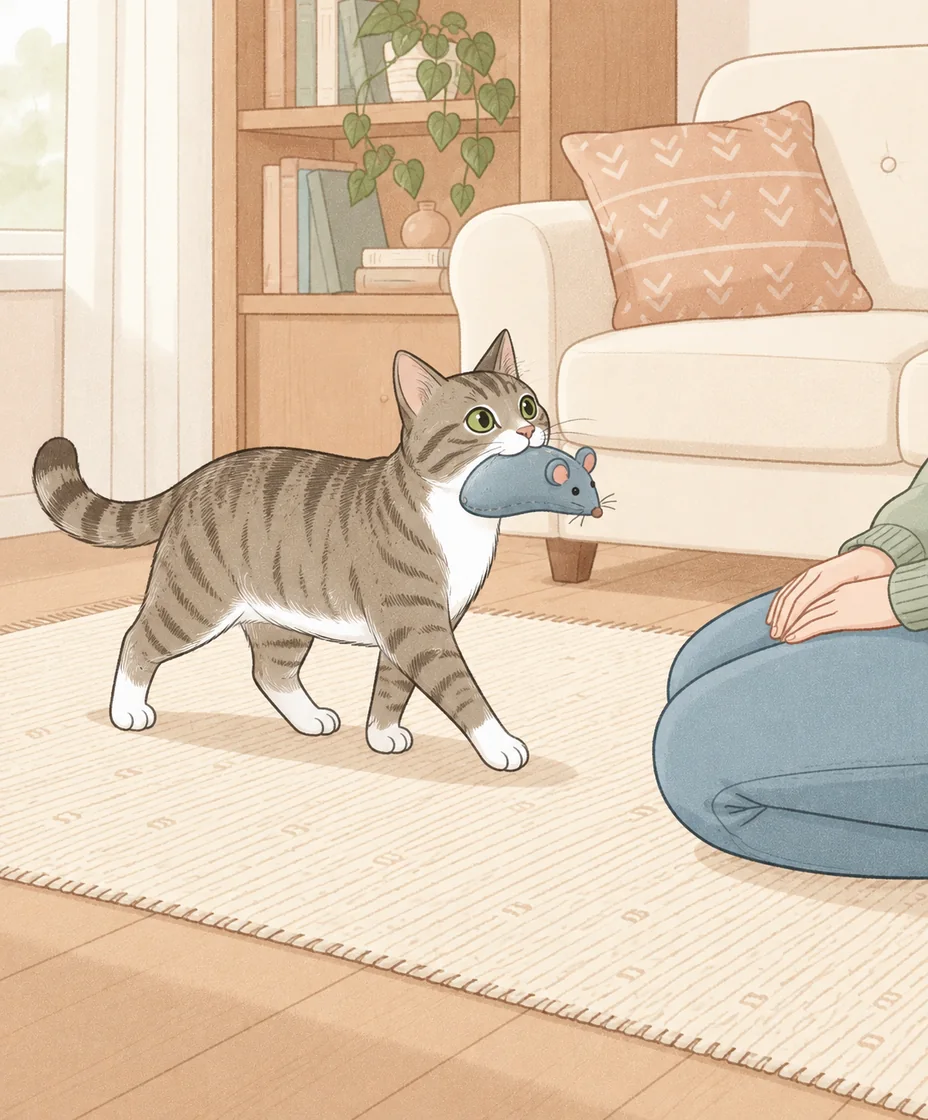
To teach your cat to fetch, start with a suitable toy close by and reward a voluntary pickup before asking for a return. Once holding it is familiar, look for one step toward you while carrying it. Increase the distance gradually. Chasing, carrying and dropping are separate skills, and a cat can enjoy playing without learning the whole sequence.
Which part of fetch already happens?
A cat who runs after a toy and returns empty-mouthed has completed a chase and a return, but has not joined them with carrying. Throwing farther adds distance without teaching that missing part. Start close enough to see the exact movement you want to reward.
Pounce’s Fetch lessons separate interest in the toy, pickup, a brief hold and the return. Drop It / Trade and Come When Called are earlier skills in that path. The exercise below adapts those stages; it is not a promise that a cat who enjoys chasing will enjoy retrieving.
Choose a toy your cat can carry safely
Use an intact, lightweight cat toy that your cat can comfortably pick up without swallowing it or pulling pieces off. Inspect it before each game and follow its instructions. Cats Protection recommends checking toys for wear and supervising toys that could be chewed apart or cause entanglement. Rubber bands, hair ties and loose string are unsuitable substitutes.
Choose a clear indoor space with a stable surface and room to leave. Keep other pets from competing for the toy. Prepare small rewards that fit your cat’s normal diet, and use a familiar click or quiet marker word. You do not need to buy a clicker if a consistent word already serves that role.
Build a pickup before adding a journey
- Place the toy nearby. If investigation is new, mark a voluntary sniff or touch and reward. Do not press the toy against the mouth or coat it with food to encourage chewing.
- As interest becomes familiar, look for a voluntary mouth contact or tiny pickup. Mark that moment and deliver the reward. The toy may drop as your cat takes the food; that does not erase the pickup you marked.
- When pickups are easy, wait for a slightly more sustained hold before marking. Keep the toy close rather than adding a long throw at the same time. If the new expectation stops participation, return to the smaller action.
- For a cat already holding comfortably, place or gently roll the toy a very short distance away. When they pick it up, invite them toward you with the familiar recall cue once. Mark a first step in your direction while the toy is still being carried, then reward.
- Repeat that small, comfortable version on another occasion. Add a little more return distance only when the existing movement is familiar. Let leaving end the game; do not pursue your cat with the toy.
These are separate practice stages. Begin with an awake, comfortable cat who wants to interact. One easy invitation can be enough; there is no required number of throws or days.
Reward the piece you are teaching
Decide before the invitation whether you are working on a pickup or a short carry. If you mark a pickup, deliver its reward even if the toy drops afterward. Do not change the requirement halfway through an attempt and expect a full delivery instead.
Our table separates common stopping points. It gives you a smaller next exercise without treating every incomplete retrieve as the same problem.
| What happens | A useful next step |
|---|---|
| Chases the toy, then watches it. | Put it nearby next time and return to voluntary investigation or pickup. Another long throw does not teach carrying. |
| Picks up, then drops before moving. | Practice the comfortable brief hold nearby; leave the return for later. |
| Comes when called but leaves the toy behind. | Keep recall practice separate. During fetch, make the gap smaller and look for a turn or step with the toy. |
| Carries toward you, then stops short. | Shorten the next return so that a familiar carry reaches you. Avoid reaching into the mouth to finish it. |
| Retrieves one particular toy only. | Keep that successful game. If trying another suitable toy, restart nearby without also increasing distance. |
Let the toy go before picking it up
When your cat comfortably returns with the toy, use an already familiar release cue if you have taught one. Reward the voluntary release and give space before collecting the toy. Do not pull it from the mouth, chase your cat or pry the jaws open. A drop beside you can be sufficient; delivery into a hand is another requirement.
For a cat who clearly seeks another throw, restarting the game can be an enjoyable consequence. If you use the learned marker, still follow it with its familiar reward. Food rewards and unmarked continuation of play can be planned separately.
Stop if approaching the toy brings stiffness, growling or swatting, and seek individual veterinary and behavior advice. New reluctance to use the mouth, eat or move normally also needs veterinary assessment. Fetch practice cannot explain that change.
What the research does—and does not—tell us
A 2023 survey collected reports from 924 owners of 1,154 fetching cats. It found considerable variation in preferred objects and how games began and ended. Because it recruited owners of fetching cats, it could not estimate how common fetching is among all cats or establish a method for teaching it.
A separate 2024 survey analysis included 8,224 cats and classified 40.9% as fetching at least sometimes. The authors noted that the sample was self-selected and did not distinguish trained from spontaneous fetching. That percentage is an observation from their sample, not your cat’s chance of completing a course.
We make Pounce, which includes Fetch, Drop It / Trade and recall lessons. This guide adds the troubleshooting table and adapts the early training stages. Sources and curriculum checked October 10, 2026. Prepared with AI assistance; not individually reviewed by a veterinarian. Neither study tested Pounce.
Source: Forman, Renner and Leavens: Fetching felines (December 14, 2023)
A little guidance goes a long way.
Follow illustrated lessons, take the next small step, and keep track of your cat’s little wins in Pounce.
Explore Pounce for iOSSources & how this guide was written
Pounce curriculum: complete Fetch, Drop It / Trade and Gather Your Tools modules checked. Adapted pickup/hold/short-return stages and familiar release prerequisite. Excludes fixed timelines, success thresholds, endurance and guarding-cure claims, food rubbed on toys, bottle caps, reward withholding after a marker, and forcing contact. Original stopping-point table. Research is observational, not a test of training or Pounce.
- Forman, Renner and Leavens: Fetching felines (December 14, 2023)
- Delgado and colleagues: Making fetch happen (September 4, 2024)
- Cats Protection: Cats and play
- Cats Protection: Keeping your cat safe in the home
- FelineVMA: How Do I Know If My Cat Is In Pain?
Sources checked October 10, 2026. This article is educational and has not been individually reviewed by a veterinarian. Our editorial policy explains our approach.