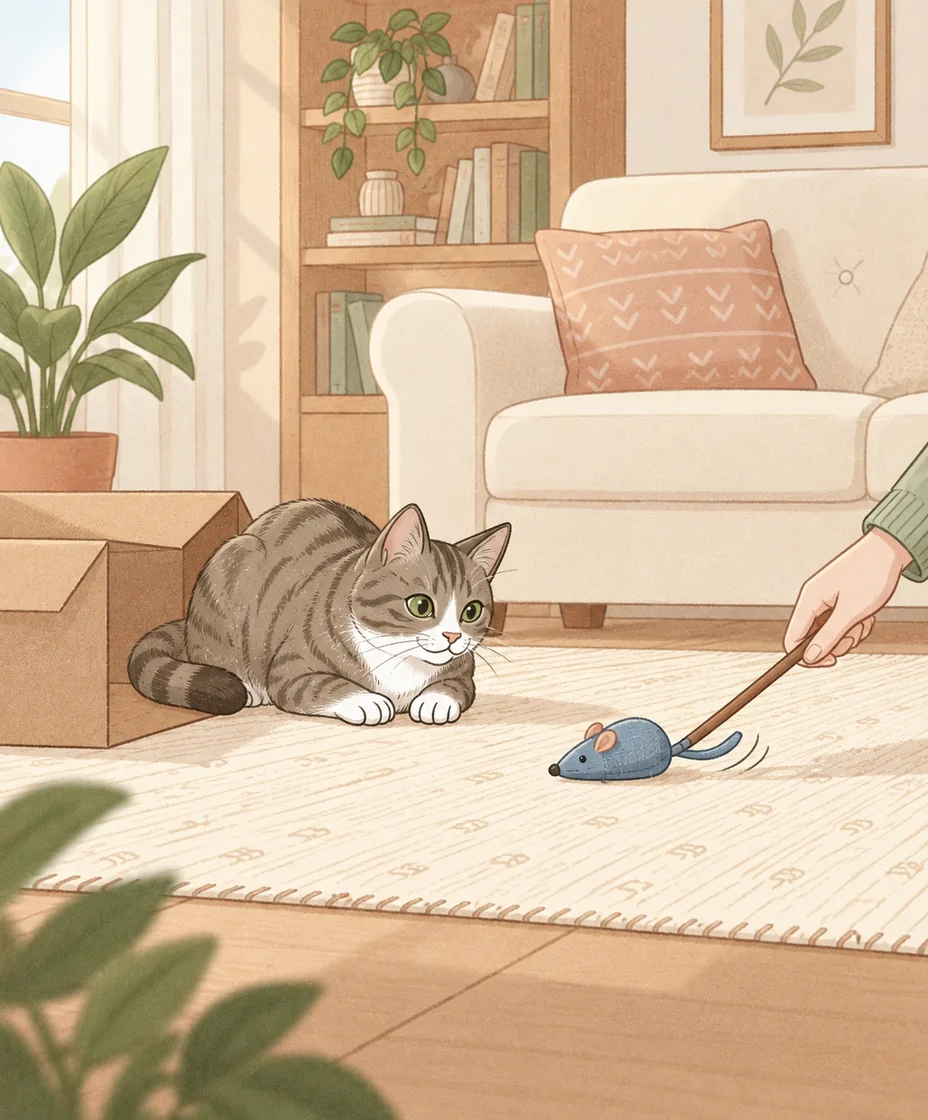
If your cat ignores toys, try one brief invitation in a quiet, familiar place: move a suitable toy a little along the floor, pause and leave room for your cat to approach or leave. Change one part of the setup before buying more equipment. A new loss of interest, especially with changes in appetite or movement, needs veterinary advice.
Is this a preference, or has something changed?
A cat who has always ignored one ball presents a different question from a cat who has stopped joining familiar games. Cat Friendly Homes advises contacting a veterinarian about changes in activity, mobility, appetite or ordinary behavior. Reduced play cannot tell you whether the cause is pain, illness or something in the environment.
Describe the change rather than testing how much exercise your cat will tolerate. Include when it began and what else is different. An earlier assessment belongs in that history; tell your veterinary team if the change continues. The play ideas below are for a comfortable cat after health concerns have been addressed.
Prepare one cat’s opportunity
Pounce’s Gather Your Tools lesson starts with a quiet space and equipment ready before the interaction. Apply that preparation here: choose somewhere your awake cat already spends time comfortably, clear a little floor space and leave the way out open. Put the phone down so you can watch the response.
Cat Friendly Homes recommends individual play opportunities in a multi-cat home. Arrange comfortable separate turns if another cat takes over the toy. Do not make the quieter cat compete for it or shut either cat into a distressing situation.
Start with an intact toy suitable for supervised cat play. Cats Protection recommends checking for wear and putting away toys that could be swallowed or cause entanglement. Keep fingers and toes out of the game. Loose string, ribbon and rubber bands are not substitutes for appropriate equipment.
Try a smaller movement, then wait
Cat Friendly Homes suggests toys that move like prey, such as a toy mouse moving across the floor. Cats Protection recommends letting the cat catch the toy and keeping games short. That gives you a starting point without a target number of chases or jumps.
Here is our small rehearsal: move the toy a short distance across the clear floor, away from the cat, then let it rest. Give your cat a chance to investigate. Avoid poking the toy toward their face or constantly moving it farther out of reach. If they catch it, allow the catch before restarting; if they leave, put it away.
You can end after that single invitation. Next time, keep the room and toy familiar and change just one detail. The table gives examples, not a sequence every cat must complete.
| What happened | One change to try |
|---|---|
| Watched a rapidly moving toy without approaching. | Use a shorter movement with a pause, in the same clear space. |
| Reached for a toy on the rug but stopped when it lifted. | Keep the next game at floor level; a jump is not required. |
| Joined in until another cat arrived. | Arrange an individual opportunity before changing the toy. |
| Ignored this toy on several comfortable occasions. | Offer a different suitable texture or shape another time, without also changing the room. |
| Walked away as soon as the game began. | End the invitation. Choose another ordinary awake moment; do not follow with the toy. |
Keep the detail that helps you try again
Instead of “doesn’t like toys,” write one specific contrast: “Watched when the mouse moved quickly; reached once after it paused.” That does not prove why the response changed. It does give you something small to repeat before adding another demand.
Toy rotation can offer variety, but a favorite does not have to be retired on a schedule. Keep useful familiar options and put the rest away. There is no need to buy a large collection to compare two ordinary invitations.
We make Pounce, which includes preparation and play-routine tasks within Gather Your Tools and Play Biting and Overstimulation. This guide adds the invitation table; it does not promise that more play resolves biting or that every cat will enjoy the same game. Sources and curriculum were checked October 7, 2026. Prepared with AI assistance; not individually reviewed by a veterinarian.
A little guidance goes a long way.
Follow illustrated lessons, take the next small step, and keep track of your cat’s little wins in Pounce.
Explore Pounce for iOSSources & how this guide was written
Pounce curriculum: Gather Your Tools and Play Biting and Overstimulation, read in full. Only quiet preparation, appropriate toy play and observing participation are adapted. Original one-change invitation table. No exercise quota, appetite restriction, guaranteed calming or bite-cure claim, diagnostic interpretation, weight-loss prescription, brand ranking or timeline. Sources checked October 7, 2026.
- FelineVMA: Playing With Your Cat
- Cats Protection: Cats and play
- FelineVMA: How Do I Know If My Cat Is In Pain?
Sources checked October 7, 2026. This article is educational and has not been individually reviewed by a veterinarian. Our editorial policy explains our approach.