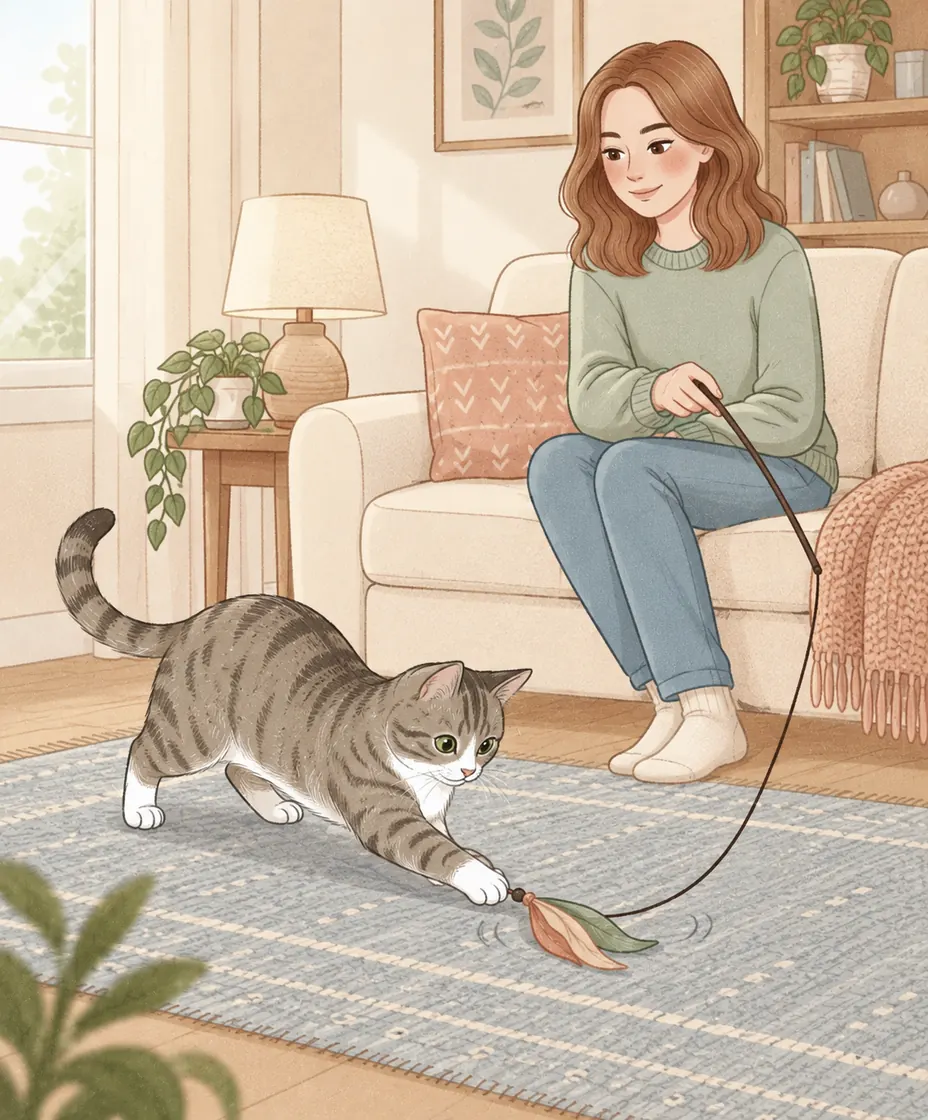
If a cat targets hands or feet during play, stop using your body as the toy and arrange regular play with a suitable toy at a comfortable distance. Notice what happens before biting and end the interaction before it escalates. New, painful, severe, or unexplained biting needs professional assessment.
Describe the moment before choosing a solution
“My cat bites” describes an outcome, not a cause. Chasing moving toes, biting during petting, and reacting when a sore area is touched are different situations. This guide covers a playful interaction that needs a better outlet. It cannot determine why an individual cat is biting.
Cats Protection recommends toys rather than hands and feet for play. Its biting guidance also discusses fear, stress, and overstimulation. If biting is new, occurs outside play, or accompanies other changes, talk to your veterinarian instead of assuming your cat needs more exercise.
Prepare a game with space between teeth and skin
Choose an appropriate wand or fishing-rod style toy that lets you move the toy away from your hands. Inspect it before use, supervise the game, and put string toys away afterward. Let your cat catch the toy during play rather than making it permanently unreachable.
Cats Protection’s play guidance supports short, regular opportunities to play. Pounce’s Play Biting program helps you build a household routine around that principle. Pick an ordinary moment you can repeat, such as before you sit down for the evening, and adapt to your cat’s interest.
Try this observation-led routine
- Notice the usual trigger without deliberately provoking a bite. Record the activity, the toy or body part involved, and any sign the interaction was becoming too intense.
- Arrange an appropriate toy game before a predictable high-energy moment. Give your cat room to approach, catch, pause, or leave.
- Watch for a change in attention toward hands or feet. Finish or pause before the game becomes uncomfortable; do not speed up your hands to compete with the toy.
- Keep future hands-on interactions calm and separate from chase games. Ask everyone in the home to stop hand wrestling so the rules are consistent.
Keep your notes descriptive. “Chased ankles as I walked to the kitchen” is useful. “Was naughty again” gives you no clue about what to change.
Prioritize getting out of the interaction safely
If an interaction becomes unsafe, create distance as calmly as you can without grabbing or restraining an aroused cat. Do not punish, shout, chase, or turn an attempt to leave into another wrestling game. Children should have an adult manage the interaction rather than trying to apply a training technique themselves.
There is no need to deliver a reward in the middle of an unsafe incident. Make the next planned play opportunity clearer instead. If contact causes injury, seek appropriate medical advice. Repeated incidents, intense reactions, or difficulty moving away safely call for individual help.
Look for a more comfortable pattern
Compare the same everyday situation over time: does your cat use the toy, take pauses, and disengage comfortably? Do you notice the warning earlier? Those observations are more useful than increasing the length of every session or trying to exhaust your cat.
If the pattern persists, reassess the environment and seek help from your veterinary team and a qualified cat behavior professional. General guidance is a starting point. It is not a diagnosis, a guarantee that biting will stop, or a reason to keep testing a situation that feels unsafe.
A little guidance goes a long way.
Follow illustrated lessons, take the next small step, and keep track of your cat’s little wins in Pounce.
Explore Pounce for iOSSources & how this guide was written
Pounce curriculum: Play Biting. The household observation routine is an original example. Biting is not assumed to have one cause, and the guide does not replace an individual assessment.
Sources checked September 12, 2026. This article is educational and has not been individually reviewed by a veterinarian. Our editorial policy explains our approach.