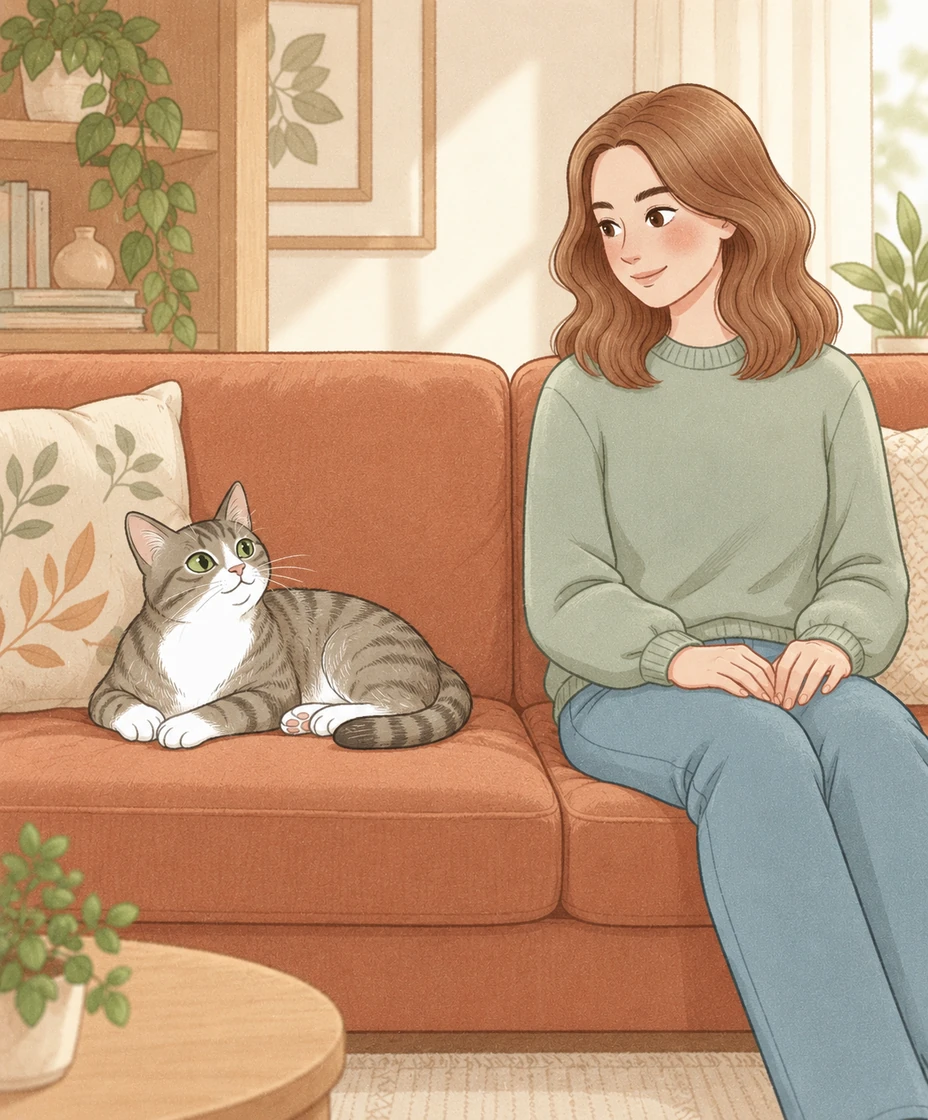
If your cat bites during petting, stop touching and give them space. For future comfortable interactions, let your cat approach, keep touch brief and pause before asking whether they want more. Sitting beside you is not a request for continuous stroking. New, repeated or unexplained biting needs veterinary assessment rather than an assumption that your cat is simply overstimulated.
Start with what was happening before the bite
A bite after several strokes, a bite when a particular area is touched and a bite while nobody is petting are different observations. The word “overstimulation” does not establish the cause. Cornell’s feline behavior guidance recommends ruling out medical problems before trying to manage aggression through changes at home.
Tell your veterinary team whether the behavior is new, where contact happened and whether eating, movement or other habits have changed. Do not touch a suspected sore area again to test your theory. Repeated bites during quiet proximity, severe incidents or difficulty getting away safely also need individual help.
The routine below is for ordinary, willing contact after health and safety concerns have been addressed. It is not an exercise to try while your cat is already biting, tense or frightened.
Make a pause part of the interaction
- Sit where your awake cat can approach or leave freely. Keep their route clear; do not pull them onto your lap.
- If your cat initiates contact and stays comfortable, offer one brief, gentle stroke in an area they already welcome.
- Rest your hand away from the cat. Notice whether they seek another interaction. If they simply sit nearby, let that be the activity.
- Stop for withdrawal or tension. Do not follow, hold a paw, or require a different signal before allowing space. There is no required next repetition.
Cats Protection recommends letting a cat initiate contact and watching their response. Some enjoy a little touch; others prefer company without it. Start where that individual already welcomes gentle contact.
Try a shorter version of an already comfortable interaction. More petting is not the goal.
Look for a change, not a perfect warning signal
Pounce’s Play Biting and Overstimulation lessons include noticing a changing tail, ears or head movement and stopping touch early. Start Button Behavior likewise practices pausing when a cat withdraws. Neither a pose nor one body signal is a diagnosis or permission to continue indefinitely.
FelineVMA’s current training guidance recommends slow, brief petting with pauses. A cat exposing their belly is not necessarily inviting a belly rub. Do not keep going until you have counted enough strokes or seen a bite: the first uncomfortable change is enough reason to stop.
Use an ordinary observation afterward to plan less contact next time. These examples are our planning aid, not a test of your cat’s temperament.
| What you noticed | Useful next decision |
|---|---|
| Settled beside you after the first brief stroke; did not seek another. | Keep your hands on your own lap and enjoy the company. |
| The body tightened or the head turned sharply toward your hand. | End contact. Plan an earlier pause rather than waiting for a swat. |
| Moved away when your hand traveled from the head toward the back. | Do not follow. Record the location change; discuss recurring sensitivity with your vet. |
| Bit during quiet proximity with no stroking underway. | Avoid labeling it a petting problem. Describe the whole situation to your veterinary team. |
Research supports changing how people interact
A 2021 study at Battersea examined interactions between 100 rehoming cats and 120 unfamiliar people. After people received guidance on giving cats choice, attending to their responses and limiting touch, the observed interactions included more affiliative behavior and less aggression than the control condition.
That is evidence about a specific handling intervention in a shelter setting. It does not promise to treat every household biting problem, test Pounce or establish a safe number of strokes. Most observations were coded by someone aware of the condition, a limitation the authors acknowledge. The practical takeaway is to change the human interaction, while respecting the individual cat.
End unsafe contact without turning it into a lesson
Stop petting and create distance calmly when safe. Do not grab an aroused cat, pin them down, shout or spray water. FelineVMA warns that punishment can increase fear and biting. Your immediate job is to end unsafe contact, not deliver a reward or demonstrate who is in charge.
If someone is injured, seek appropriate medical advice. Keep young children from hands-on contact with a cat who has a history of biting during petting, and ask your veterinary team for a household safety plan. Cornell specifically highlights the risk of children missing early signals.
For your next conversation with the team, record three things: what contact was happening, the first change you noticed and what you did next. “On sofa; stopped after an ear turn; cat stayed beside me” is useful. So is “no petting; bite occurred.” Neither needs a guessed motive attached.
We make Pounce, which includes Play Biting and Overstimulation and Start Button Behavior. This guide focuses on everyday touch and adds the observation examples above. Sources and curriculum were checked September 30, 2026. It was prepared with AI assistance and has not been individually reviewed by a veterinarian.
A little guidance goes a long way.
Follow illustrated lessons, take the next small step, and keep track of your cat’s little wins in Pounce.
Explore Pounce for iOSSources & how this guide was written
Pounce curriculum: Play Biting and Overstimulation; Start Button Behavior. Adapted early observation and stopping on withdrawal, without prescribed play quotas, restraint, diagnostic claims, deadlines or promises that biting stops. Original contact/change/response examples. Sources checked September 30, 2026.
- Cats Protection: How to pet a cat (February 15, 2024)
- FelineVMA: Training techniques for addressing undesirable behaviors
- Cornell Feline Health Center: Feline behavior problems — aggression
- Haywood and colleagues: Human–cat interaction guidelines study (July 23, 2021)
Sources checked September 30, 2026. This article is educational and has not been individually reviewed by a veterinarian. Our editorial policy explains our approach.