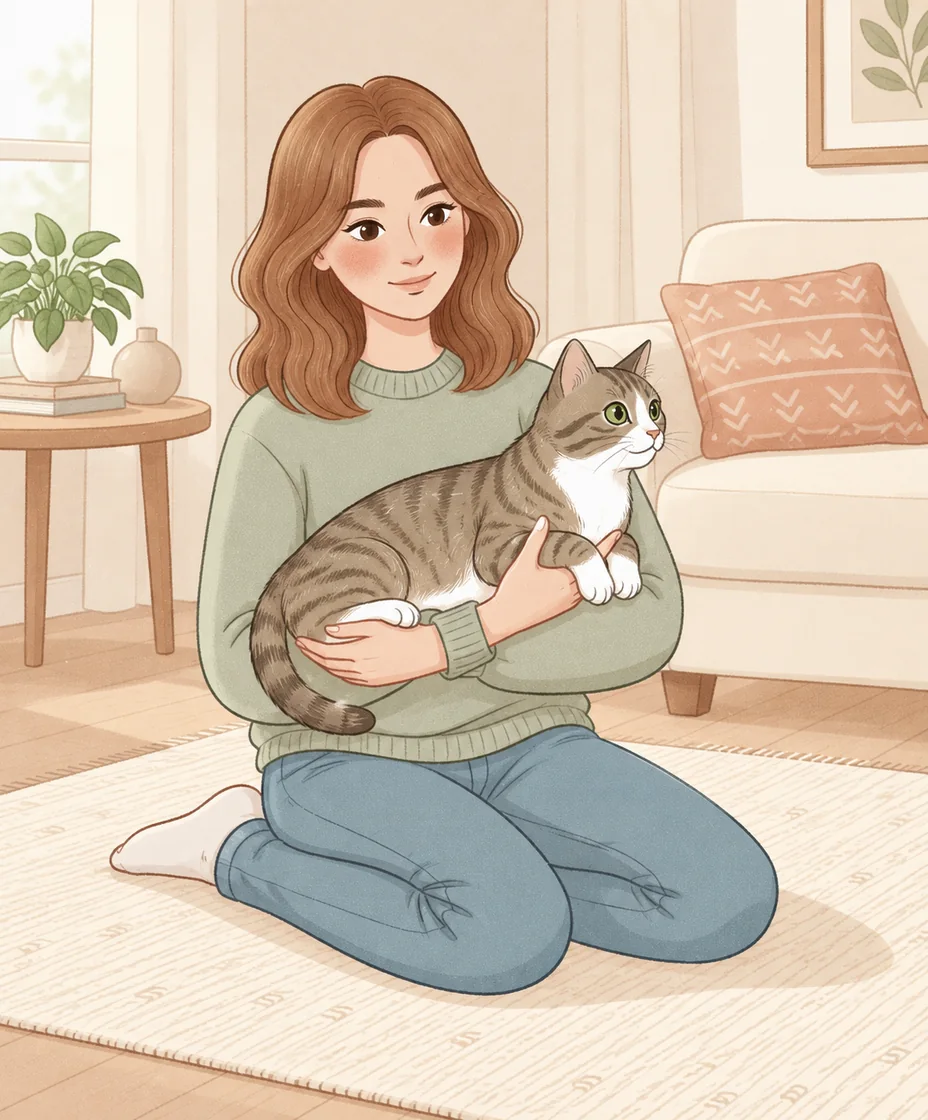
If your cat dislikes being picked up, begin with comfortable contact while their paws stay on the floor. Check discomfort with your vet before practicing, then separate approaching hands, lifting, holding and moving into different steps. Keep any eventual lift brief and fully supported, and lower your cat promptly if they want out. Comfortable petting does not mean comfortable carrying.
Decide what the pick-up is for
A cat can enjoy sitting beside you and still dislike being carried. Cats Protection distinguishes preparation for necessary care from trying to make a cat accept cuddles whenever a person wants them. More time in your arms does not have to be the goal.
Write down the actual task: a brief transfer your veterinary team recommends, for example. If you simply want your cat beside you, invite them over. If the task is entering a carrier, teach voluntary entry separately. That may remove the need for a lift altogether.
This guide is for planned practice with a cat already comfortable approaching their person. A frightened, hiding or defensive cat needs a different starting point and individual advice. Do not pull a cat from a retreat to begin.
Source: Cats Protection: How to pick up a cat (February 22, 2024)
Check discomfort before asking for more handling
Cats Protection’s handling guidance recommends a veterinary check when contact causes discomfort. Tell your team if the reaction is new, happens around a particular body area, or accompanies changes in movement, appetite, grooming or skin. Do not keep pressing or lifting to test where it hurts.
Describe the difference you have already noticed: ‘Approaches for a head rub; moves away when my hand reaches under the chest.’ That observation is more useful than deciding your cat is stubborn or assuming a history you do not know. A cat staying still does not rule out discomfort.
If care is needed now, call the veterinary team for a handling and transport plan. Do not postpone treatment until your cat completes a home exercise.
Source: Cats Protection: Train your cat to accept handling (October 2, 2018)
Give the first practice a smaller job
- Let your cat approach. If they prefer to stay elsewhere, finish without following them.
- Give a consistent spoken warning before one brief touch in an area they already welcome. Remove your hand and offer a small reward.
- Pause with your hands away. Watch whether the cat remains loose and interested. End contact for withdrawal, tension or a sharp turn toward your hand.
- On later comfortable occasions, change only a small part of the contact. Hand placement for support is its own task; it need not become a lift that day. Ask your veterinary team to demonstrate suitable placement for your cat.
After health concerns have been addressed, choose a quiet moment on a stable, nonslip floor. Sit beside your awake cat with small suitable rewards ready. Leave a clear route away. There is no lift to complete in this first exercise.
Pounce’s Start Button Behavior teaches a repeatable invitation and an immediate pause when the cat withdraws. Use that principle here: a familiar mat can organize practice, but staying on it or eating is not permission to keep handling a tense cat.
Separate touch, lift, hold and movement
Our preparation map helps you describe the first change that matters. It is a planning aid, not a checklist to finish or a reason to provoke a reaction. Use observations from ordinary contact and stop at the comfortable step.
For example: ‘Comfortable with both hands in position; shifted away when I began to lift; stopped.’ Next time, return to comfortable hand placement. Do not add a longer hold to make the same attempt more successful.
| Part of the task | Keep separate | What to record |
|---|---|---|
| Hands approaching | Approach from contact | Did posture change before either hand touched? |
| Hands in support position | Placement from lifting | Which placement stayed comfortable with paws on the floor? |
| A brief supported lift | Lifting from a longer hold | Was the body relaxed through the return to the floor? |
| Being held | A stationary hold from carrying | Did a change begin when the person stood or moved? |
| Another place or person | A familiar task from a new situation | What was different? Do not assume the old step transfers unchanged. |
When a brief lift is appropriate, keep both ends supported
Only consider lifting after the preparation is comfortable and you can support your cat confidently. Cat Friendly Homes recommends two hands: support beneath the chest and beneath the hindquarters, keeping the cat close to your body. Do not leave the rear legs dangling, squeeze the torso or lift by the scruff.
Keep the first lift low and brief. Return your cat gently to a secure surface while maintaining support, then offer the prepared reward. Keep both hands available for support rather than trying to hold a treat and the cat at once.
If your cat stiffens, wriggles, vocalizes or tries to leave, lower them safely and finish. Do not hold on waiting for quiet or repeat the attempt to see whether the reaction changes. Inability to do this safely is a reason to get hands-on professional help, not to use a tighter grip.
Comfort in a stationary hold does not establish readiness for walking, stairs or an emergency. Keep those situations out of an initial practice. You do not need to test how much your cat will tolerate.
Finish with a useful note, not a longer hold
Record the comfortable starting point, the first change you noticed and what you will make easier. Share that note with everyone who handles the cat. Ordinary meals, company and access to favorite resting places should remain available without submitting to a pick-up.
If you need help, take the same note to your veterinary team or a qualified cat behavior professional. Repeated fear, swatting, biting or uncertainty about physical support needs an individual plan. Preparation cannot guarantee safe handling in an emergency.
We make Pounce, which includes Start Button Behavior and a separate Defensive Pick-Up lesson. This article focuses on gentle indoor preparation and adds the map above; it does not reproduce the adventure lesson’s speed or outdoor exercises. Sources and curriculum were checked October 14, 2026. It was prepared with AI assistance and has not been individually reviewed by a veterinarian.
A little guidance goes a long way.
Follow illustrated lessons, take the next small step, and keep track of your cat’s little wins in Pounce.
Explore Pounce for iOSSources & how this guide was written
Complete Start Button Behavior and Defensive Pick-Up modules checked. Uses voluntary approach, pausing on withdrawal and full physical support. Excludes speed, surprise, outdoors, fixed timeline/repetition counts, food-dependence, large rewards and guarantees of safety. Original preparation map distinguishes hand approach, contact, lifting, holding and moving. Sources checked October 14, 2026.
- Cats Protection: How to pick up a cat (February 22, 2024)
- Cats Protection: Train your cat to accept handling (October 2, 2018)
- Cat Friendly Homes: How to pet and handle cats
Sources checked October 14, 2026. This article is educational and has not been individually reviewed by a veterinarian. Our editorial policy explains our approach.