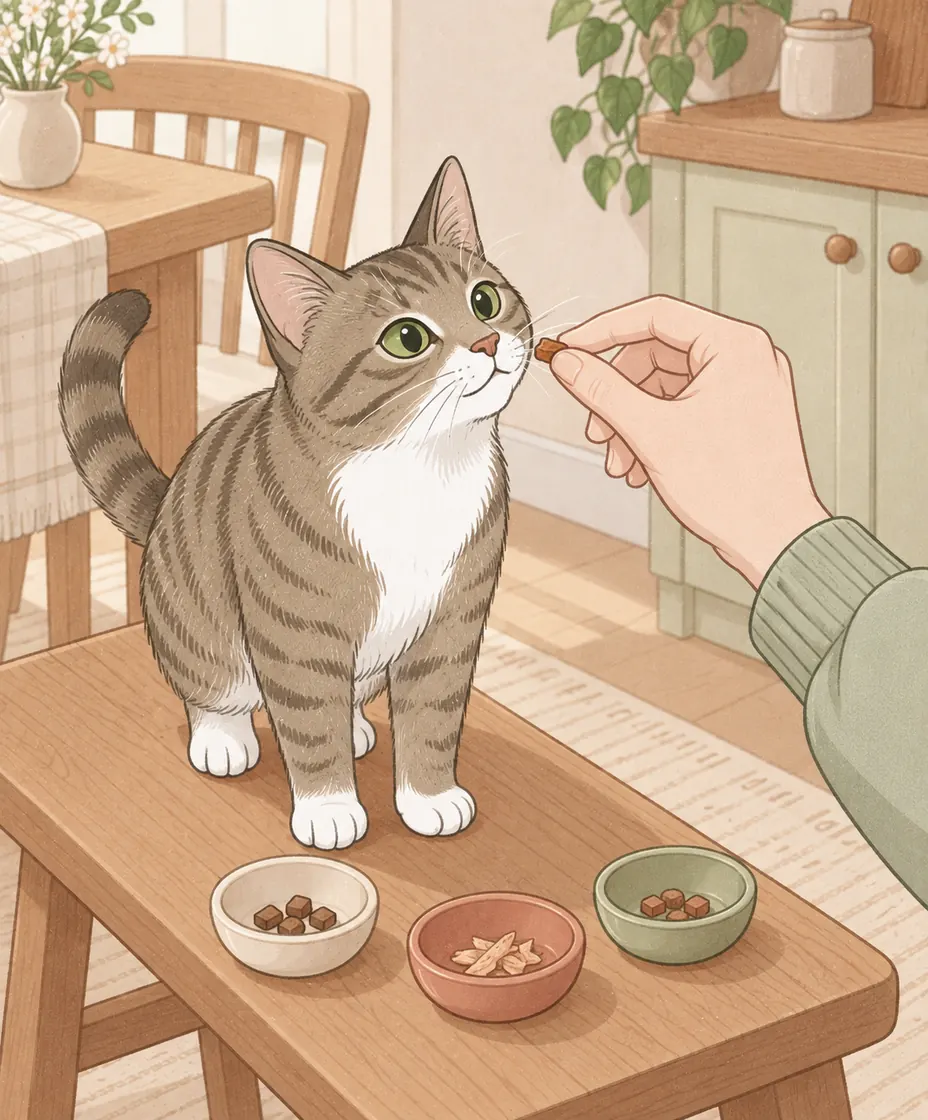
A useful cat training reward is something your cat wants at that moment and that you can deliver clearly after the action. Start with a small portion of suitable familiar food or an enjoyable play interaction. Notice the response, keep food within dietary needs, and adjust the session before assuming your cat is untrainable.
Choose for this cat, on this day
An expensive treat is not automatically a useful reward. Your cat may prefer an ordinary familiar food, a brief toy game, or no interaction at the time you chose. Pounce’s Gather Your Tools lesson asks you to prepare the reward before the exercise; that preparation includes checking whether your cat currently wants it.
Food can be convenient for marking small actions because a tiny portion is easy to deliver and finish. A toy interaction takes longer and changes the pace of the session. Neither format needs to become a rule for every cat or every exercise.
Keep food choices simple
Begin with something your cat already tolerates and normally likes. Make each reward a manageable small portion and account for training food in the usual daily intake. If your cat has dietary restrictions, use options agreed with your veterinary team rather than introducing a rich new treat for training.
Do not skip meals or make your cat hungry enough to participate. A sudden loss of appetite is a health concern, not a reward-selection puzzle. If eating is normal but the training food is ignored, consider the environment, timing, and task difficulty as well as the food itself.
Run a small preference check
- At a calm moment, offer a tiny amount of one familiar, suitable food without asking for a trick. Observe whether your cat readily takes it.
- On another comparable occasion, try a different suitable option if needed. Avoid offering a buffet that makes the comparison hard to interpret.
- Use the promising option for one easy action your cat already understands. Notice whether delivery is smooth and your cat remains interested.
- Record the situation as well as the choice: “regular food in the quiet room” tells you more than “likes this brand.”
This is an informal planning exercise, not a scientific preference test. You are collecting enough information to prepare a comfortable session, not ranking all rewards for all cats.
A play reward needs a clear beginning and ending
If your cat enjoys a toy interaction, plan how you will offer it promptly and then pause before the next invitation. Use an appropriate toy at a safe distance from your hands. Cats Protection recommends playing with toys rather than using hands and feet as targets.
For example, after an easy familiar action, offer a brief supervised wand game, allow a catch, and pause. If the game becomes too exciting to return comfortably to the exercise, end the session or choose a quieter reward next time. Never keep reaching into an intense chase to demand another trick.
Check your timing before replacing the reward
Suppose your cat touches a target but then watches you search a packet for several seconds. The reward may be appealing; the delivery simply needs preparation. Put a small portion within easy reach, keep the target and reward in separate hands, and mark only when you are ready to follow through.
If your cat refuses several normally appealing options, stop the session instead of making the exercise harder. If they enjoy the reward outside practice but disengage during it, return to an easier action in a quieter setting. A useful reward supports a clear, comfortable invitation; it cannot repair every problem in the setup.
A little guidance goes a long way.
Follow illustrated lessons, take the next small step, and keep track of your cat’s little wins in Pounce.
Explore Pounce for iOSSources & how this guide was written
Pounce curriculum: Gather Your Tools, Clicker Charging, and Target Touch. The preference notes and delivery example are original practical exercises, not research findings or individual dietary advice.
Sources checked September 12, 2026. This article is educational and has not been individually reviewed by a veterinarian. Our editorial policy explains our approach.