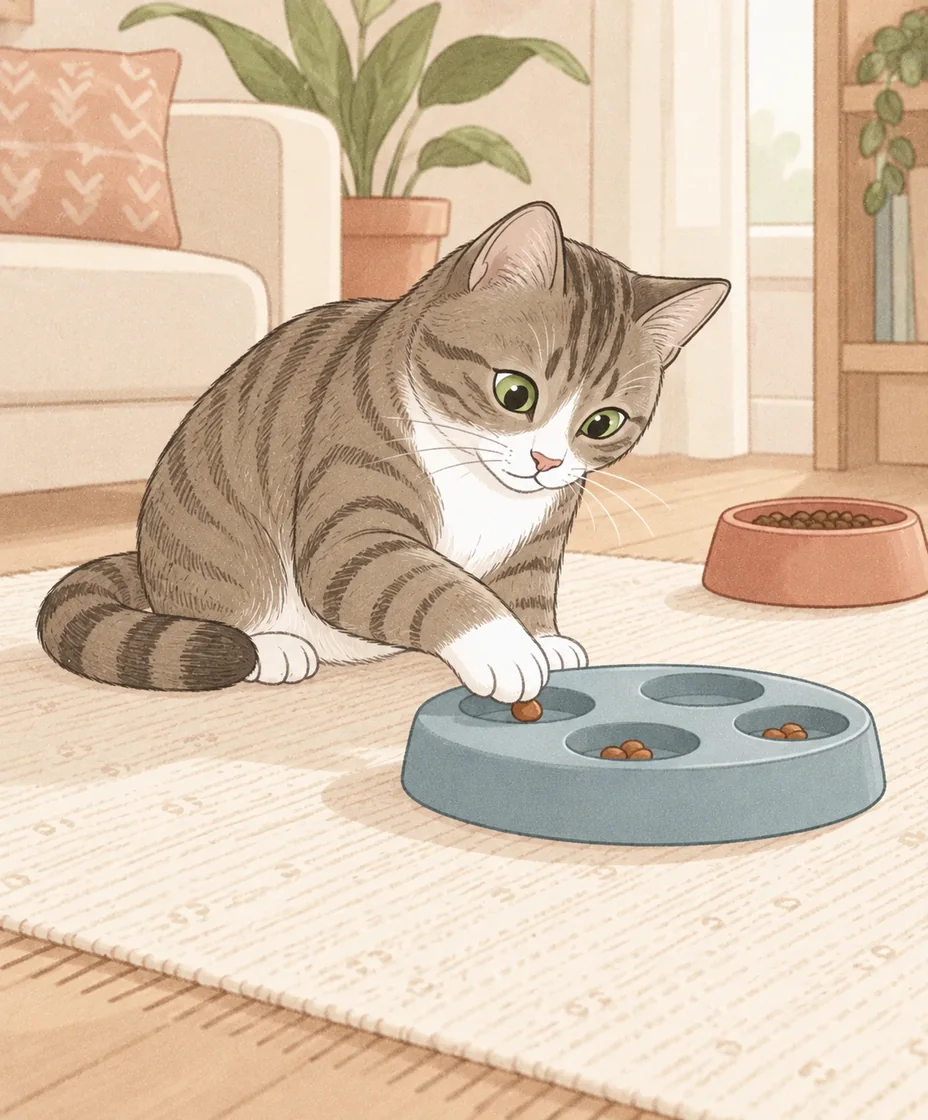
Introduce a cat food puzzle at its easiest setting, with familiar food visible and within easy reach. Offer a small portion from the usual food allowance while keeping ordinary meals accessible. Watch whether your cat can actually retrieve the food before adding difficulty. Walking away is a reason to simplify or stop, not withhold the next meal.
Make the first puzzle an option
A cat who eats from a bowl but leaves a puzzle has shown you a difference between two setups. That is more useful than deciding they are lazy or untrainable. The new container may move, make a sound, hide the food or require an unfamiliar paw movement. Start by reducing those demands.
In a small home study published in 2021, cats ate more food from an accessible tray than from a food puzzle. The comparison used one puzzle design; it does not tell us whether an individual cat will enjoy every other design. Choosing the easier food is not a failed training session.
For this introduction, keep the normal feeding routine available. If appetite has fallen generally, eating seems painful, or your cat is unwell, stop experimenting and contact your veterinary team. A puzzle is an optional activity, not a treatment or a test of hunger.
Look at what your cat must do to reach one piece
The AAFP feeding handout distinguishes stationary and moving puzzles, including designs for wet and dry food. It recommends beginning simply and increasing difficulty gradually. Choose equipment suitable for the food your cat already eats, rather than changing the diet to match a toy.
Before adding food, inspect the puzzle and its instructions. Choose an intact, cleanable design without sharp edges or parts your cat could detach and swallow. Set it on a stable, easily reached surface. Supervise the introduction and remove equipment that your cat chews or damages.
Our setup check is specific: imagine the route from nose or paw to one piece of food. Does it require reaching deeply, lifting a lid and moving a slider? That is several tasks. A shallow, uncovered section gives you a simpler first observation. If the model cannot offer easy access using its intended settings, start with another suitable container.
Try one easy food-retrieval opportunity
- Choose a quiet, familiar feeding area and an awake cat who is eating normally. Arrange comfortable separation from other pets, with room for your cat to leave.
- Set aside a small portion of familiar food from the normal daily allowance. Put it in a shallow, uncovered part of the puzzle where it can be reached without solving a mechanism. Keep the rest of the planned meal easy to access.
- Let your cat approach. If they take the visible food, allow them to finish without adding a lid or moving the equipment underneath them. You do not need a clicker for this first encounter.
- If they sniff and leave, end the attempt. Make the food accessible in the familiar dish rather than leaving a needed meal trapped inside. Later, consider a simpler surface or a different quiet moment.
- After easy retrieval is familiar, change only one detail using the device’s intended settings. For example, try one slightly more recessed compartment while keeping other food easy to reach. Leave a new room, new food and a moving puzzle for separate decisions.
A 2016 clinical review recommends matching the puzzle to the cat’s ability and discusses offering it beside the familiar feeding container. Its case reports are not proof that puzzles alone resolve behavior or health problems. The practical exercise below focuses only on making the first encounter understandable.
Notice where the attempt stopped
Use this small record: setting, food access, action, next change. For example: “Kitchen corner; open shallow well; ate two pieces, left the deeper one; use only shallow wells next time.” The observation identifies a starting point without guessing what your cat was thinking.
Keep the same suitable food and location while changing access. Otherwise, if the next attempt differs, you will not know which part helped. These examples are planning aids, not diagnoses.
| What you notice | What to change |
|---|---|
| Eats the same food from the usual dish but leaves a deep compartment. | Use an open, shallow section or simpler equipment. Do not reduce meals to force a reach. |
| Retrieves food until the puzzle rolls or rattles. | Pause and try a suitable stationary version on a stable surface. |
| Touches the mechanism repeatedly but gets no food. | Make access easier. More effort without retrieval is not a reason to increase difficulty. |
| Stops eating when another cat approaches. | Provide comfortable separate feeding locations and check each cat’s actual intake. |
| Also refuses the usual food, or has a new change in eating. | Contact your veterinary team; stop treating this as a puzzle-learning problem. |
An empty puzzle does not tell you who ate
In a shared home, check each cat individually. The AAFP handout recommends separate feeding stations and monitoring intake; eating beside another cat does not establish that both are comfortable. One quick solver can empty equipment while another gets little. Keep appropriate meals accessible to each cat.
Follow the food and equipment instructions for cleaning and storage, especially for wet food. Do not leave leftovers indefinitely just because they are inside a toy. Use the established food allowance, and ask your veterinary team before changing a medical diet or feeding schedule.
You do not need to graduate to the hardest level. A familiar easy puzzle can remain the useful activity. Keep ordinary play, rest, interaction and other resources in the day rather than expecting feeding equipment to occupy your cat through every busy moment.
Keep the next step smaller than the whole meal
Pounce’s Begging at the Table curriculum includes food-puzzle activities and adjusting their difficulty. This guide isolates the introduction to the equipment; it does not promise to stop begging, replace all bowls or keep a cat busy for a set time. A mat is another skill to teach separately, once you know the activity is comfortable.
We make Pounce. The setup check, example record and troubleshooting table here are editorial planning tools. Sources and curriculum were checked September 28, 2026. This article was prepared with AI assistance and has not been individually reviewed by a veterinarian.
A little guidance goes a long way.
Follow illustrated lessons, take the next small step, and keep track of your cat’s little wins in Pounce.
Explore Pounce for iOSSources & how this guide was written
Pounce curriculum: Begging at the Table. Confirms food-puzzle activities and adapting difficulty. This guide adds a first-introduction setup check and observation table; no bowl removal, fixed results, weight-loss claim, brand testing or requirement to persist through distress. Current welfare guidance and the updated 2021 food-choice paper provide the independent context.
- AAFP: How to Feed a Cat — Addressing Behavioral Needs
- Dantas and colleagues: Food puzzles for cats, clinical review (2016)
- Delgado, Han and Bain: food-puzzle versus freely available food study (2021; updated article)
- Publisher correction notice (August 18, 2021)
Sources checked September 28, 2026. This article is educational and has not been individually reviewed by a veterinarian. Our editorial policy explains our approach.