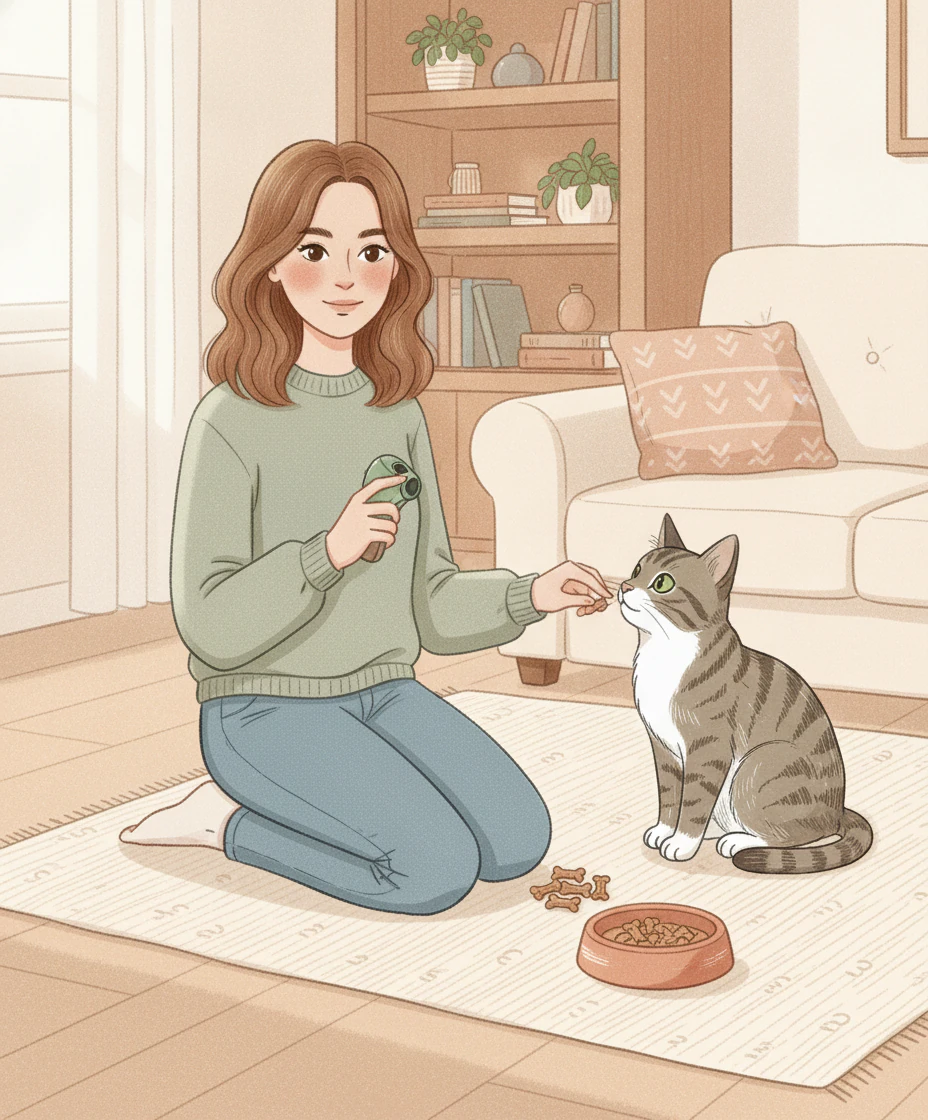
To start clicker training a cat, make one quiet click and immediately offer a small reward. Repeat a few times in a calm space, without asking for a trick yet. The first goal is simply to help your cat learn that the sound predicts something they like.
What does the click actually mean?
A click is a marker: it identifies the moment you want to reward. It is not a command, a way to get your cat’s attention, or the reward itself. First the cat learns the connection between sound and food. Later, you use that same sound to mark a nose touch, a sit, or a paw meeting your hand.
Cats Protection describes clicker training as a form of positive reinforcement. Its beginner guidance starts with pairing the click and a reward, before choosing a simple behavior to teach.
Set up a very small first session
Pounce’s Clicker Charging lesson starts with a quiet room, an awake and relaxed cat, and rewards ready to deliver. Sit somewhere comfortable and give your cat enough space to move away. If other pets are competing for the food, practice separately.
Choose a quiet physical clicker, Pounce’s in-app clicker, or a short, consistent verbal marker such as “yes.” Try the sound at a comfortable distance. If your cat startles, stop and choose a softer option before continuing. Keep food rewards small and account for them in your cat’s usual diet; use something suitable for any dietary restrictions.
Your first session, step by step
- Get the reward ready before you begin. You want to deliver it smoothly, without searching a bag after every click.
- Make one quiet click. Your cat does not need to sit, touch anything, or perform a trick.
- Immediately give a small reward. Keep the order clear: sound first, food second.
- Pause briefly, then repeat while your cat remains relaxed and interested. Several easy pairings are enough for a first attempt.
- Finish before interest fades. Put the clicker away and let your cat carry on with their day.
Five minutes is an upper guide for a little practice window, not a target your cat must meet. One good minute can be the whole session. Avoid clicking repeatedly to persuade them to return: each click should keep its promise of a reward.
Look for anticipation, not a performance
In Pounce’s foundation lessons, a small turn toward you after the sound is an early sign to notice. Over a few short practices, you are looking for your cat to hear the click and expect the reward. Still give the reward after the click even if the reaction is subtle.
Write down one observation, such as “looked toward my hand after the third click” or “walked away after four rewards.” That gives your next session a useful starting point. It is more informative than deciding the whole session was a success or failure.
If it doesn’t click yet
If your cat leaves, let them. Next time, try a quieter setting or a reward they normally enjoy. If they watch the food but seem confused, slow down your own movements and make the click-then-reward order easier to follow. If the sound worries them, a gentle verbal marker may be a better fit.
Do not skip meals to make your cat participate, increase the volume to get a response, or insist on finishing a set number of repetitions. A sudden loss of appetite or a new change in behavior calls for veterinary advice, rather than a harder training session.
What should you teach next?
Once the marker is familiar, choose one simple behavior. Pounce’s training path includes Target Touch, where a small voluntary nose touch becomes the action you mark and reward. You can then build toward sit, recall, and high five without changing the basic conversation.
For a playful goal, read our high-five guide. For a practical one, explore carrier confidence. You do not need to teach everything at once; one clear next step is plenty.
A little guidance goes a long way.
Follow illustrated lessons, take the next small step, and keep track of your cat’s little wins in Pounce.
Explore Pounce for iOSSources & how this guide was written
Pounce curriculum: Clicker Charging and Target Touch. This guide adapts the app’s learning sequence and adds a session-observation example.
Sources checked September 12, 2026. This article is educational and has not been individually reviewed by a veterinarian. Our editorial policy explains our approach.