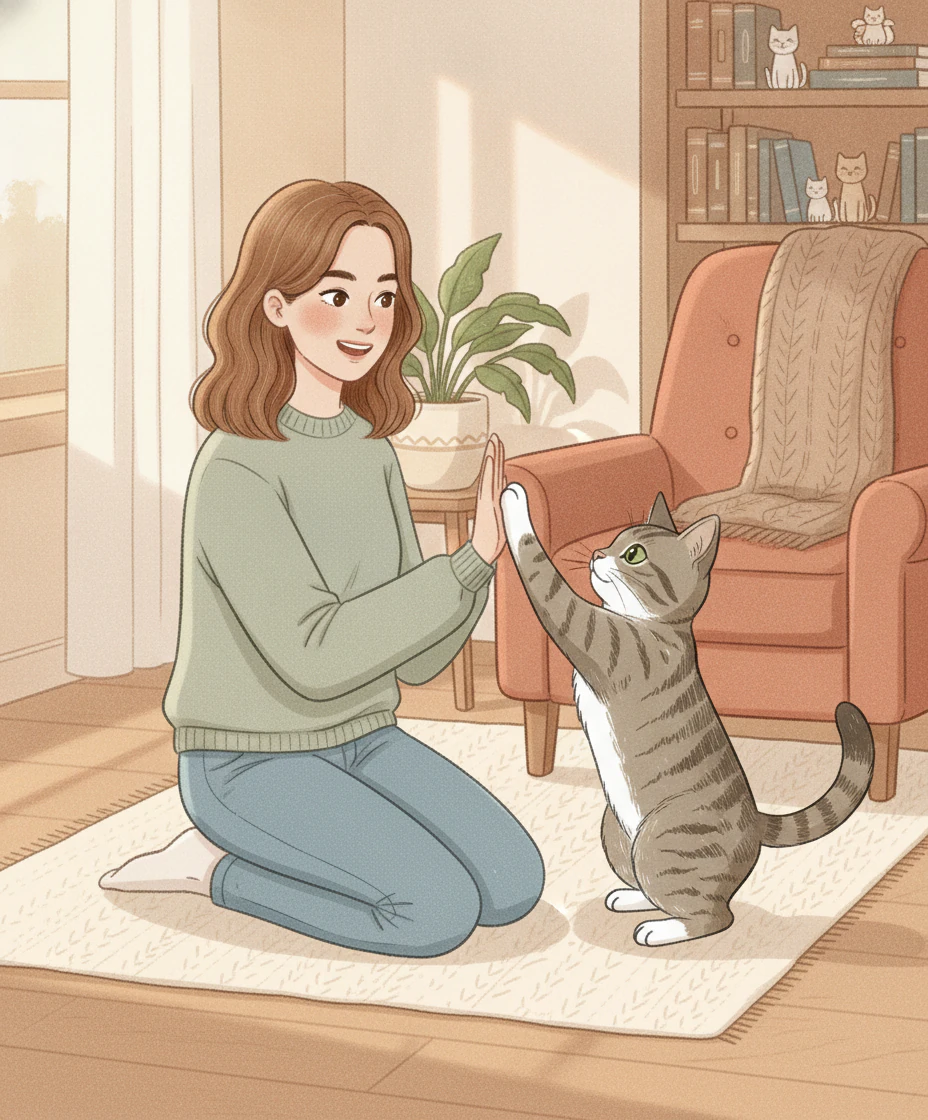
To teach your cat a high five, reward a small, voluntary paw lift first. Gradually move your hand into a comfortable position for a gentle paw touch, then mark and reward the contact. Add the words “high five” once the movement is familiar. Never pick up or pull your cat’s paw to make the trick happen.
Make the first step easier than the finished trick
The picture in your head may be a confident, upright high five. Your first session has a much smaller goal: noticing a paw begin to lift. Pounce’s High Five program separates that first movement from hand contact, palm position, and the spoken cue.
Begin on a stable, comfortable surface with a relaxed cat who already understands a marker and reward. If you have not introduced a clicker or verbal marker, start with our beginner guide. Have a few tiny rewards ready and keep the session short enough that your cat can stay interested.
First, reward a little paw lift
Let your cat settle comfortably. Present an open hand low and slightly to the side, within an easy reach. Watch for a small shift of weight or a voluntary paw movement. Mark that small movement and deliver the reward.
You are observing and rewarding, rather than taking hold of a paw. If your cat sniffs the hand, there is no need to correct them. Lower the difficulty, reset, and give them a brief chance to explore. If nothing useful happens, end kindly and return to a familiar lesson next time.
Keep a note of the exact hand position that worked: which side, roughly how high, and whether you were seated on the floor. That makes the next attempt easier to repeat.
Turn the lift into a gentle touch
Once paw lifts are comfortable and repeatable, place your hand where a small reach can meet it. Mark the instant the paw touches your hand, then reward. Avoid moving your hand into the cat’s paw and counting that as their choice.
Increase the height only a little at a time. Gradually rotate toward an upright palm when your cat is comfortable. The right height is the height your cat can reach easily, without stretching awkwardly or losing balance. A low high five is still a high five.
Give the action a name
When your cat reliably recognizes the hand invitation, say “high five,” pause briefly, then offer the hand. Mark and reward the contact as usual. The words come before the familiar gesture, so they have a chance to become meaningful.
Use the same short phrase rather than repeating it several times in one attempt. If your cat does not respond, reset instead of saying it louder. Go back to the easier hand position if the new sequence seems confusing.
A few ordinary bumps along the way
Only getting a nose touch? Your hand may already mean “touch with your nose” from another lesson. Make the setup more distinct, keep it easy, and reward an offered paw movement rather than becoming more insistent.
Seeing claws or a fast swat? Pause. You are aiming for a calm touch, not an excited grab. Give more space, keep the hand low, and shorten the next attempt. Do not hold the paw, tap it repeatedly, or continue if your cat seems uncomfortable.
Losing the trick in a different room? Practice a familiar, easy version in the new setting. A change of surface, your posture, and the surrounding distractions can make the same invitation feel quite different.
Let progress be specific
Instead of judging whether your cat has “learned high five,” notice the current step: offered a lift, touched fingers, met an upright palm, or responded after the words. Pounce breaks the lesson into those smaller pieces, with time to repeat and rest between them.
There is no guaranteed number of days. Your cat’s comfort, prior training, and interest matter more than a schedule. Stop when they disengage. If reaching seems painful, they avoid using a paw, or their movement changes, ask a vet before continuing.
Why this uses rewards
Cats Protection includes high fives among behaviors that can be taught with clicker training. The shared principle is to mark the action you want and follow it with a reward. The progression above is adapted from Pounce’s own High Five curriculum.
A little guidance goes a long way.
Follow illustrated lessons, take the next small step, and keep track of your cat’s little wins in Pounce.
Explore Pounce for iOSSources & how this guide was written
Pounce curriculum: High Five. The hand-position notes and progress checklist are practical adaptations of its paw-lift, contact, palm, and cue sequence.
Sources checked September 12, 2026. This article is educational and has not been individually reviewed by a veterinarian. Our editorial policy explains our approach.