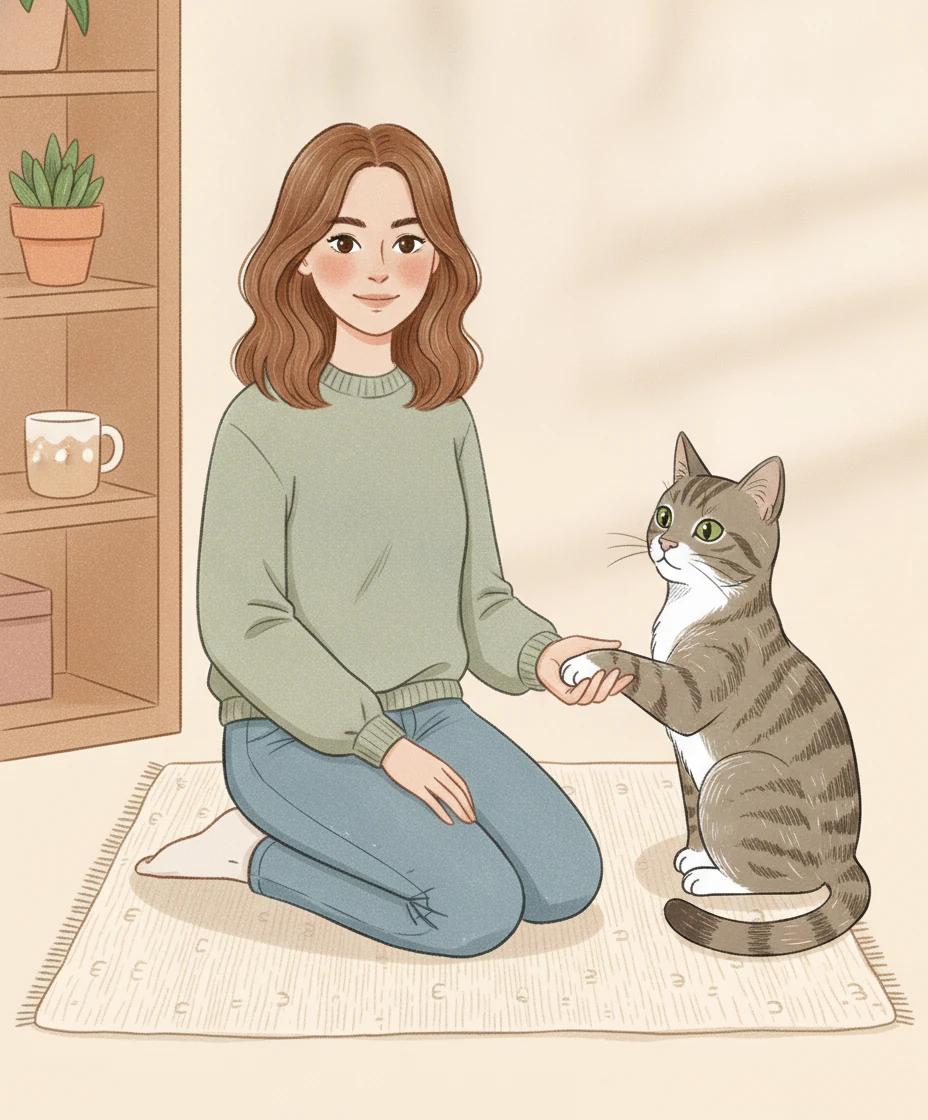
Ask your cat to sit, then hold one hand flat and palm up near the floor and wait. The moment a paw lifts, even an inch, mark it and treat. When the paw lands in your palm reliably, add the word “shake” just before you offer your hand. Keep sessions to two minutes. Never take the paw — the paw has to be offered.
What you need before you start
Four things: a clicker or a short spoken marker like “yes”, treats your cat rates highly, a quiet non-slip surface, and a cat who already sits on cue. The non-slip part matters more than it sounds. A cat sliding on a wooden floor will not lift a foot, because that foot is holding them up.
Charge the marker first if your cat has never heard it. Cats Protection advises clicking at a short distance, treating immediately each time, and repeating until your cat looks for the treat the moment they hear the click. Pounce teaches that in its Meet the Clicker lesson, and Sit on Cue is the lesson that comes just before Shake / Paw.
One health note before the first session: Cats Protection recommends a veterinary check before starting training, because a cat who is unwell will struggle with it. That goes double here, since this trick is built on a body part cats guard.
Source: Cats Protection: Tips for clicker training a cat (August 11, 2025)
How to teach the shake: 5 steps
- Reward a paw lift. Ask for a sit, then hold one hand flat, palm up, near the floor and within easy reach. Wait. If nothing happens after several seconds, gently tap the back of one front leg. The instant the paw lifts, even an inch, mark and treat. Success looks like three or four lifts inside a two-minute session, and nothing more than that on day one.
- Wait for the paw to land in your palm. Same flat hand, no leg tap this time. Mark the moment the pads touch your skin, treat, then take your hand away. Taking it away is the important half: a hand that is always there turns into furniture, and the next placement stops being a decision. Success is the paw arriving in your palm on most repetitions with no prompt.
- Add the word. Say “shake” (or “paw”), wait about a second, then present the flat hand. Use the same word every time. Cats Protection points out that your cat hears the sound rather than the meaning, so consistency is the whole job. Mark and treat on contact. Success is the paw arriving on the word plus the hand, with no tap in the sequence.
- Hold for one second. Once the cue works, let the paw rest in your hand for one full second before you mark, then treat and let go. Cats Protection’s handling guide builds duration exactly this way, starting at one second per repetition and growing to two or three once the cat is comfortable. If your cat tugs the paw back, you held a beat too long — shorten it and build up again.
- Close your fingers gently, then release. With the paw resting in your palm, close your thumb over it for about a second, mark, treat and let go straight away. The fast release is the lesson, not the hold. Success is a soft paw that stays for roughly two seconds under a light hold, in more than one room.
Each step is one short session, repeated over a few days until your cat can do it without help. Cats Protection’s handling guide keeps training sessions to two minutes at most, and that is the right length here too — stop while your cat still wants another go.
Source: Cats Protection: How to train your cat to be comfortable with handling (October 2, 2018)
How long does it take?
Two to four weeks is the realistic range, and it is slower than most tricks on purpose: your cat is not only learning a movement, they are deciding that your hand is a safe place to put a paw. Cats Protection puts clicker training in general anywhere from a few days to a few months.
Build in rest days. Pounce’s Shake / Paw program runs a two-minute session on day one, three-minute sessions after that, and a rest day in the first week, because this skill consolidates between sessions rather than during them.
Age is not the barrier people assume. Cats Protection says cats can be clicker trained at any age, while noting that nervous cats may struggle and that older or unwell cats can find handling practice harder. With an older cat, keep the hand low so no stretching is involved, and treat any reluctance to bear weight on three legs as information rather than stubbornness.
Once the shake is solid, thin the treats out gradually. Cats Protection suggests keeping the new frequency consistent — every other time, then every fourth time — rather than stopping abruptly.
Source: Cats Protection: Tips for clicker training a cat (August 11, 2025)
Why you should never take your cat’s paw
Most shake-hands instructions online tell you to pick the paw up, hold it a few seconds and treat. Skip that. International Cat Care puts paws in the most sensitive category of places to touch a cat: paws are what a cat escapes, hunts, explores and defends themselves with, so touch there may not be welcome, and reaching for one is a common way to get bitten or scratched.
The same guidance recommends gentle, non-restrictive contact in brief periods of three to five seconds, pausing after each to let the cat decide whether to carry on. Cats Protection’s handling guide is blunter still: your cat should always have the option to move away, and should never be restrained.
This is not just ethics, it is what makes the trick work. A paw that gets taken teaches your cat to tuck their feet under them when your hand comes near — the exact opposite of what you are training. A paw that gets offered, marked and released teaches them that handing one over is safe and always pays. One paw given freely is worth ten you coaxed out.
Source: International Cat Care: Handling and interactions (updated June 2, 2026)
What if my cat won’t lift a paw?
Reward something smaller. A glance at your hand, a shift of weight toward it, a shoulder leaning in — mark any of those for a session or two and the lift usually follows. Shaping a trick means paying for the half of it you already have.
Check your hand height. Held too high, the hand asks for a stretch your sitting cat cannot make without standing up. Keep it near the floor, close enough that a short reach gets there.
Getting claws instead of soft pads? Pull your hand back, withhold the mark, wait about ten seconds and offer again. Nothing to scold — you are simply not paying for that version. A cat who swats rather than reaches is too wound up to train, so wait until they are calm and use a plainer treat.
Getting a nose touch? Your flat hand may already mean “boop this” from target training. Change its shape and position enough that it reads as a different invitation, and reward only paw contact.
And know when to stop. International Cat Care lists walking away, turning the head away, rotating ears, a thumping tail, skin rippling along the back and nose licking as signs a cat wants an interaction to end. End the session on the step before the one that went wrong and come back tomorrow.
Source: International Cat Care: Handling and interactions (updated June 2, 2026)
From shake to easier nail trims
The charm is the trick. The real prize is a cat who will let you hold a paw, because that is most of a nail trim. Cats Protection’s clipping guide asks you to hold the paw between finger and thumb with very gentle pressure until the claws show — the same light, brief hold you built in step five — then clip only the white tip, well clear of the pink quick near the toes, which bleeds and hurts if cut.
They also recommend doing one paw and stopping, spacing a full set over a few days rather than pushing through all four in one stressed sitting. A cat who has practiced the shake arrives having already agreed to the hard part.
Plenty of cats never need this. Cats Protection notes that a young, active cat with enough places to scratch is unlikely to need their claws trimmed at all, and that it is usually older cats or ones with mobility problems such as arthritis who need the help. Signs claws have got too long: they catch on blankets and carpet, you can see them clearly while your cat is resting, they tap on hard floors, or your cat struggles to retract them. Pounce’s Nail Trim Tolerance lesson picks up from here.
When to call your vet
Guarding the paws is a medical sign before it is a training problem. Hissing, growling, swiping or biting when you reach toward a leg can mean an ingrown claw, arthritis or an injury, and no amount of patient shaping fixes pain. Cats Protection advises getting a cat checked by a vet if they show any sign of discomfort with handling, before you start training at all.
Book a visit if your cat limps, stops putting weight on a leg, licks or chews one paw repeatedly, suddenly objects to a paw they used to let you touch, or if you notice a change in the claws themselves — in particular a claw that may be growing into the pad. If your cat is fearful of people generally, or reacts to handling with aggression, ask your vet to refer you to a qualified behaviorist rather than working through it alone.
Source: Cats Protection: How to train your cat to be comfortable with handling (October 2, 2018)
Practicing it in two minutes a day
The hardest part of this trick is not the training. It is doing a small amount regularly, and resisting the urge to grab the paw on a day when your cat is slow to offer it.
Pounce’s Shake / Paw program breaks the five steps above into guided daily sessions, each with an illustration and a goal for the day. It lists Sit on Cue as a prerequisite and High Five as a useful warm-up, and it finishes where this article does: a paw placed in your hand, held gently for about two seconds, in several rooms.
A little guidance goes a long way.
Follow illustrated lessons, take the next small step, and keep track of your cat’s little wins in Pounce.
Explore Pounce for iOSSources & how this guide was written
Pounce curriculum: Shake / Paw, with Meet the Clicker and Sit on Cue as its foundations and Nail Trim Tolerance as the care lesson it leads into.
- International Cat Care: Handling and interactions (updated June 2, 2026)
- Cats Protection: How to train your cat to be comfortable with handling (October 2, 2018)
- Cats Protection: Tips for clicker training a cat (August 11, 2025)
- Cats Protection: How to trim cat claws
Sources checked October 27, 2026. This article is educational and has not been individually reviewed by a veterinarian. Our editorial policy explains our approach.