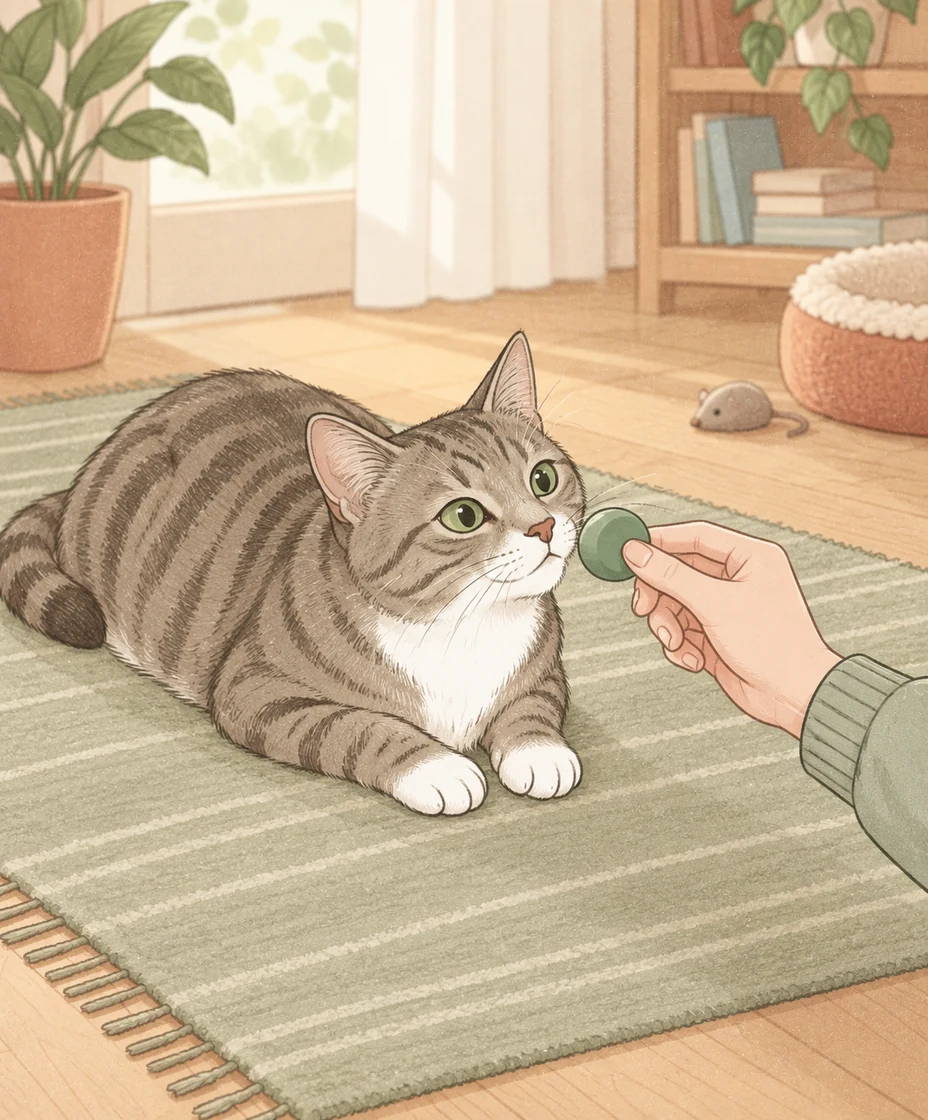
Older cats can learn new skills. Choose a small activity that fits your cat’s current comfort and mobility, keep rewards within easy reach, and let the cat decide whether to participate. A nearby nose touch can be a more useful starting point than a jump or repeated sit. New changes in movement, appetite or behavior need veterinary attention, rather than a harder lesson.
Being older does not close the door to learning
The Feline Veterinary Medical Association’s 2026 positive reinforcement toolkit states that cats can learn throughout life and that reward-based training can begin at any age. It also emphasizes individual differences in interest and motivation. That supports offering a suitable opportunity; it does not promise a particular trick or learning speed.
Decide what you want the activity to offer today: a little shared attention, an easy familiar action or the first step toward a useful care routine. You do not need to reproduce a younger cat’s performance. An ordinary moment together can be the whole point.
A change in movement is information to share
The AAHA/AAFP feline life-stage guidance recommends medical assessment for new or unusual behavior in senior cats. Reduced jumping or climbing can reflect pain or weakness. Do not assume that avoiding a once-familiar movement simply means your cat is less interested in learning.
If you notice a change, stop asking for the affected movement and describe it to your veterinary team. “Used to jump onto the chair; now pauses beside it” is a useful observation. Training cannot diagnose the reason. Follow any individual activity or dietary advice you have already been given.
Change the setup before adding effort
Here is our practical adaptation checklist for an otherwise comfortable cat. It draws on Pounce’s preparation and target-touch lessons; it is not a rehabilitation plan. Keep the learning question small enough that you can tell what your cat chose.
| Part of the session | A smaller starting point |
|---|---|
| Getting to the activity | Practice in a familiar place your cat already reaches comfortably, on a stable surface. |
| The action | Offer a nearby nose touch without asking for a step, jump or high reach. |
| Receiving the reward | Deliver beside the cat’s comfortable position instead of tossing food across the room. |
| Repeating the exercise | Pause after one easy invitation and notice whether your cat wants another. |
| Other cats joining in | Choose separate, comfortable turns so nobody has to compete for food or space. |
An example: a nose touch without the journey
If your cat already understands a reward marker, offer a smooth, blunt target near nose level while they are comfortably settled and awake. Leave a small gap for a voluntary investigation. Mark a gentle touch and deliver the prepared reward close by. Remove the target, then pause.
The difference from a distance exercise is deliberate: you are practicing contact, with no requirement to stand or walk. Do not place the object against the face, keep moving it farther away, or interrupt sleep for a session. If your cat turns away or leaves, put it aside. If they are new to a marker, start with the separate sound-and-reward guide first.
A sample note might read: “touched once while resting on the rug; looked away when I offered it again.” That gives you a complete observation. It does not establish fatigue, pain or poor memory, and it does not need to be turned into a score.
Let the next session start from your observation
Keep the comfortable setup and repeat the same small invitation another time if your cat is willing. More distance, duration or repetitions are optional changes, not automatic next steps. Record those separately so you can see what changed.
We make Pounce, which includes Gather Your Tools, Clicker Charging and Target Touch. This guide adapts those foundations; it does not claim that Pounce has a clinically tested senior-cat program or that training prevents cognitive decline. The sources and curriculum were checked September 17, 2026. As described in our editorial policy, this educational article was prepared with AI assistance and has not been individually reviewed by a veterinarian.
A little guidance goes a long way.
Follow illustrated lessons, take the next small step, and keep track of your cat’s little wins in Pounce.
Explore Pounce for iOSSources & how this guide was written
Pounce curriculum: Gather Your Tools, Clicker Charging and Target Touch. The adaptation table and one-touch observation are original teaching examples, not a measured outcome or a medical protocol. Welfare sources checked September 17, 2026. Pounce publishes this guide; no specialist review, senior-program trial or cognitive-health benefit is claimed.
- Feline Veterinary Medical Association: Positive Reinforcement Training Educational Toolkit (2026), pages 11–15
- AAHA/AAFP: Behavior and Environmental Needs — Senior Cats (February 18, 2021)
Sources checked September 18, 2026. This article is educational and has not been individually reviewed by a veterinarian. Our editorial policy explains our approach.