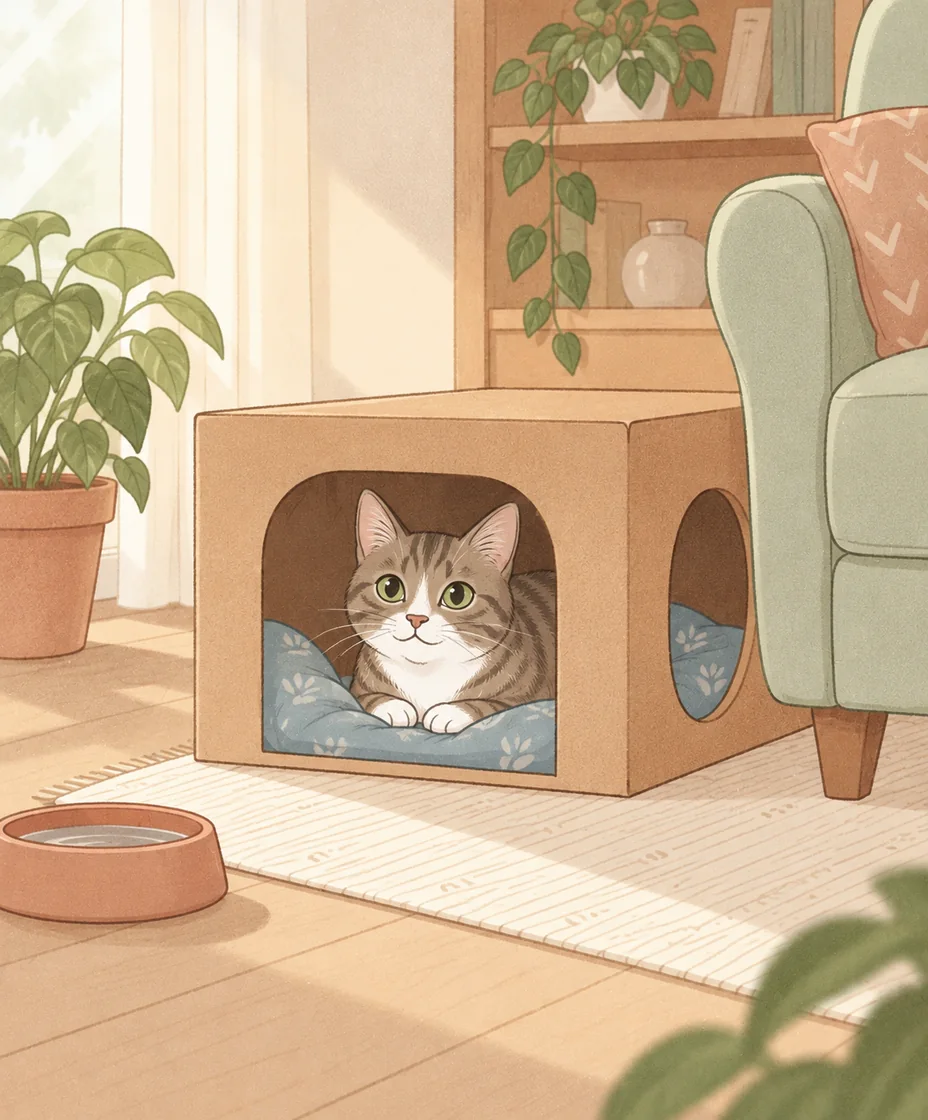
If your new cat is hiding, offer a quiet retreat with easy access to food, water and a litter tray, and let them decide when to approach. Avoid pulling them out or picking them up to introduce the house. Keep track of what they actually eat and how they use their resources. Hiding does not rule out illness: contact your veterinarian promptly about appetite loss or other concerning changes.
Make the first space easy to live in
This guide is for a newly adopted cat who is avoiding contact in an unfamiliar home. Eating only when the room is quiet does not mean the cat is ready to be held. Start with daily comfort; handling can wait.
Cats Protection recommends a quiet room with somewhere to hide, separate feeding and toileting areas, resting places and opportunities to scratch and play. An open box or covered bed can offer shelter without requiring the cat to disappear into an inaccessible gap. Keep water apart from the food bowl and the litter tray away from both.
If your cat is already under the sofa, do not turn improving the room into a chase. Keep the route to essentials clear and offer another retreat nearby. Do not reach underneath to test whether they now accept petting. If the location is unsafe or prevents necessary care, ask your veterinary or adoption team how to move them safely.
A hiding place is a resource, not a failed introduction
A 2019 randomized trial followed 23 cats during their first 12 days in a Dutch shelter. Cats given a hiding box showed a faster reduction in observed stress scores. The box did not significantly prevent weight loss. This small shelter study supports offering a refuge; it does not establish a settling-in deadline for adopted cats or show that a hidden cat is healthy.
Keep those two questions separate: “Can my cat retreat?” and “Are their daily needs being met?” Removing the retreat to make the cat more visible does not answer the second question.
Offer company without asking for a greeting
Cats Protection advises calm routines, quiet presence and allowing a shy cat to approach. Pounce’s The Fearful Cat lessons also separate sharing a room, approaching a person and accepting touch. Use that separation when deciding what to try next.
For one quiet visit, sit where you leave a clear route between the hiding place and resources. Read or do another calm activity. There is no required visit length: if your presence interrupts eating or keeps the cat retreating, give them more space and privacy.
If the cat comes closer, let that be the whole interaction. Do not add a reach, a lift or a tour of the house. A cat sniffing a shoe has chosen to investigate the shoe; record that without treating it as permission to pick them up.
Ordinary meals should remain accessible without approaching you. Avoid gradually moving the bowl toward your chair to make contact happen. You can build a relationship without making food depend on closeness.
Keep a record that distinguishes “offered” from “used”
The following observation card is our practical tool, not a diagnostic score. Make a brief note when you replenish food or check the room. Write “unknown” when you cannot tell, rather than filling the gap with reassurance. Bring the record to your veterinary team if you are concerned.
| Check | Record what you can observe | What the note helps you decide |
|---|---|---|
| Food | What and how much you offered; what remains; whether another pet could have eaten it. | Food left out is not proof of eating. Contact your vet about reduced intake or uncertainty. |
| Litter | Urine and stool observed, or unknown; any repeated unsuccessful attempts. | Describe the change accurately to your veterinary team; do not label it stubbornness. |
| Quiet presence | Where you sat, what the cat did and what changed when you left. | Keep the next visit at a comfortable distance, or allow more privacy. |
| Voluntary activity | An observed meal, a change of resting place or a brief investigation of the room. | Notice small actions without immediately adding handling or a larger space. |
Let exploration have a return route
Pounce’s confidence curriculum introduces optional exploration after home-base preparation and quiet company. Apply that idea by making one adjoining indoor area available when your cat is comfortable using the starting space. Check exterior doors and windows first, keep other pets separate, and leave access back to the retreat.
You do not need to carry the cat across the threshold. Staying put or returning to the original room is useful information. Change one part of the arrangement at a time so you can tell what made the next outing harder. Save visitors and introductions to other pets for their own plans.
Do not wait out appetite loss
Cornell advises contacting a veterinarian immediately when a cat stops eating. Do not wait for a settling-in milestone or withhold food to encourage an approach. Ask for advice promptly about reduced intake or if you cannot establish whether your new cat has eaten. Do not force food into their mouth.
New or worsening fear, pain signs or changes in toileting also deserve veterinary attention. Explain that the cat is hiding and may be difficult to handle so the team can help plan care. If daily health needs are being met but fear remains persistent, ask about qualified behavior support rather than increasing the pressure to interact.
We make Pounce, which includes The Fearful Cat. This article adds an observation card for new adopters; the app does not diagnose hiding or predict when a cat will want contact. Sources and curriculum checked October 13, 2026. Prepared with AI assistance; not individually reviewed by a veterinarian.
A little guidance goes a long way.
Follow illustrated lessons, take the next small step, and keep track of your cat’s little wins in Pounce.
Explore Pounce for iOSSources & how this guide was written
Complete The Fearful Cat module read in content/modules.json. Home-base setup, quiet presence, voluntary approach and optional exploration inform this guide. Fixed schedules, guarantees, food-luring prescriptions, drug names and delayed appetite-loss advice excluded. The observation card is an original editorial aid, not a diagnostic tool.
- Cats Protection: Bringing a cat home
- Cats Protection: Shy cats
- van der Leij et al.: The effect of a hiding box on stress levels and body weight in Dutch shelter cats; a randomized controlled trial (October 14, 2019)
- Cornell Feline Health Center: Anorexia
Sources checked October 13, 2026. This article is educational and has not been individually reviewed by a veterinarian. Our editorial policy explains our approach.