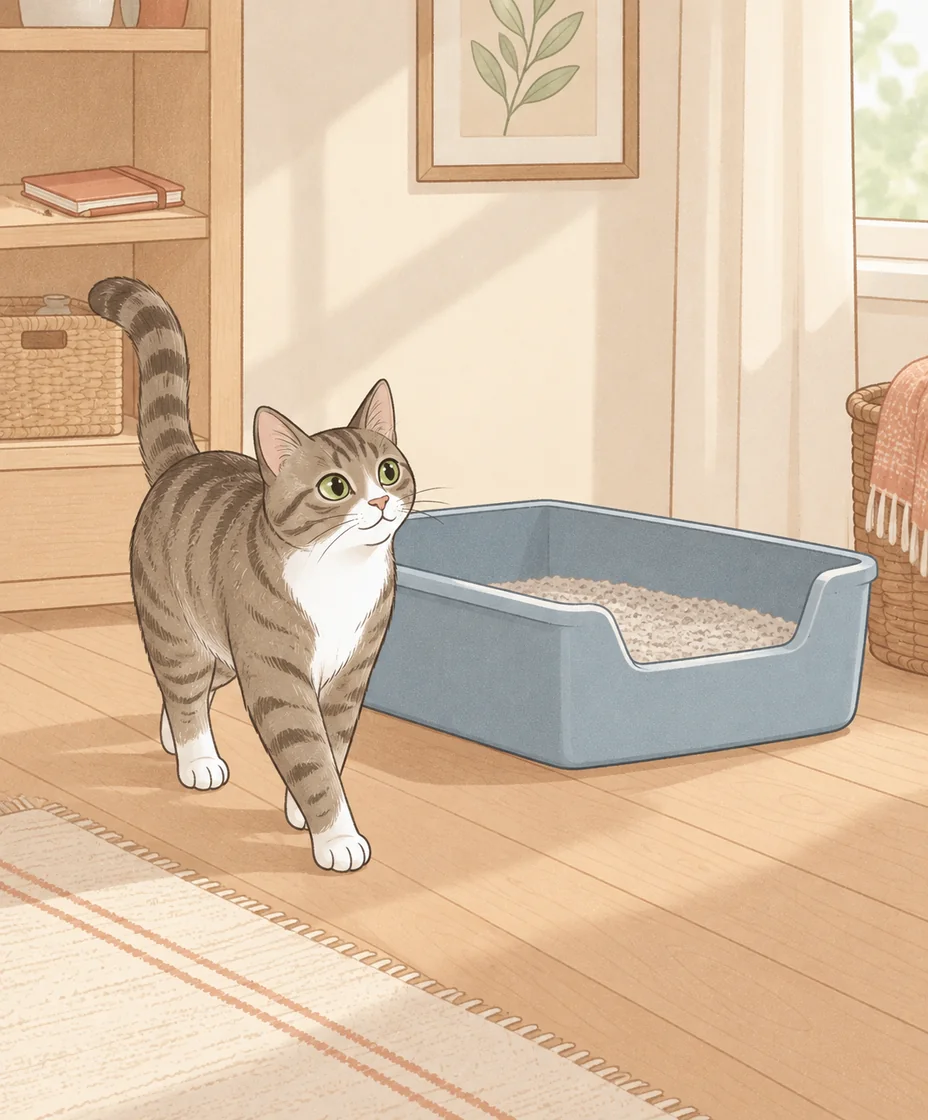
If your cat keeps peeing outside the litter box, contact your veterinarian and bring a clear record of what happens, including previous assessments and setup changes. Check that toileting areas remain clean and easy to reach. Do not punish your cat or assume an earlier check rules out a new problem. Straining with little or no urine needs emergency veterinary attention now.
Know when the record can wait
Repeated attempts to urinate with little or nothing coming out can indicate a blockage. Cornell describes urethral obstruction as a medical emergency. Contact an emergency veterinarian immediately, including if you are unsure whether your cat is trying to urinate or defecate. Do not wait to finish a log or see whether a different tray helps.
Blood, painful urination or a new change in toileting also warrants prompt veterinary contact. Tell the team what you can see and follow their advice. This guide helps organize an ongoing problem; it cannot identify the cause or provide treatment.
An earlier assessment belongs in the history
The 2025 iCatCare consensus guidelines explain that similar urinary signs can have different causes, and the cause can change between episodes. Tell your vet when the last assessment happened, what was checked and what has changed since. Do not assume that continued box use on some occasions establishes that everything is medically normal.
Cat Friendly Homes also describes physical, social and environmental contributors to house-soiling. It is not evidence of spite. A cat who avoids the tray only sometimes still needs an individual assessment; watching more closely or repeatedly placing them inside is not a substitute.
Turn “we tried everything” into a useful record
Make two short lists: what happens now, and what has already been tried. Our table keeps observation separate from interpretation. Fill gaps with “unknown” instead of reconstructing details you did not see. In a shared home, finding a puddle does not establish which cat produced it.
For example: “Found urine beside the study door at breakfast; did not see which cat; door had been shut overnight.” That identifies a question about access without diagnosing a preference, a relationship problem or illness. Include ordinary box use too, when you happen to observe it. Do not hover, interrupt toileting or provoke an incident to complete the note.
| Record | Useful detail |
|---|---|
| The event | When it was seen or found; location and surface; urine or stool; whether the cat was actually observed. |
| The current setup | A simple room sketch showing each tray, doors and the routes between resting places and toileting areas. |
| Previous changes | What changed, approximately when, what stayed the same and what you observed afterward. Include changes that did not help. |
| Previous care | Dates of assessments, advice received and any new signs since then. Bring existing records rather than guessing test results. |
Check the route as well as the number of boxes
FelineVMA recommends separated, quiet toileting locations where a cat cannot easily be cornered or blocked. Walk the ordinary route yourself: a tray can be clean yet unavailable behind a closed door. Notice narrow approaches, noisy appliances and other animals waiting nearby. Record these details without assuming that one explains the whole problem.
International Cat Care’s caregiver guide recommends roomy trays with easy entry, suitable unscented litter and regular cleaning. Mobility needs matter. Keep familiar usable options available while discussing changes; do not replace every box and every litter at once. If your cat struggles to enter or move normally, tell your vet rather than treating the difficulty as a preference test.
Clean soiled areas with a suitable urine-cleaning product according to its instructions and the surface requirements. Keep your cat away as the label requires. FelineVMA advises avoiding ammonia-based cleaners and punishment. Cleaning supports the plan but does not tell you why the incident happened.
Leave the appointment with a follow-up plan
Use the history to ask three practical questions: What needs assessing now? Which household change should we try first? When should we report back, and which signs mean calling sooner? If the problem persists, ask whether coordinated help from a qualified feline behavior professional would be useful.
Write the agreed change beside its start date and keep the observations brief. A single use of a new tray is worth recording, but it does not prove the cause or promise a lasting resolution. Do not wait out a home experiment when symptoms change or your cat seems unwell.
We make Pounce, which includes Litter Box Troubleshooting with setup, maintenance and observation tasks. This guide adds a history table and appointment questions. An app cannot diagnose urinary disease or replace individual care. Sources and curriculum were checked October 6, 2026. This article was prepared with AI assistance and has not been individually reviewed by a veterinarian.
A little guidance goes a long way.
Follow illustrated lessons, take the next small step, and keep track of your cat’s little wins in Pounce.
Explore Pounce for iOSSources & how this guide was written
Pounce curriculum: complete Litter Box Troubleshooting module checked. Retains the veterinary-first boundary, setup, maintenance and observation tasks. Does not reproduce fixed resolution deadlines, guaranteed causes, cure claims, a waiting period for urinary signs or male-only emergency wording. Original history table and appointment questions. Sources checked October 6, 2026.
- Cornell Feline Health Center: Feline Lower Urinary Tract Disease (updated October 2016)
- Taylor and colleagues: 2025 iCatCare consensus guidelines on lower urinary tract diseases (February 11, 2025)
- FelineVMA / Cat Friendly Homes: Not Using the Litter Box
- International Cat Care: Cat Carer Guide to Lower Urinary Tract Diseases
Sources checked October 6, 2026. This article is educational and has not been individually reviewed by a veterinarian. Our editorial policy explains our approach.