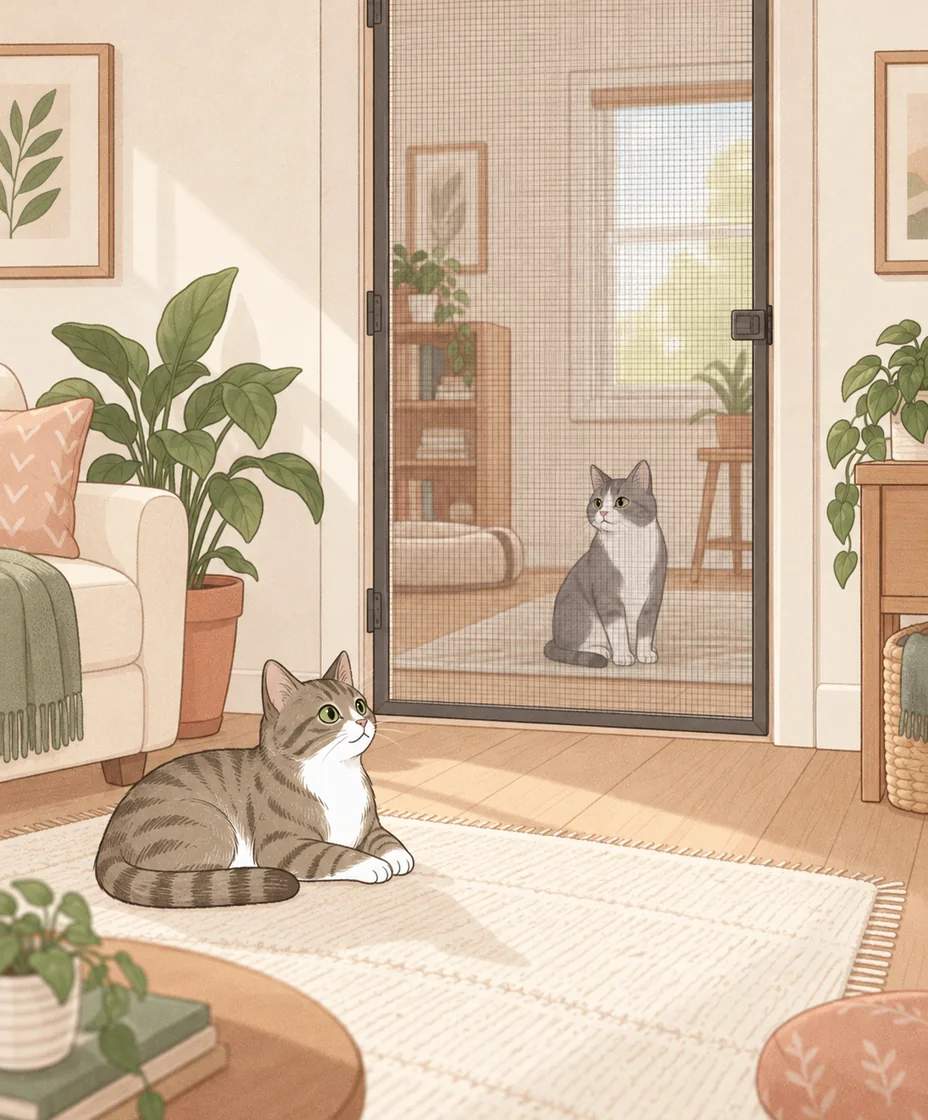
Slow a cat introduction down if either cat becomes tense, repeatedly hides, blocks the other’s route, or starts stalking or chasing. Restore comfortable separation and return to an easier stage. Move forward only when both cats are comfortable with the current arrangement; eating nearby or avoiding a fight is not enough on its own.
Watch the cat who needs more space
One cat may walk toward the doorway while the other stays behind a chair. Writing “they met without fighting” misses that difference. Notice what each cat does before, during and after the encounter, including whether they can move away and return to their ordinary routine.
The 2024 AAFP intercat tension guidelines describe subtle signs such as staring and blocking, as well as overt conflict. They also recommend veterinary assessment for health problems that may contribute. Sudden conflict between established housemates, pain, injury or a cat not eating warrants prompt veterinary advice rather than another introduction exercise.
Make separation comfortable before asking for company
Cats Protection recommends separate essential resources and space away from other cats. A transition room needs its own food, water, litter facilities, resting and hiding places, and appropriate activity. The resident cat also needs comfortable access to these things outside that room.
Check the route, not just the item count. Can one cat sit in a doorway and control access to both food bowls? Are all the litter trays beyond the same narrow hallway? Spread resources across useful locations so a cat does not have to pass the other to reach them.
Keep familiar individual attention and play in the day. Separation is an arrangement for safety and comfort, not punishment or a reason to leave a cat without interaction. If you cannot provide safe separate areas, ask your veterinary team or adoption organization for help planning the setup.
Know which part of the introduction you are practicing
Cat Friendly Homes describes a gradual progression from settling separately and becoming familiar with scent to brief visual access and, later, supervised proximity. If either cat is distressed, stop and return to an earlier stage. There is no calendar date on which a door must open.
Pounce’s Multi-Cat Introductions curriculum also separates scent, sight and shared space. For an introduction already underway, name the current challenge before changing anything: is it the other cat’s scent, seeing them across a room, or their movement nearby?
For visual practice, use a securely fitted barrier that actually prevents these cats from getting through, over or around it. A short gate or loose insect screen may not do that. Arrange the space so you can end visual contact safely. Start with distance and a brief view; do not carry either cat up to the barrier or use food to draw them into uncomfortable proximity.
Use a pause-or-progress check
This table is our planning aid, drawing on the staged approach in Pounce. It is not a diagnostic test or a score that can certify a pair safe. When the cats give different signals, plan around the one who needs the easier setup.
For example: “Cat A glanced toward the screen, then walked back to the rug. Cat B stayed low behind the chair and watched.” That is a reason to end the view and make the next attempt easier, even if Cat A seemed ready to approach.
| What you observed | Next decision |
|---|---|
| Both cats stayed loose, could look away and resumed ordinary activity. | Repeat the comfortable arrangement. A later change can be small; progress is optional today. |
| One ate a treat but stayed stiff or watched the other continuously. | End the encounter. Food taken is only one observation, not permission to move closer. |
| A cat retreated, hid or kept a distance while the other approached. | Preserve the retreat. Next time use more distance or an earlier stage, rather than following. |
| Stalking, chasing, guarding a doorway or blocking resources appeared. | End shared access safely, restore separate resources and seek help if the pattern continues. |
A pause should reduce the next challenge
If tension rises, avoid reaching between the cats or picking up an aroused cat. The AAFP guidance describes blocking visual contact with a suitable barrier and safely separating the cats, then allowing them to settle. Plan this before an encounter; do not put yourself within biting or scratching range. If you cannot manage separation safely, get professional help.
Do not punish hissing, spray water or force the cats to remain together. After a difficult encounter, do not immediately reopen the door to check whether they are over it. Give them their separate resources and ordinary routine, then choose an earlier comfortable stage with your veterinary or behavior team when needed.
Keep two notes, then choose one small change
Use a short record with five fields: setup, Cat A’s response, Cat B’s response, what you changed, and how each behaved afterward. Include the barrier and distance so the next attempt is repeatable. A quiet photograph cannot tell you what happened before or after it.
Change one part of the setup at a time. For example, repeat a brief view from the same comfortable distance before considering a longer encounter. Do not simultaneously remove the barrier, reduce the gap and extend the time. Those are three different challenges.
Persistent fear, repeated chasing or difficulty maintaining comfortable separation needs individual support. An introduction guide cannot decide compatibility or replace that assessment. Once cats already share the home comfortably, our separate two-cat training guide explains how to organize individual practice turns.
We make Pounce, which includes Multi-Cat Introductions. This article adds a decision table and a two-cat observation record. Sources and curriculum were checked September 24, 2026. It was prepared with AI assistance and has not been individually reviewed by a veterinarian; it offers no guaranteed outcome or completion date.
A little guidance goes a long way.
Follow illustrated lessons, take the next small step, and keep track of your cat’s little wins in Pounce.
Explore Pounce for iOSSources & how this guide was written
Pounce curriculum: Multi-Cat Introductions. The pause-or-progress table and separate observation fields are original planning aids. Fixed day labels, guarantees, supplement recommendations and unsafe barrier assumptions are not carried over. The guide is educational support, not a diagnosis or a treatment plan for an individual household.
- AAFP (2024): Intercat tension guidelines — recognition, prevention and management
- Cat Friendly Homes: Introducing a New Cat Into Your Home
- Cats Protection: Getting Another Cat
Sources checked September 24, 2026. This article is educational and has not been individually reviewed by a veterinarian. Our editorial policy explains our approach.