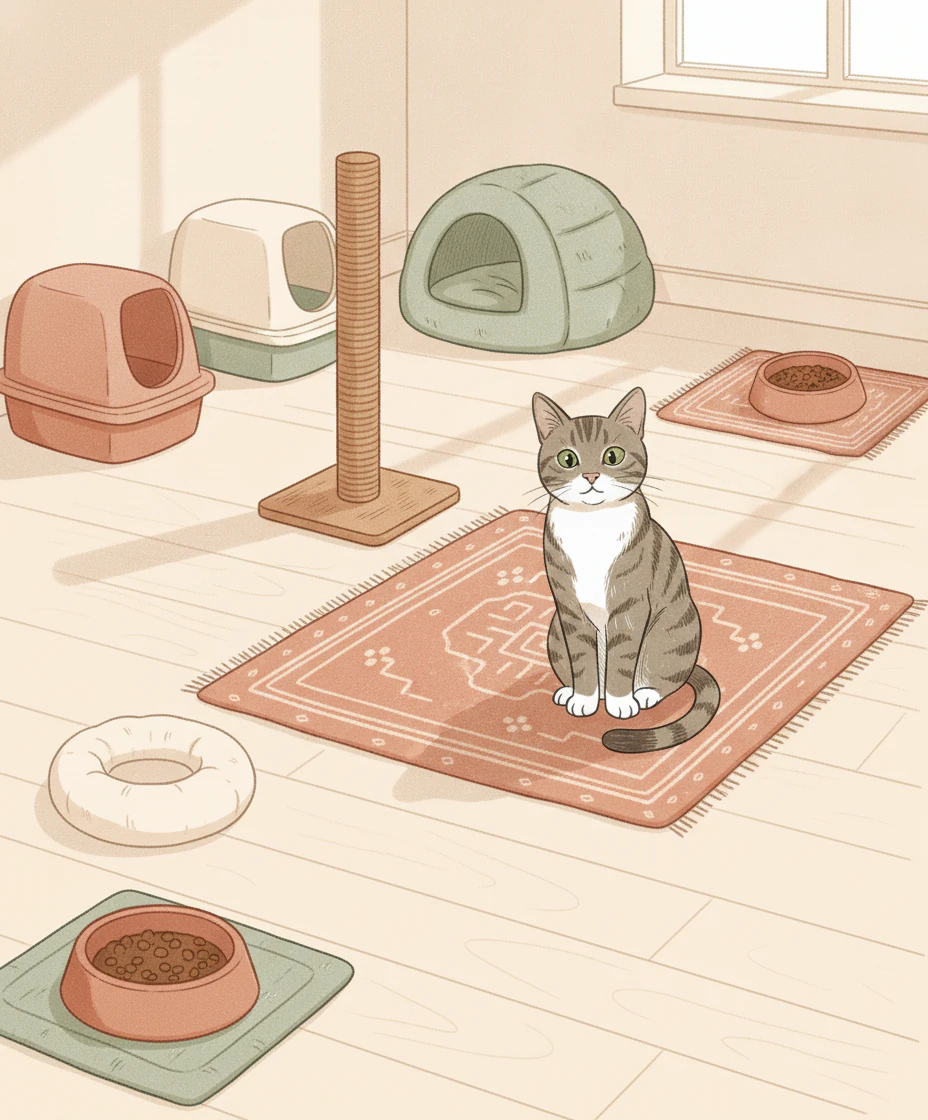
To stop a cat spraying indoors, get a vet check and neuter or spay if your cat is intact. Then work out what feels threatening: marks by doors and windows usually point to cats outside, marks in hallways to tension at home. Clean every mark with an enzymatic cleaner, block views of outdoor cats, and give each cat their own litter tray, food and resting spots, plus one extra.
Is my cat spraying or peeing?
The posture tells you. A cat who needs to pee squats and leaves a large puddle, usually somewhere secluded. A cat who sprays stands, backs up to an upright surface, raises their tail and lets it quiver, often treading with their back feet, and squirts a small amount behind them. International Cat Care puts a typical spray at under 2 ml, which is why you often find a sticky yellow-brown trickle on a skirting board, door or curtain rather than a pool.
The ASPCA adds two useful clues: sprayed urine smells especially pungent, and a cat who still uses the litter tray can be marking all the same. Some cats mark on the flat too, on bags, clothes or new things left on the floor.
If what you are finding is puddles on the floor or the bed, that is a different problem with different causes. Start with the guide to peeing outside the litter box instead.
Source: International Cat Care: Urine spraying in cats (updated September 26, 2025)
Why is my cat spraying indoors?
Spraying is a scent message, not spite. Outdoors it is normal territorial behaviour. Indoors, Cats Protection and International Cat Care both describe it as a sign that your cat doesn’t feel secure in their own home.
The usual triggers are an intact cat reaching maturity, a cat outside the window or coming in through the cat flap, tension with another cat or pet in the house, and change: a move, building work, a new baby, new furniture. The ASPCA notes that even a new coat or an unusually large shopping bag can set off a sensitive cat. The risk also climbs with every cat you add; International Cat Care says the likelihood of spraying rises in direct proportion to the number of cats in the home.
How to stop a cat spraying: 7 steps
- Book a vet check. Bladder problems and kidney disease can look like marking, and a stressed or unwell cat sprays more. Ask whether the vet wants a urine sample; International Cat Care describes collecting one at home with non-absorbent litter. Success: medical causes ruled out, or treated.
- Neuter or spay. If your cat is intact, this is the biggest single change you can make. International Cat Care reports a significant drop in spraying after neutering in both sexes, though around 10% of neutered males and 5% of neutered females still spray. Success: the procedure done, and a note of how often marks appear in the weeks after.
- Map the marks for a week. Write down every spot and what is nearby. Cats Protection reads them like this: marks on the cat flap, outside doors or windows suggest a threat outside; marks on internal doorways and hallways suggest the cats who share those routes. In a multi-cat home, the ASPCA says a vet can give a dye, fluorescein, that makes urine glow under ultraviolet light for about 24 hours, so you can see who is marking. Success: a pattern, and a best guess at the trigger.
- Clean every mark properly. A cat who can still smell their mark tends to top it up. Find old spots with a UV torch, blot, then use an enzymatic cleaner made for cat urine. International Cat Care also gives a home method: a warm 10% solution of biological washing powder, rinsed, then wiped with surgical spirit once dry. The ASPCA warns against ammonia-based cleaners, which can draw a cat back to the same spot. Throw out fabric that is heavily soaked. Success: no smell at nose height after drying.
- Shut out the cats outside. Cover the lower part of glass doors and low windows with frosted or privacy film, or cardboard as a stopgap, so your cat can’t see the visitor on the patio. Fit a microchip-activated cat flap so only your cats get in, and pin up sprayed curtains for a while. Give it at least two weeks. Success: fewer marks by doors and windows, and less staring and tail-lashing at the glass.
- Give every cat their own resources. Use the one-per-cat-plus-one rule for litter trays, and International Cat Care applies it to food bowls, water, beds, scratching posts, high perches and hiding places too. Spread them around the home: Pounce’s Litter Box Troubleshooting lesson points out that three trays side by side count as one to a cat. Put trays in quiet spots with two ways out, as the ASPCA suggests, scoop daily, and play with each cat on their own. Success: no queueing or guarding at trays, food or doorways.
- Calm things down and change one thing at a time. A synthetic feline pheromone diffuser near the problem area may help; the ASPCA says pheromones have shown some effect in relieving stress, and International Cat Care suggests spraying the product on cleaned spots as well. Hold each change for seven full days before judging it, as the Pounce lesson does, and keep logging marks. Success: the log trends down week on week.
Work through these in order. Most of the fix is detective work and setup, not training, so it suits a notebook more than a clicker.
Why is my neutered cat spraying?
Because neutering removes the mating reason, not the stress reason. Neutered cats who spray are usually reacting to something in their surroundings, most often other cats, inside or outside. Steps 3 to 7 are written for exactly this cat. Spraying in a cat who looks perfectly relaxed is still worth taking seriously: International Cat Care points out that it is a stress signal even when you see no other sign.
Source: International Cat Care: Urine spraying in cats (updated September 26, 2025)
How long does it take to stop a cat spraying?
Plan on two to four weeks of steady changes before you judge the result. That is the timeline Pounce’s Litter Box Troubleshooting lesson uses, holding each change for a week so you can tell what made the difference. The lesson also notes that the first improvement often shows within a day or two of the right change, so a week with no change at all is a sign to look for a different trigger.
Expect some ups and downs. International Cat Care notes that spraying can come and go, and a quiet spell does not mean the cause is gone. Keep the setup that worked, and if marks return, look first for what changed that week: a visitor, a new piece of furniture, a new cat in the street.
Should I tell my cat off for spraying?
No. Cats Protection is clear that punishment never helps and can lead to more spraying, because it adds to the anxiety behind it. The ASPCA specifically warns against rubbing a cat’s nose in urine. If you catch your cat backing up to a wall, calmly toss a toy or a treat away from the spot, then clean up later when they aren’t watching.
Instead, put your energy into the map and the setup. A cat who feels their home is safe has no reason to keep re-signing it.
When to call your vet
Call your vet as soon as spraying starts, even if it stops again after a few weeks; International Cat Care says the longer you wait, the more complicated it gets. Call the same day if your cat is straining in the tray, crying, passing very little urine or urine with blood in it, or going in and out of the tray often. A male cat who strains and produces little or nothing needs an emergency vet now.
If the vet rules out illness and the setup changes haven’t helped after a few weeks, ask for a referral to a qualified feline behaviourist. Your vet may also discuss medication as one part of a behaviour plan; the ASPCA advises giving it only under veterinary direction.
Source: International Cat Care: Urine spraying in cats (updated September 26, 2025)
Working through it with Pounce
Pounce’s Litter Box Troubleshooting lesson walks you through the same order as this article: the vet check first, then tray setup, enzymatic cleaning, daily scooping, a week of tracking and one change at a time, with a two-week check-in. In a multi-cat home, the Multi-Cat Introductions lesson takes you through scent swaps, meals on either side of a door and short supervised time together, which helps when tension between your cats is behind the marks.
A little guidance goes a long way.
Follow illustrated lessons, take the next small step, and keep track of your cat’s little wins in Pounce.
Explore Pounce for iOSSources & how this guide was written
Pounce curriculum: the Litter Box Troubleshooting lesson for the vet-first order, tray setup, enzymatic cleaning, one-change-a-week tracking and timeline, with Multi-Cat Introductions for households with more than one cat.
- International Cat Care: Urine spraying in cats (updated September 26, 2025)
- ASPCA: Urine marking in cats
- Cats Protection: Spraying
Sources checked November 3, 2026. This article is educational and has not been individually reviewed by a veterinarian. Our editorial policy explains our approach.