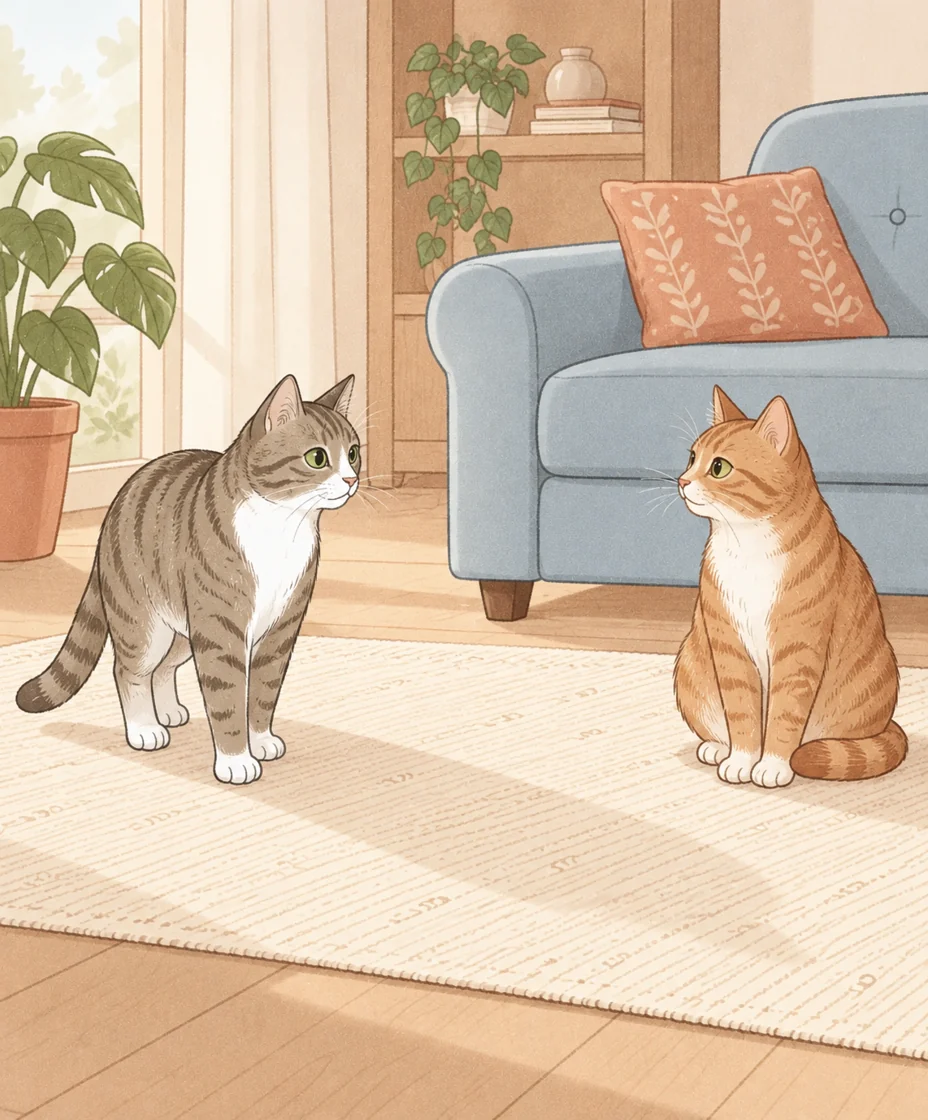
To judge whether cats are playing or fighting, watch both cats across the whole interaction. Mutual participation, opportunities to disengage and comfortable behavior afterward matter more than one dramatic wrestle. Repeated pursuit of a retreating cat, cornering or escalating distress is a reason to end contact safely. Do not wait for an injury to take tension seriously.
One cat enjoying it is not enough
Cat Friendly Homes describes balanced play as mutual, with either cat able to initiate. It also identifies persistent staring, blocking access and avoidance as possible tension. A quiet encounter can still deserve attention; the absence of a scream does not certify that both cats are comfortable.
Notice what happens when one cat stops. Does the other allow the break, or keep pursuing them into a hiding place? There is no required number of role changes to count. Describe what each cat actually does rather than deciding that one is the bully or that a tussle proves they dislike each other.
Research found a middle ground, too
A study published January 26, 2023 analyzed videos of 105 pairs of cats. Reciprocal wrestling was associated with playful interactions, while vocalizing and chasing were associated with conflict. The researchers also identified an intermediate category containing elements of both. They specifically cautioned against treating wrestling alone as proof of play.
These were selected videos from owners and YouTube, not a test that predicts an individual pair’s future. The researchers lacked detailed histories of the cats and used broad behavior categories. Their findings help explain why a simple play-or-fight label can miss a changing interaction; they do not validate a home scoring system.
A disagreement during one encounter also does not establish that a relationship is permanently broken. Keep the immediate decision about giving space separate from the larger question of how these cats live together.
Save the sequence, not just the dramatic second
Use this three-part note after an ordinary interaction. It is our observation aid, not a diagnostic checklist. Do not bring cats together, delay separation or recreate a difficult encounter to fill it in. If you already have a recording, preserve its original sound and the context before and after the contact for your veterinary team.
| Moment | What to write |
|---|---|
| Before contact | Where each cat was, what each was doing and which cat approached. Include a doorway or resource nearby. |
| During contact | What each cat did; any sounds; when one paused or moved away; what the other did next. |
| Afterward | Where each went and whether ordinary activity resumed. Write unknown when a cat left your view. |
Make room to stop safely
If tension rises, prioritize distance rather than collecting more evidence. The AAFP caregiver handout advises blocking visual contact with a suitable barrier and separating cats when needed. Do not put your hands between them or pick up an aroused cat. Only position a barrier if you can remain safely out of reach; get professional help when you cannot manage separation safely.
Give each cat a comfortable separate area with their own ordinary resources. Do not punish a hiss or immediately put the cats back together to see whether the problem has passed. If there may be an injury, contact your veterinarian promptly. People who are bitten or scratched should seek appropriate medical advice.
Bring the wider pattern to your vet
Cat Friendly Homes recommends veterinary assessment and behavior support when encounters become more frequent or intense, including when one cat hides. Sudden conflict, changes in appetite or movement, and difficulty reaching food or litter facilities belong in that conversation. A friendly moment afterward does not erase a recurring problem.
A useful note might read: ‘Both on rug; one walked toward hall; other followed and blocked doorway; separated safely.’ That identifies a situation to discuss without guessing a motive. Ask which household changes to make first and what would mean contacting the team again sooner.
We make Pounce. Its Multi-Cat Introductions lessons separate preparation, scent, sight and shared space, and include watching for tension. This article adds the observation record; Pounce is educational support, not an assessment of a video or a treatment for aggression. Sources and curriculum checked October 8, 2026. Prepared with AI assistance; not individually reviewed by a veterinarian.
A little guidance goes a long way.
Follow illustrated lessons, take the next small step, and keep track of your cat’s little wins in Pounce.
Explore Pounce for iOSSources & how this guide was written
Pounce curriculum: complete Multi-Cat Introductions module, including preparation, scent, sight, shared space and tension monitoring, checked October 8, 2026. The observation record is an editorial adaptation, not a diagnostic test or video assessment. No guaranteed compatibility, fixed timeline or treatment claim.
- Gajdoš-Kmecová et al. (2023): analysis of inter-cat play and conflict
- Cat Friendly Homes: How to Recognize Intercat Tension
- AAFP caregiver handout (2024): safe separation, pages 4–5
- Cat Friendly Homes: Intercat Tension
Sources checked October 8, 2026. This article is educational and has not been individually reviewed by a veterinarian. Our editorial policy explains our approach.