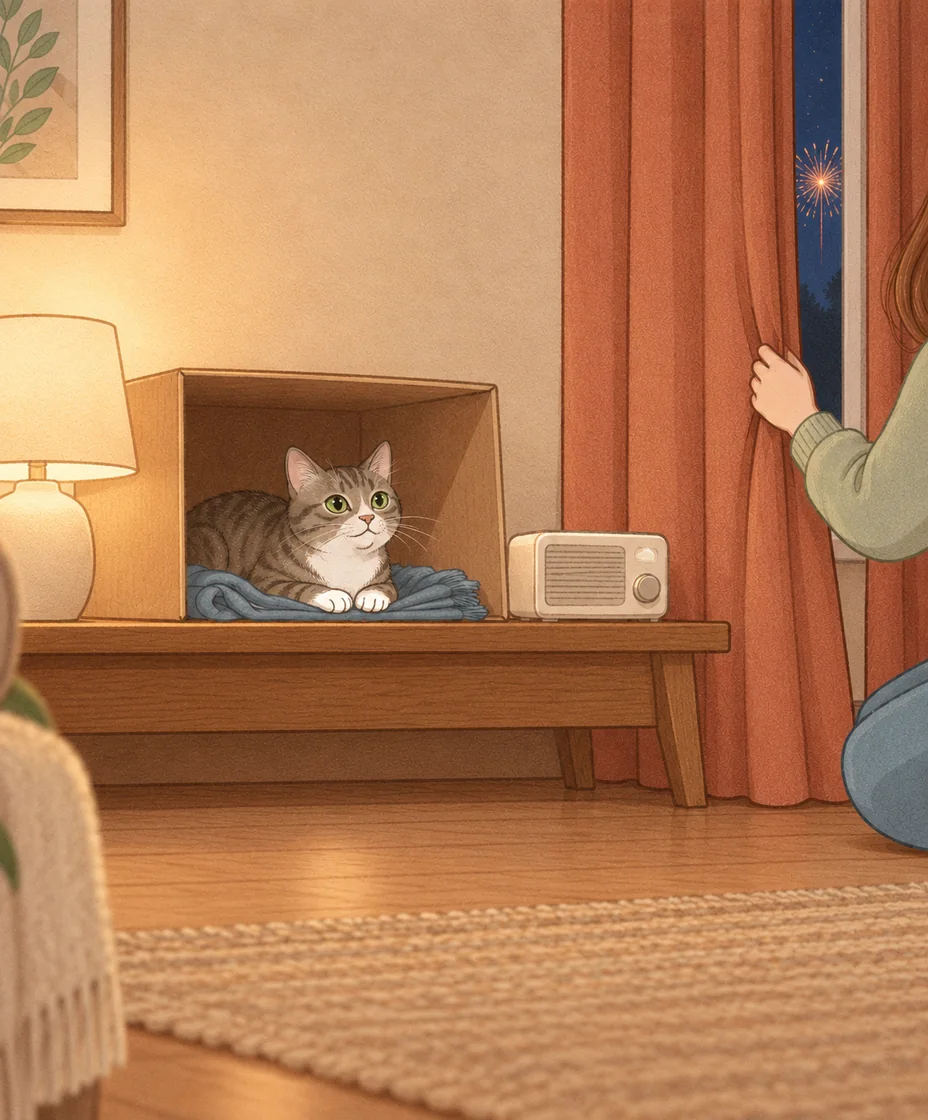
Bring your cat indoors by early afternoon and keep them in after dark. Lock windows, doors and the cat flap, and close the curtains before the first bang. Set out two or three covered hiding places with food, water and a litter tray within reach. Play familiar TV or radio at normal volume. Let your cat hide, and never pull them out.
What to do before dark: 6 steps
- Bring your cat in by early afternoon. PetMD advises getting outdoor cats home early on days you expect fireworks rather than calling them in at dusk, when the noise may already have sent them in the opposite direction. Cats Protection recommends keeping cats indoors after dark through the season.
- Lock every exit. Windows, exterior doors and the cat flap, all shut and latched. Cornell's Feline Health Center points out that a startled cat will take an open door during a noisy evening, so agree with everyone in the house who handles deliveries and arrivals tonight.
- Check the microchip details. Cornell recommends a collar tag or microchip in case a cat does get out, and Cats Protection specifically says to confirm your current address and phone number are on the chip record. This takes two minutes online and it is the step people skip.
- Set up two or three hiding places. Cats Protection suggests a cardboard box or a blanket-lined bed, plus high options such as a cat tower or a bed on top of a wardrobe. More than one matters, because the spot your cat picks is rarely the one you expected.
- Put food, water and a litter tray within reach of those spots. Cornell's holiday guidance is that a cat should be able to get to all of it easily and at their own discretion. A cat who will not cross a loud hallway to reach the tray is a cat who ends up uncomfortable as well as frightened.
- Close the curtains before sunset and turn on familiar background sound. Covering the windows blocks the flashes as well as some of the noise. Cats Protection suggests the radio or television, and notes classical music can be particularly calming.
Everything that actually calms a cat happens before the first firework goes off. Work through these in order during the afternoon.
Source: Cats Protection: Cats and Fireworks (current page; publication date not displayed)
What to do once the fireworks start: 5 steps
- Keep the background sound at its normal volume. Do not turn it up to compete with the bangs. Louder is still loud, and you lose the one familiar thing in the room.
- Leave a hiding cat where they are. VCA's fear guidance is to let a cat get to a quiet place and have time to relax, and not to force interaction or push treats on them. Cats Protection is blunter: trying to pick them up or cuddle them can make them more fearful.
- Let your cat decide about company. If they come to you and stay, sit with them. If they leave again, let them. Both are fine; neither is a verdict on your relationship.
- Keep children and visitors out of the hiding spot. No reaching in, no torch, no photo. Cornell warns that loud noises can trigger redirected aggression, and a hand arriving in a dark box is how a frightened cat ends up biting someone they like.
- Do not confine your cat to one room to 'keep them safe'. Cats Protection cautions that some cats feel more stressed when shut in. Leave the indoor doors they normally use open so they can move between their options.
Your job for the next few hours is to be boring. Nothing on this list involves touching your cat.
Source: VCA Animal Hospitals: Cat Behavior Problems — Fears and Phobias (updated October 23, 2026)
How can I tell my cat is frightened?
Cats rarely yowl or run in circles when they are scared. They get smaller and stiller, which is easy to read as calm.
Cornell's Feline Health Center describes a fearful cat as having dilated pupils, ears flattened and held outward, whiskers flattened or pressed down onto the face, and the tail wrapped closely around or tucked under the body. VCA adds crouching and pinning the ears back, freezing in place, a puffed-up tail, hissing, an arched back, and swatting or biting if pushed. PetMD also lists drooling and panting, both of which are worth a call to your vet rather than a wait-and-see.
A cat who flattens into a loaf under the bed and does not move for three hours is frightened, not relaxed. Treat the stillness as information and leave them to it.
Should I comfort my cat or leave them alone?
Let your cat choose, and assume the answer is 'leave me alone' until they show you otherwise. You cannot reinforce fear by being kind, but you can frighten a cat further by handling one who is already trying to get away from something.
Cornell's advice during these moments is not to punish or even touch the cat, because that is how a cat learns to associate people with the thing that scared them. If your cat does come out and settle against you, stroke them calmly and let them leave when they want to. That is your cat asking for contact, which is different from you going to find them.
What makes a good hiding place?
Two exits. This is the detail the tip lists leave out, and it is the one that changes how a hiding place feels to a cat. A box with a single opening is a dead end: if something approaches the hole, there is nowhere to go. Cut a second hole in the opposite side of a cardboard box, or use a cat cave with an open back, and the same box becomes a place a cat can leave on their own terms.
Height is the other option worth offering. Cats Protection lists the top of a wardrobe or a box on a sturdy shelf alongside floor-level beds. Give your cat one of each and let them pick.
Line it with something that already smells of home — a blanket off the sofa, a jumper you have worn — rather than something new out of the cupboard. Cats Protection also suggests a pheromone plug-in, started a couple of weeks before fireworks season rather than on the night, and VCA notes pheromone products placed in a cat's safe space may help reduce stress.
This is the same setup Pounce's The Fearful Cat lessons build in the 'Build the sanctuary' step: one quiet room, food, water, litter, flow-through hiding spots with two exits rather than a single-exit trap, and a pheromone diffuser.
Source: Cats Protection: Cats and Fireworks (current page; publication date not displayed)
How long will my cat hide afterwards?
PetMD puts it at anywhere from a few hours to a few days, and that range is normal. Leave the hiding places up for the rest of the week rather than tidying them away the next morning, and keep food, water and the tray where they were.
The thing to watch is not how long they stay hidden but whether ordinary life restarts: eating, drinking, using the litter tray. Writing down what you notice is more useful than remembering it — 'first bang 8:10 p.m., went under the bed, came out 10:30, ate at 11' gives your vet something to work with if you do end up calling. 'Not observed' is a better note than a guess.
If several displays are expected over a fortnight, leave the setup in place for the whole stretch. Taking it down and putting it back up each evening makes the house less predictable, which is the opposite of what a frightened cat needs.
Can you train a cat not to fear fireworks?
You can lower a cat's reaction to loud noises, but not tonight and not with a real display. The method is desensitisation and counterconditioning: a recording played quietly enough that your cat stays relaxed, paired with something good, then raised in very small increments.
VCA gives the numbers worth copying. Keep early sessions to 10 to 15 minutes, finish while your cat is still calm, and only raise the intensity after two or three successful sessions at the current level. A neighbourhood display has no volume dial and no stop button, so playing a fireworks recording during one is not a training session — it is just more noise.
Pounce's Kitten Socialization chapter runs this as 'Sounds, low and far': five minutes of everyday noises at low volume while treats arrive, raising the volume across days only while the kitten stays relaxed. For an adult cat who is already frightened, The Fearful Cat chapter is the slower route — a sanctuary room first, then short sessions of simply sitting at the far side of the room, reading aloud and leaving a treat behind. Expect weeks, not evenings; the first real sign of progress is usually your cat eating while you are still in the room.
Source: VCA Animal Hospitals: Cat Behavior Problems — Fears and Phobias (updated October 23, 2026)
When to call your vet
Call your vet if your cat is drooling, panting or trembling, if they have not eaten, drunk or used the litter tray by the next day, or if their toileting changes after the event. Call sooner if they are injured from trying to escape.
Fear that appears suddenly in a cat who was previously fine deserves a health check rather than a behaviour plan. VCA notes that underlying medical problems can change how a cat responds to things that frighten them, and pain is a common reason a cat starts hiding. Cats Protection adds that if stress persists, your vet may refer you to a qualified behaviourist.
Do not give your cat anything from your own medicine cabinet, and do not copy a supplement or dose from a forum. If previous years have been severe, ask your vet now — before the next display — what they would recommend for your cat.
Source: VCA Animal Hospitals: Cat Behavior Problems — Fears and Phobias (updated October 23, 2026)
A little guidance goes a long way.
Follow illustrated lessons, take the next small step, and keep track of your cat’s little wins in Pounce.
Explore Pounce for iOSSources & how this guide was written
Draws on two Pounce chapters: The Fearful Cat (the 'Build the sanctuary' setup — one quiet room with food, water, litter, two-exit hiding spots and a pheromone diffuser — and the 'Passive presence' sessions) and Kitten Socialization ('Sounds, low and far', five minutes of everyday noises at low volume paired with treats). No fireworks-specific course, cure, medication recommendation or success rate is claimed.
- Cats Protection: Cats and Fireworks (current page; publication date not displayed)
- VCA Animal Hospitals: Cat Behavior Problems — Fears and Phobias (updated October 23, 2026)
- Cornell Feline Health Center: Feline Behavior Problems — Aggression (current page; publication date not displayed)
- Cornell Feline Health Center: Beware Holiday Hazards (current page; publication date not displayed)
- PetMD: How To Keep Your Cat Calm and Safe During Fireworks (veterinary-reviewed; publication date not displayed)
Sources checked October 26, 2026. This article is educational and has not been individually reviewed by a veterinarian. Our editorial policy explains our approach.