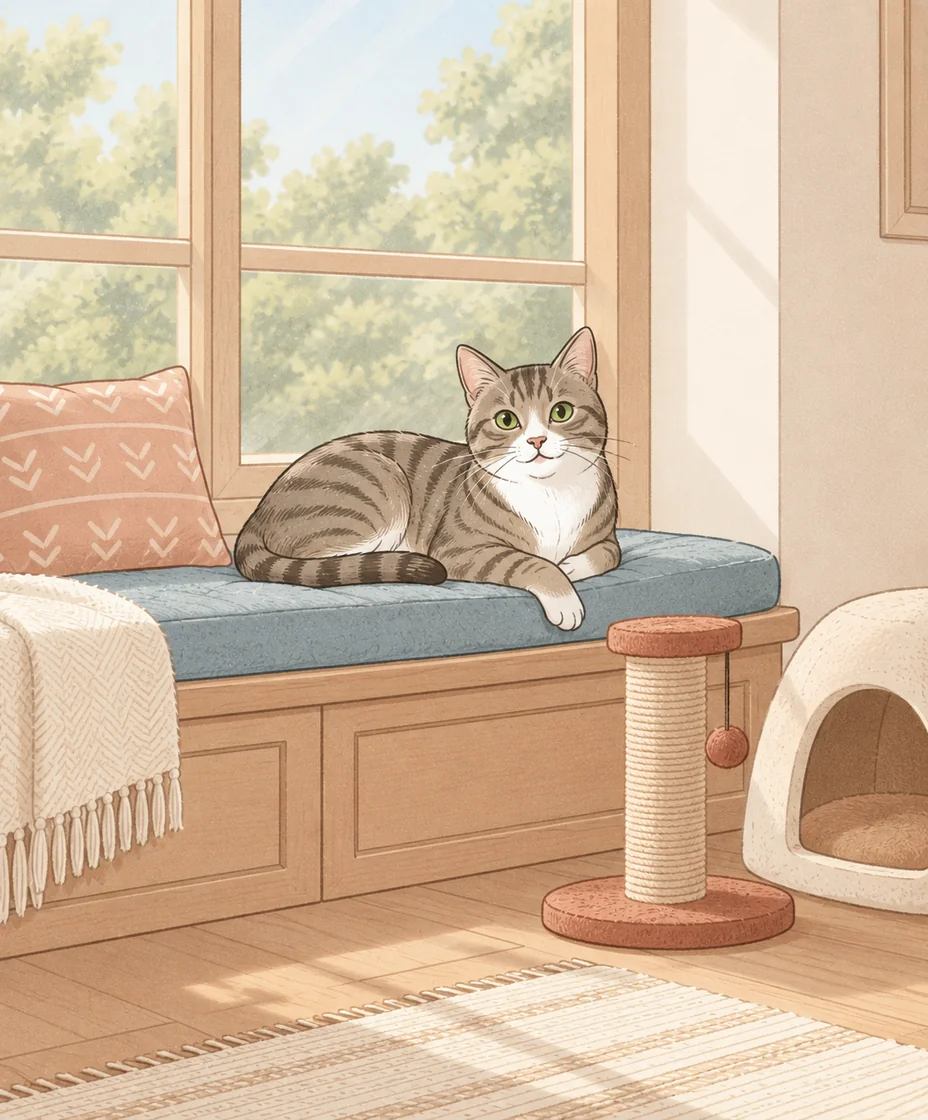
To bring an outdoor pet cat indoors, prepare places to toilet, hide, rest, scratch and play, then agree how everyone in the home will maintain the change. Preventing escapes matters, but the cat also needs a satisfying daily life inside. Watch how they eat, toilet, move and interact, and ask your veterinarian for help if they struggle. There is no reliable adjustment deadline for every cat.
Start with the people who open the doors
This guide is for a pet cat who already lives with people and has outdoor access. It is not a plan for catching or confining a cat who is frightened of people.
If one person keeps the cat inside and another lets them out, a training session cannot resolve the disagreement. Before changing the routine, explain the specific reason for the move indoors and agree who handles arrivals, visitors and times when the main caregiver is away. Ask each person what would make that arrangement practical.
Write an instruction people can follow: “Before bringing shopping in, check that the cat is in the prepared room and close its door.” Name a backup person. A reminder beside the entrance helps only if everyone has agreed to act on it. If the household cannot maintain safe access, resolve that practical gap with your veterinarian or a qualified behavior professional.
Make everyday needs easy to reach
Set up indoor toilets before relying on them. Offer clean, roomy trays in quiet, accessible places, away from food and water. A cat who usually toilets outdoors may need help finding a setup they will use; do not punish accidents. The RSPCA recommends a choice of toilet locations and veterinary advice for problems.
Provide hiding places where the cat can be left alone, comfortable resting spots and stable scratching surfaces. In a home with several cats, distribute resources so one cat cannot control access to everything. Check windows, screens and balconies for escape or fall hazards. Indoor living still requires preventive veterinary care.
Give each part of the old routine an indoor option
Think about the opportunities the cat used outside, rather than buying a pile of toys at once. Cats Protection emphasizes places to hide and climb, play, scratching and accessible resources. Offer choices and notice what your cat actually uses.
Use this planning table to divide the work. Fill in names and realistic times together; the examples are starting points, not a prescribed daily exercise quota.
| Old opportunity | Indoor option to try | Agree who will maintain it |
|---|---|---|
| Exploring and choosing a resting place | A stable perch plus a quiet hide, with an easy route between them. | Check access; keep the quiet space available. |
| Stalking and chasing | Invite a short game with a suitable toy, allowing catches and a voluntary finish. | Name the person and a convenient daily opportunity; store interactive toys safely afterward. |
| Searching for food | Offer a very easy supervised puzzle using part of the usual food allowance, alongside familiar feeding access. | Check whether food was retrieved; do not make meals depend on solving it. |
| Toileting outside | Accessible indoor trays the cat is comfortable using. | Assign checking and cleaning, including when the main caregiver is away. |
| Coming and going with people | An agreed safe room or secure separation during busy arrivals. | Name who checks the cat’s location before the outside door opens. |
Check the cat, not a countdown
In an owner survey by Henning and colleagues, people described both practical difficulties and varied adjustment experiences. The study relied on retrospective reports from 87 owners and a self-selected sample. It cannot predict how quickly your cat will settle or prove that a particular transition method works.
Keep a short daily note: food eaten, litter use, comfortable rest, voluntary play or contact, and any repeated attempts to escape. Add the circumstances: “Pacing began when the delivery arrived,” is more useful than “Bad all afternoon.” The note is a record for adjusting the household plan, not a welfare score.
Do not assume persistent distress is a phase to ignore. Contact your veterinarian promptly for reduced appetite, changed toileting, unusual hiding, reduced movement or other substantial changes. If the cat remains distressed despite adjustments, ask for an individual behavior plan. Do not punish vocalizing, spray the cat with water or remove meals to make training rewards more attractive.
Use training as one part of indoor life
Once the everyday setup works, brief voluntary practice can be another activity you share. Keep escape prevention in place even when a trained behavior looks reliable. A trick is not a substitute for secure doors, usable litter trays or comfortable places to retreat.
We make Pounce. Its Gather Your Tools and Door Dashing lessons cover training preparation and station practice. This article adds a household transition plan; Pounce does not diagnose distress or guarantee an indoor transition. Sources and curriculum checked October 12, 2026. Prepared with AI assistance; not individually reviewed by a veterinarian.
A little guidance goes a long way.
Follow illustrated lessons, take the next small step, and keep track of your cat’s little wins in Pounce.
Explore Pounce for iOSSources & how this guide was written
Complete Gather Your Tools and Door Dashing modules read in content/modules.json. Only preparation and station-practice facts used; excluded fixed timelines, guarantees, unprotected doorway testing, food deprivation and unsupported success rates. No dedicated indoor-transition app program claimed.
- Henning et al.: Owner-reported experiences of transitioning cats from outdoor to indoor living (2026)
- RSPCA: Looking after indoor and house cats
- Cats Protection: Indoor and outdoor cats
- FelineVMA: How Do I Know If My Cat Is In Pain?
Sources checked October 12, 2026. This article is educational and has not been individually reviewed by a veterinarian. Our editorial policy explains our approach.