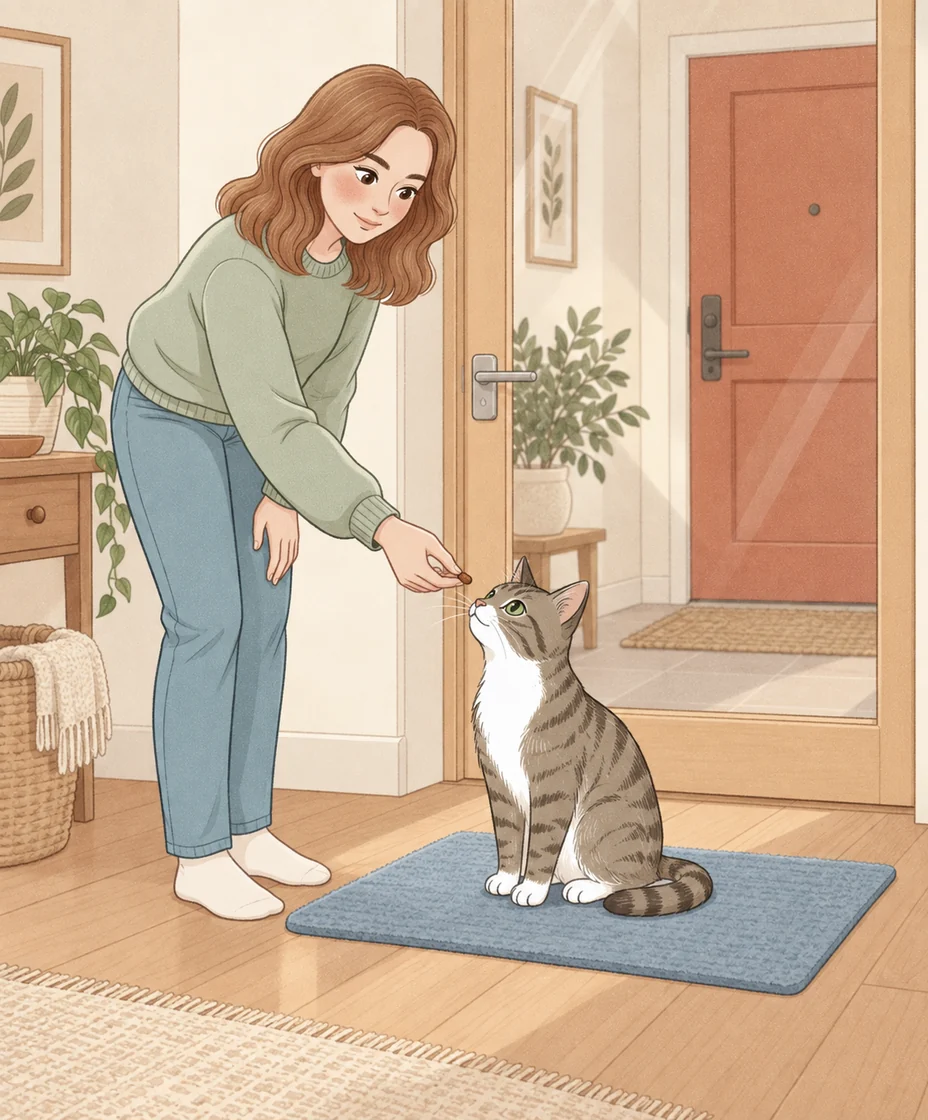
To reduce cat door dashing, arrange a secure second barrier before the outside door opens, then teach a rewarding place to wait away from the exit. Practice small movements toward a closed door before adding more difficulty. A treat, a recall cue or a successful practice does not replace physical escape prevention during real arrivals and departures.
First, check the route to the outside
Wisconsin Humane Society recommends blocking access to exits before working on the behavior. An interior door can separate the cat from the entrance. Where a barrier is needed, it must prevent that particular cat from climbing over or getting through. A low baby gate is not automatically a secure boundary.
For busy arrivals, the same guidance suggests a comfortable separate room with food, water, litter facilities, bedding and suitable activities. Prepare it before people start coming through. If your cat becomes distressed there, ask for help arranging another workable setup rather than making confinement the training exercise.
Walk through your own routine without the cat near the entrance. Which door closes first? Where do you put bags? Can someone else open the inner door while you are still outside? Resolve that last question with the household before relying on a two-door arrangement. Keep human emergency exits usable.
Make the greeting happen farther inside
Anti-Cruelty recommends a consistent greeting area away from the exit, where attention and other enjoyable interactions happen. Choose a comfortable mat or stable perch your cat can reach easily. Put it outside the path used by people and swinging doors.
Pounce’s Door Dashing curriculum begins by building interest in that station, before adding door movement. Reward voluntary visits with small portions suitable for your cat’s normal diet. Start at an ordinary quiet moment, when you are staying home and nobody is waiting outside.
If your cat has not learned to go to a place yet, use our mat guide for that foundation. There is no need to repeat the whole lesson beside the exit. The new skill here is remaining comfortable while a person moves toward a door.
Rehearse one movement with the outside door closed
- Invite your cat to the familiar waiting spot and reward there. Leave them room to move away within the secure indoor area.
- Take one small step toward the closed door, then return and reward at the spot if your cat remained comfortable. Begin with less movement if one step draws them after you.
- On later occasions, add a little distance. Keep the reward location the same. Do not also increase the length of the pause or add someone knocking.
- Once the approach is easy, briefly reach toward the handle without opening the door. Return to reward at the station. A reach, a touch and a handle sound can be separate practice steps.
- If your cat leaves the spot, pause. Let them move freely inside the secured area, and make the next invitation easier. Do not carry them back or repeatedly call the cue.
This exercise adapts the early station and handle stages in Pounce. Keep the exterior door shut and your second barrier in place. You are observing a small change in your movement, not testing whether your cat would escape.
Give each kind of arrival a practical plan
A quiet rehearsal leaves you free to watch your cat. Coming home with groceries does not. Use the table below to decide what must be arranged before each real opening. It is our household planning aid, not a certification that a particular barrier is escape-proof.
| Situation | Prepare first |
|---|---|
| Leaving with bags or a bicycle | Move bulky items into position first. Locate your cat and confirm the second barrier is closed before opening the exterior door. |
| Returning when nobody else is home | Have the secure separation arranged before you leave. Do not rely on squeezing through a gap faster than the cat. |
| A delivery or visitor | Ask them to wait for you to open. Secure the cat first; greet them farther inside after the outside door is closed. |
| Movers or repeated trips | Prepare the comfortable separate space beforehand. Tell everyone which door must stay closed and who will check it. |
Keep the barrier when practice gets easier
Later door movement should happen only with secure physical separation from the outside. Do not remove that protection for a trial opening. If the layout gives your cat a route through, over or around the barrier, resolve it before practicing an open door. Seek individual help if you cannot arrange this safely.
Record the exact movement that changed the response. For example: “Stayed on the mat while I stepped toward the door; followed when I picked up my bag.” Next time, try a smaller bag movement with the door closed. A successful handle rehearsal has not yet taught the whole departure.
A harness outing and ordinary household entry are also different situations. Keep the departure plan secure even if your cat wears a harness comfortably or comes when called indoors. Neither skill establishes that an unrestrained cat will stop at the threshold.
Notice distress as well as the dash
Do not shout, spray water or grab an agitated cat. FelineVMA’s behavior guidance warns against punishment and approaching or picking up a highly aroused cat. Biting needs veterinary assessment, including possible pain or illness. Repeated distress around departures or a sudden change in behavior deserves individual veterinary and behavior support, rather than a harder door exercise.
Anti-Cruelty also highlights identification and microchipping. Check that your cat’s identification details are current alongside your door plan. This is preparation in case an escape occurs, not a reason to relax the barrier routine.
We make Pounce, which includes Door Dashing and Go to Mat / Place lessons. This guide adds the arrival-planning table and closed-door observation example. Sources and curriculum were checked September 29, 2026. It was prepared with AI assistance and has not been individually reviewed by a veterinarian. No training timeline or guaranteed escape prevention is claimed.
A little guidance goes a long way.
Follow illustrated lessons, take the next small step, and keep track of your cat’s little wins in Pounce.
Explore Pounce for iOSSources & how this guide was written
Pounce curriculum: Door Dashing and Go to Mat / Place. The station and gradual door-movement sequence is adapted with a separate entry/departure planning table. No fixed results, 95% success claim, barrier-removal test, large food handfuls, diagnosis or assumption that an ordinary baby gate contains a cat is reproduced. Sources checked September 29, 2026.
- Wisconsin Humane Society: Door Dashing (updated March 23, 2026)
- Anti-Cruelty: Preventing Door Dashing
- FelineVMA: Training Techniques for Addressing Undesirable Behaviors
Sources checked September 29, 2026. This article is educational and has not been individually reviewed by a veterinarian. Our editorial policy explains our approach.