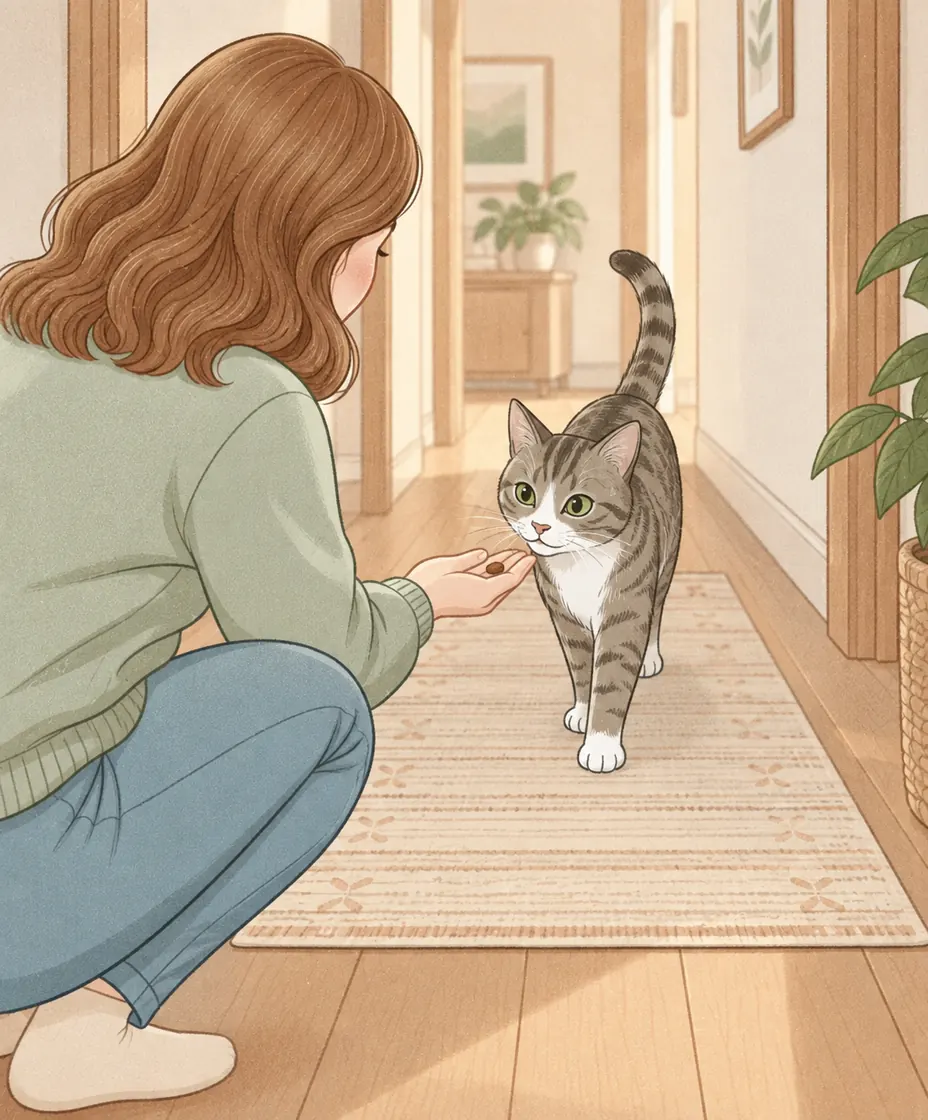
Start indoor cat recall at a very short distance in a quiet room. Say your chosen cue once, reward your cat for coming toward you, and gradually increase the gap as the response becomes familiar. Practice when your cat is awake and willing. Indoor recall does not make outdoor roaming safe.
Hearing a name and coming over are different skills
Cats Protection’s name-response guidance begins with a calm setting and rewarding attention. In Pounce, Name Response similarly comes before Come When Called. First your cat learns that a sound is worth noticing; then you practice moving toward you after that sound.
If saying your cat’s name produces a head turn but no steps, you have a useful starting point. You have not yet taught the whole journey. Choose a consistent arrival cue, such as “come,” and decide what you will count as success at the current distance. Keep family members’ wording consistent.
Practice when there is little competition
Begin indoors with exterior doors and windows secured, no other pet competing for the reward, and a cat who is already comfortable near you. Do not wake them for a drill or start while they are eating, hiding, or intensely watching something outside.
Have a small reward ready before you call. You should be able to deliver it as your cat reaches you, instead of searching a pocket while they wonder what happened. A relaxed practice can be only a few invitations long. Use rewards suitable for your cat’s normal diet and do not withhold meals to get a response.
Begin with a journey your cat can understand
- Stand or sit a short step away while your cat is looking in your direction. Use your chosen cue once in a familiar, gentle voice.
- As your cat comes toward you, mark the arrival with the familiar click or word and deliver the reward at your position.
- Let your cat move freely again. Set up another easy attempt only if they remain interested.
- After easy arrivals are familiar, add a little distance in the same room. Return to the shorter gap if the response becomes hesitant.
Pounce’s recall path starts with a small indoor gap and later introduces more distance. These are separate practice stages, not a checklist to complete in one sitting.
A missed cue is information about the setup
Suppose your cat comes from beside the chair but remains on the rug when you call from the doorway. Record the difference. Perhaps the doorway is much farther away, or the room beyond it is noisy. Next time use a smaller gap near the chair. Avoid repeating “come” louder and louder from the doorway.
After a missed attempt, pause. You can move closer and invite an easier interaction later, without pursuing or carrying your cat to the finish. A sudden change in responsiveness, movement, appetite, or usual behavior deserves veterinary attention rather than a tougher recall session.
Do not make every arrival end the fun
Make plenty of practice arrivals lead to a reward and freedom to carry on. If the cue always predicts the end of play or an unwanted handling session, your practice has a competing consequence. Train carrier and care routines separately and give your cat a clear experience of those steps.
Only introduce an adjacent room or mild distraction after the current version is comfortable. A response in the living room tells you about that setting. It does not establish reliability near traffic, wildlife, an open door, or a frightening noise outdoors. Keep physical safety measures in place regardless of training progress.
A little guidance goes a long way.
Follow illustrated lessons, take the next small step, and keep track of your cat’s little wins in Pounce.
Explore Pounce for iOSSources & how this guide was written
Pounce curriculum: Name Response and Come When Called. The chair-to-doorway example illustrates how to record and reduce a distance challenge; it is not a measured training result.
Sources checked September 12, 2026. This article is educational and has not been individually reviewed by a veterinarian. Our editorial policy explains our approach.