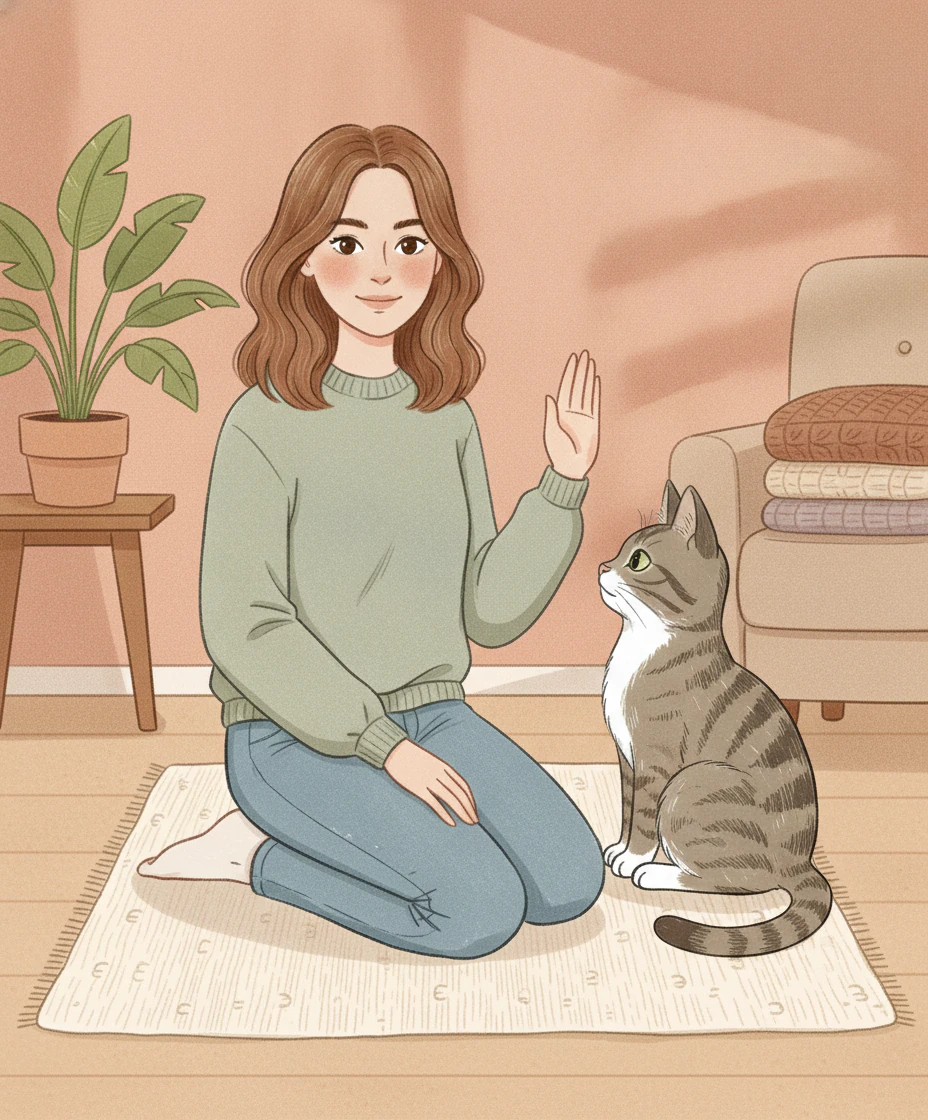
Ask your cat to sit, show a flat palm and say “stay” once, then wait just one second before you click and bring the treat to their mouth. End every rep with a release word such as “free”. Add one thing at a time: seconds first, then half-steps back, then distractions. Expect four to six weeks to a 10-second stay while you walk five steps away.
What you need before you start
A cat who already sits on cue. Stay means holding a position, so your cat needs a position to hold first: Pounce’s Stay / Wait lesson lists Sit on Cue and Meet the Clicker as required before it. A lie-down or a favourite mat works as the starting position too, and Vetstreet’s Mikkel Becker suggests the same three options.
A clicker or a short spoken marker like “yes”. The click lands the instant your cat is still holding, which tells them that staying put is the thing that pays.
Mild treats, not the most exciting ones. This is the one trick where a jackpot works against you: a cat who is wild about the reward stands up to chase it. Pick something tasty but ordinary, quick to eat with little chewing, as Cats Protection advises for clicker work, and set aside a small portion so the session ends when it runs out. Players are best trained with food for this one, since a wand toy breaks the stay.
A quiet room and a few minutes. Pounce’s stay sessions run two to four minutes. Pick a moment when your cat is relaxed but awake, not straight after a burst of play.
Source: Cats Protection: Tips for clicker training a cat (August 11, 2025)
How to teach your cat to stay: 5 steps
- Hold for one second (2 minutes). Ask for a sit. Hold up a flat palm, like a small stop sign, and say “stay” once, calmly. Wait one second, no more, with your feet still. If your cat is still sitting, click and bring the treat to their mouth so they can eat without getting up, then release them with a word like “okay”. Success: front paws stay planted until the click, four tries out of five.
- Build to five seconds (3 minutes). Time only today: your feet don’t move. Give the palm and “stay”, wait three seconds, and work up to five. Click while your cat is still holding, a beat before any break. Weight shifting, an ear twitch or a glance away means a break is coming, so click sooner. Success: a calm five-second sit while you stand still.
- Rest a day. No session. Self-control is tiring, and the lesson builds in a day off here.
- Take one half-step back (3 minutes). Now distance, so drop the time back to one second. Say “stay”, take a single half-step back, click straight away and step in to deliver the treat. Moving feet are the top reason cats break, because to a cat it looks like the fun is starting. If your cat rises as you shift your weight, make it a quarter-step and click faster. Success: your cat holds while you step back and return.
- Add the release word (4 minutes). Pick a release word, such as “free” or “break”, and say it at the end of every single stay from now on. Mix a little distance with a little time: two steps back, two seconds, click, walk back, treat, release. Build to about three steps away. Small numbers held calmly beat big ones that break. Success: your cat stays put until you say the release word.
One step per session, in the order and timings of Pounce’s Stay / Wait lesson. Move on when the current step works four times out of five.
How long does it take to teach a cat to stay?
Expect four to six weeks to a finished stay. Most cats manage a one-second hold in the first session, but stay grows in tiny pieces because cats are built to sprint, not to wait. Pounce’s Stay / Wait lesson allows four to six weeks and counts the trick as mastered at a 10-second stay while you walk five steps away, turn your back and come back, holding until your release word, in a few different rooms.
Keep each session to a few minutes and end on a stay your cat held. Cats Protection notes that clicker-trained behaviours can take anywhere from a few days to a few months to learn, so a slow week is normal, not a sign your cat can’t do it.
Source: Cats Protection: Tips for clicker training a cat (August 11, 2025)
Why does my cat keep breaking the stay?
Almost every broken stay comes from one of these. Match what you see to the fix.
**You changed two things at once.** The most common mistake is adding time, distance and distraction together. Change one at a time: whenever you add distance, drop the hold back to one second.
**They run to you when you click.** You are clicking from across the room. Click, then walk back and deliver the treat where your cat is sitting.
**They get up to chase the treat.** The treat is too exciting, or you are holding it out for them to come and get. Use a milder treat and bring it all the way to their mouth.
**They get up just before you click.** You waited for the break. Watch for the early signs, a tail thump, a weight shift or a look away, and click before them. Next time, ask for a shorter hold.
**It worked last week and fell apart.** You pushed too fast. Go back to a one-second stay right beside them for a session or two, then build again.
**They stand up and walk off.** Calmly ask for the sit again and make the next stay easier. The FelineVMA (formerly the AAFP) notes that punishment increases fear and makes new learning harder, so a broken stay simply earns no click.
How can I use stay at the door and at mealtimes?
**Waiting for food.** Once your cat holds five seconds, use stay while you put the bowl down. Ask for a sit and “stay”, lower the bowl part of the way, and if your cat stands, calmly lift it back up and start again. When the bowl reaches the floor with your cat still sitting, say the release word and let them eat. Every meal becomes a short stay session.
**At the door.** A stay in a spot away from the door keeps your cat parked while you carry shopping in. Treat it as an extra layer, not a lock: keep an inner door or barrier closed whenever the outside door opens.
**On a mat.** A stay on a mat gives your cat a place to wait during visitors, grooming or vet visits, and the mat can travel with you.
Can kittens and older cats learn to stay?
Yes. Kittens can learn a short stay, but their self-control is brief, so keep sessions to a minute or two and holds to a few seconds. A kitten who sits for three seconds while you lower a bowl is doing well.
Older cats are often natural at staying put. If holding a sit looks uncomfortable, let your cat stay in a lie-down or curled on a mat instead. The skill is the hold, not the position.
When to call your vet
Stop training stays and talk to your vet if your cat seems stiff getting into or out of a sit, keeps shifting position, or won’t hold any position for more than a moment. International Cat Care lists stiffness after rest, resting in stiff positions instead of a relaxed curl, reluctance to jump and irritability when handled among the signs of arthritis, which is very common in older cats and often missed. A short video of your cat at home helps, since signs often don’t show in the clinic.
If your cat yowls, scratches frantically at a door or barrier, or pants the moment you step away, Pounce’s Stay / Wait lesson flags that as possible separation distress rather than a training problem. Cats Protection says true separation anxiety is uncommon in cats, recommends a vet check first for any sudden change in behaviour, and suggests a qualified behaviourist if intense distress lasts 15 minutes or more after you leave.
Source: International Cat Care: Arthritis in cats (updated September 26, 2025)
Practising stay with Pounce
Pounce’s Stay / Wait lesson runs these five steps as short illustrated sessions, from one calm second to a stay with a release word, each with one goal and a note on what to watch for. Sit on Cue and Meet the Clicker come first, and Go to Mat / Place is a good next skill, because a stay on a portable mat goes with your cat to the carrier and the vet.
A little guidance goes a long way.
Follow illustrated lessons, take the next small step, and keep track of your cat’s little wins in Pounce.
Explore Pounce for iOSSources & how this guide was written
Pounce curriculum: the Stay / Wait lesson for the steps, timings, mastery goal, troubleshooting and separation-distress flag, with Sit on Cue and Meet the Clicker before it and Go to Mat / Place after it.
- Vetstreet, Mikkel Becker: Teach your cat to “stay” on command — really! (February 2, 2016)
- Cats Protection: Tips for clicker training a cat (August 11, 2025)
- Feline Veterinary Medical Association (formerly AAFP): Training techniques for addressing undesirable behaviors
- International Cat Care: Arthritis in cats (updated September 26, 2025)
- Cats Protection: Can cats get separation anxiety? (September 5, 2026)
Sources checked November 1, 2026. This article is educational and has not been individually reviewed by a veterinarian. Our editorial policy explains our approach.