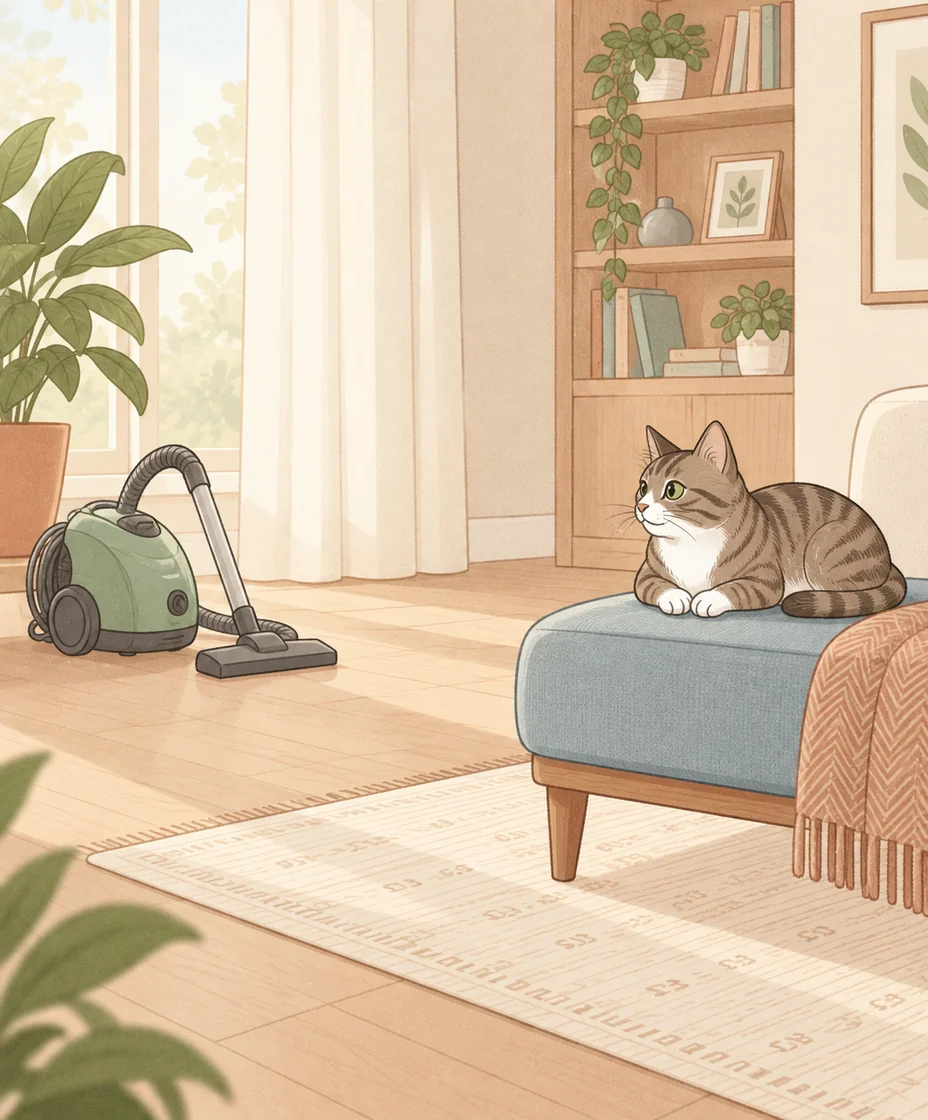
If your cat is scared of the vacuum, arrange a quiet retreat before cleaning and keep the machine away from their route to it. Later practice can begin with the vacuum switched off and well away from the cat. Sound and movement are separate challenges. Your cat does not need to sit beside a running vacuum for the household routine to work.
Decide where your cat can be before you start
Cats Protection recommends giving cats hiding places and a clear way to leave, avoiding a sudden start beside a sleeping cat, and storing the machine away from food and litter facilities. Do not carry your cat over to inspect it or use its noise to chase them out of another place.
Make a simple room plan before cleaning. Choose an area your cat already uses comfortably, with the resources they need. Pounce’s The Fearful Cat lessons begin with a quiet home base and room to retreat. If a closed door causes distress, that arrangement needs changing; shutting a frightened cat away is not a solution by itself.
| Before this task | Decide |
|---|---|
| Bringing out the machine | Where is the cat now, and can they reach the quiet area without passing you and the equipment? |
| Cleaning another room | Will the hose, your movement or an opening door cut across that route? Change the order of rooms if needed. |
| Cleaning the usual retreat | Can this room wait until the cat has comfortably settled elsewhere? Do not follow them from hiding place to hiding place. |
| Putting everything away | Will the stored vacuum or an exposed cord obstruct a route to food, water or a litter tray? |
A parked vacuum and a running vacuum are different tasks
VCA’s guidance on reducing fear separates a trigger into parts: an inactive object, its sound at a distance, and movement. It describes pairing a sufficiently mild exposure with something the animal enjoys, rather than making them remain beside a frightening stimulus.
Start only at a level your cat can manage comfortably, with health concerns addressed. For an inactive vacuum, that might mean seeing it briefly across a room while you offer a small, suitable reward where the cat already is. Approaching or touching it is optional. Put it away before adding more; do not turn it on because the cat has come over to sniff.
If even that distant view prompts retreat, hissing or tension, stop. A closer treat does not make the task easier. Ask your veterinary or behavior team to help choose a manageable starting point.
Do not make the next step a surprise
Sound practice belongs in a separate, planned session. Use enough distance and control to keep it mild, with someone able to stop the sound immediately while the cat’s response is observed. If your home cannot provide that setup, keep using the cleaning arrangement and seek help. Do not improvise by switching the machine on next to the cat.
Write down the exact event that changed the response, without recreating it: ‘Rested while machine was parked; left when I lifted the handle.’ The next conversation is then about the handle movement, not how many minutes of vacuum noise to endure. Looking toward the machine, staying still or taking food alone does not establish readiness for more.
You may decide that a comfortable retreat during cleaning is enough. There is no required final performance and no deadline for adding sound, movement or proximity.
Bring persistent fear to the veterinary team
VCA recommends physical and behavioral assessment for fearful cats, particularly when fear begins suddenly. Tell your team if your cat remains unsettled after cleaning, avoids ordinary rooms or resources, or shows other changes. Stop the experiment and contact them promptly if eating, drinking or toileting changes. Do not wait for a training schedule to finish.
Keep your observations simple: where the machine was, what it did, where the cat went and whether ordinary activity resumed. An unknown cause can stay unknown until assessed. Avoid punishing a hiss or holding the cat still for exposure.
We make Pounce, which includes The Fearful Cat and preparation lessons. This guide adds the room-by-room cleaning plan; it does not claim the app contains a dedicated vacuum program or treats a phobia. Sources and curriculum checked October 9, 2026. Prepared with AI assistance; not individually reviewed by a veterinarian.
A little guidance goes a long way.
Follow illustrated lessons, take the next small step, and keep track of your cat’s little wins in Pounce.
Explore Pounce for iOSSources & how this guide was written
Pounce curriculum: complete The Fearful Cat and Gather Your Tools modules checked. Quiet home-base preparation and choice inform the original room-by-room cleaning plan. No dedicated vacuum program, treatment outcome, fixed exposure duration, food restriction or forced proximity claimed. External guidance checked October 9, 2026.
- Cats Protection: Why are cats scared of vacuum cleaners? (June 10, 2021)
- VCA: Reducing Fear and Stress with Desensitization and Counterconditioning (updated October 18, 2023)
- VCA: Cat Behavior Problems — Fears and Phobias (updated January 25, 2023)
Sources checked October 9, 2026. This article is educational and has not been individually reviewed by a veterinarian. Our editorial policy explains our approach.