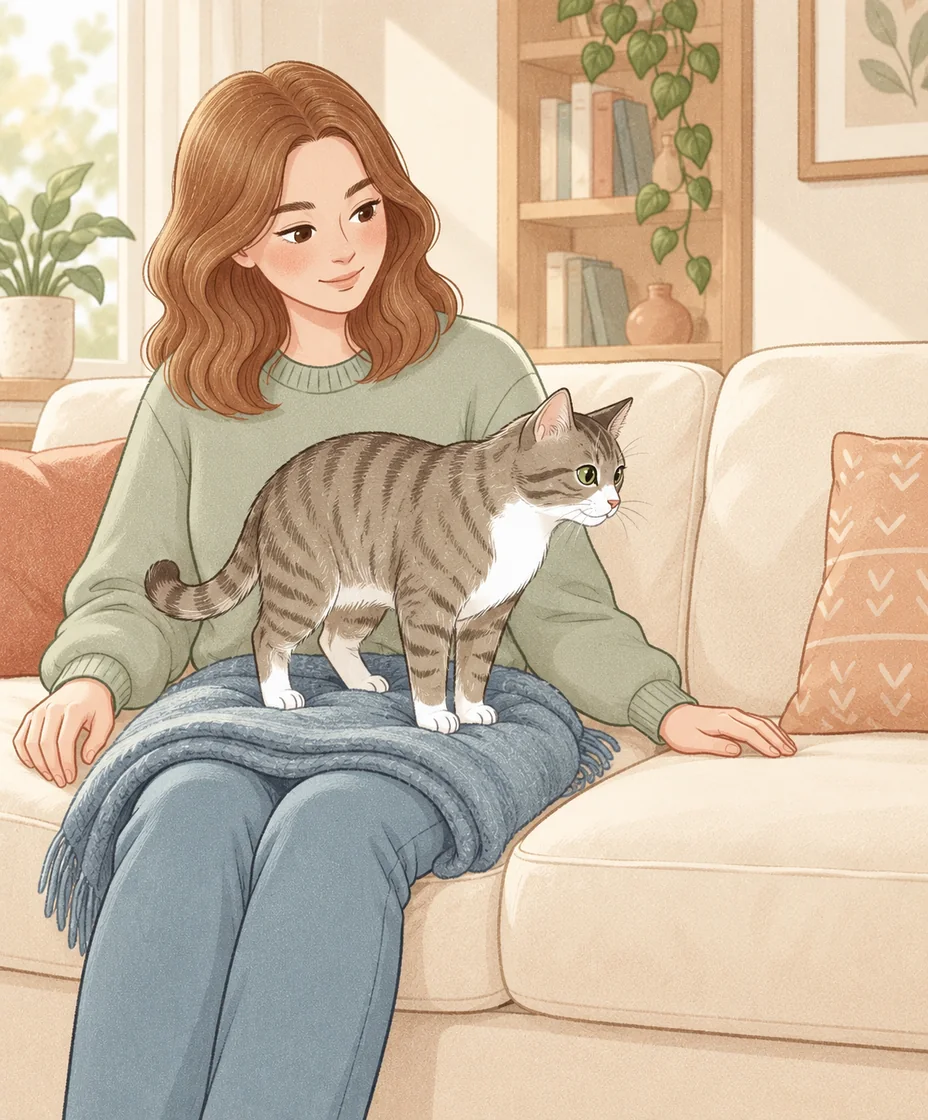
You can make your lap easier to approach, but you cannot guarantee that your cat will enjoy resting there. Offer a comfortable surface and an easy route away, then let them choose where to settle. A cat standing on your lap for a treat has shown interest in the food; that alone does not tell you they want a cuddle or a longer stay.
Being beside you counts
A cat who greets you, leans against you or rests on the next cushion may already be choosing company. Lap time is one possible interaction, not a relationship score.
Cats Protection describes wide individual differences in how much touch cats welcome. Its advice is to let the cat initiate and keep contact within their preferences. Use that as the starting point: make a pleasant invitation, with no requirement to accept it.
This guide is for an awake cat who already approaches you comfortably. If your cat is newly adopted and hiding, start with their settling-in needs. If a cat who used to climb or sit comfortably suddenly avoids it, or touch and movement seem painful, contact your veterinary team before trying to train through the change.
Source: Cats Protection: How to pet a cat (February 15, 2024)
Offer two comfortable places, side by side
Choose a quiet moment on a sofa your cat already uses. Sit with your legs supported and put a familiar, flat blanket across your lap if that makes the surface more comfortable. Leave the neighboring cushion open. Cats Protection lists soft surfaces and familiar scent among the things that can make a resting place appealing; a blanket is an option to try, not a special training product.
Our two-place setup gives you a useful comparison. Your cat can investigate the lap and still rest right beside you. Keep your hands out of their route and let them arrive on their own. Avoid lifting them into position, pushing their hindquarters down or blocking the way off.
If the blanket slips or your posture makes the landing awkward, change the setup while the cat is elsewhere. There is no reason to keep repeating an uncomfortable approach. Do not make the room cold or add a heater to persuade your cat to use your lap.
Source: Cats Protection: Why do cats like sitting on things? (March 7, 2024)
Separate following food from settling
If a lickable treat brings your cat onto your lap but they remain standing and reaching for it, record exactly that. You have not failed to teach a sit. You have also not established that the lap is a preferred resting place.
Give any reward you have offered without making your cat hold a harder position to get it. On another ordinary occasion, offer the same comfortable seating arrangement without displaying food and notice what they choose. Keep normal meals, company and other resting places available.
You do not need to add a sit cue, a longer hold or petting to this invitation. Those would change several things at once. Pounce’s Start Button Behavior curriculum separates participation from continuing contact and pauses when the cat withdraws. The useful principle here is respecting that pause, rather than treating eating or stillness as permission to handle.
If you want to practice a sit as a separate trick, do it on a stable surface with room to move. A learned sit does not establish that your cat wants to nap on a person.
Use the choice to plan less, not more
These examples help separate location, posture and touch. They are our observation aid, not a test that diagnoses how your cat feels.
| What you observed | A useful next decision |
|---|---|
| Stood on the blanket while following a treat, then left. | Record a food-following visit. Leave the next invitation optional; do not demand a sit before allowing departure. |
| Walked across your lap and rested on the next cushion. | Keep that cushion available. The nearby resting place already works. |
| Settled on your lap, then moved when your hand reached over. | Let them leave. Keep the next visit hands-off rather than trying more stroking. |
| Approached, but the blanket shifted under a paw. | Fix the surface before another occasion; do not steady the cat by holding them there. |
| Previously comfortable climbing or sitting now looks difficult. | Seek veterinary advice. Do not use repeated invitations to test possible pain. |
A lap visit does not have to become petting
Let a comfortable visit stay quiet. If your cat asks for familiar touch, keep it brief and pause. If they settle to sleep, leave them to rest. Stop contact for tension or withdrawal, and let the cat move off freely.
Cat Friendly Homes recommends inviting cats into your space and avoiding pursuit or unnecessary handling. If your cat becomes upset, do not reach in for a cuddle to persuade them to stay. Repeated fear, swatting or biting calls for individual veterinary and behavior support.
A useful note could be: “Blanket stayed flat; walked onto lap without food; chose the cushion when I moved my hand.” Next time, keep your hand still. The note helps you change your own setup without turning every visit into a longer exercise.
We make Pounce. Its Start Button Behavior and Go to Mat / Place lessons offer structured practice for separate everyday skills; they do not promise to turn a cat into a lap cat. This guide adds the two-place setup and observation aid. Sources and curriculum were checked October 20, 2026. It was prepared with AI assistance and has not been individually reviewed by a veterinarian.
A little guidance goes a long way.
Follow illustrated lessons, take the next small step, and keep track of your cat’s little wins in Pounce.
Explore Pounce for iOSSources & how this guide was written
Pounce curriculum: Start Button Behavior and Go to Mat / Place. The sofa comparison and observation aid are original editorial adaptations. No lap-training module, fixed timeline, forced posture, diagnostic interpretation or promised temperament change is claimed.
- Cats Protection: How to pet a cat (February 15, 2024)
- Cats Protection: Why do cats like sitting on things? (March 7, 2024)
- Cat Friendly Homes: How to pet and handle cats
Sources checked October 20, 2026. This article is educational and has not been individually reviewed by a veterinarian. Our editorial policy explains our approach.