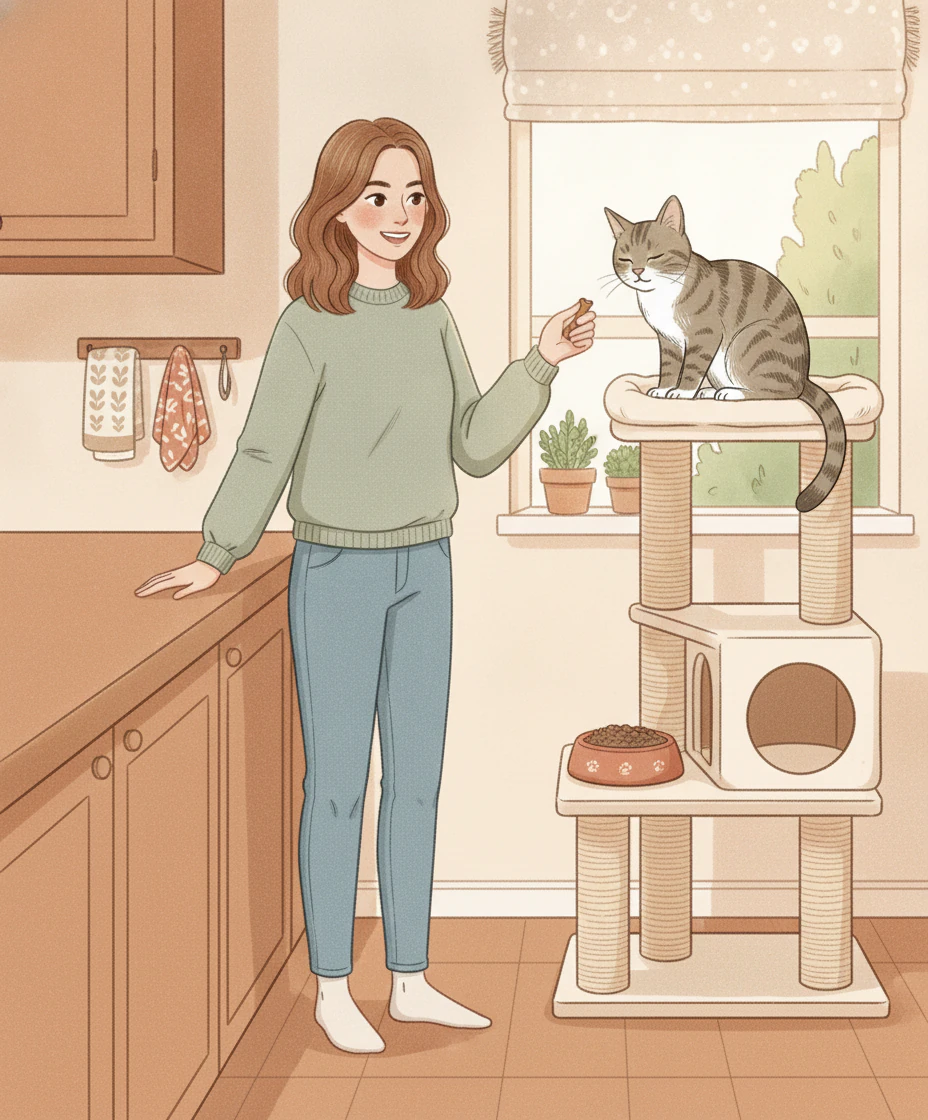
In a thick hoodie, let your cat onto a steady counter at shoulder height and stand with your shoulder level with its edge. Set a treat on your shoulder and click as the paws step across. Over about six five-minute sessions, add a cue like “Shoulder!” with two taps, then open a one-inch gap and stand taller, one change per day.
What you need before you start
**A thick top.** A hoodie or heavy sweater over both shoulders and the back of your neck, so claws grip cloth, not skin. Keep your cat’s claws trimmed as usual: International Cat Care recommends trimming when they need it, and blunt tips are kinder to your neck while the fabric gives the grip.
**A steady perch about shoulder height.** A counter, dresser, sturdy table or cat-tree top, with nothing that wobbles or slides, and a rug or soft mat on the floor below it for every early session.
**Treats reserved for this trick.** Pounce’s Jump to Shoulder lesson uses pea-sized, soft, extra-tasty treats and sets every piece on your shoulder, never in your hand, so the shoulder itself is where the good stuff happens. Cats Protection suggests treats your cat finds irresistible that are quick to eat and need little chewing, and setting aside a small portion so treats don’t add up to weight gain.
**A clicker your cat already knows**, or a short spoken marker like “yes”. A cat who can already touch a target and step onto your forearm is ready: the lesson lists Jump Into My Arms, where your cat learns that your braced arm holds their weight, as the one to do first.
**A healthy adult cat.** This trick is for cats with sound joints. Pounce’s lesson advises skipping it for kittens still growing, senior cats, overweight cats and any cat with arthritis or an old leg or back injury, and asking your vet first if you’re not sure.
Source: Cats Protection: Tips for clicker training a cat (August 11, 2025)
How to train your cat to jump on your shoulder: 6 steps
- One paw, then two (5 minutes). Let your cat up onto the perch, then stand with your back or side to it and bend your knees until your shoulder sits right at the edge, level with the surface. Hold still. Set a treat on your shoulder; the instant the first paw touches you, click and let your cat eat it there. Then wait for both front paws, click, and feed while they stay on you. Aim for 5 to 8 tries. Success: both front paws press onto your shoulder without hesitating.
- All four paws across (5 minutes). Same stance. Set the treat a little further along your shoulder, toward your neck, so reaching it means bringing the back paws too. Click when all four paws are on you and feed up there. Then freeze: no turning or straightening up. To finish, lean back to the counter and let your cat step off onto it. Aim for 3 to 5 relaxed tries. Success: a soft step across and a calm perch while you stay still.
- Rest a day. No session. A day off is built into the lesson so the new step can sink in. If your cat climbs onto you uninvited, a cuddle is fine, but no treat.
- Add the cue (5 minutes). Pick a fresh word such as “Shoulder!” plus two taps on the shoulder you want. Say the word, tap twice, then offer your shoulder at the edge: cue first, position second, so the word means something. Now and then, stand at the counter without cueing. If your cat climbs on anyway, turn your shoulder away quietly, with no click and no treat. About 5 tries in all. Success: your cat waits for the word and the taps.
- The first real jump (7 minutes). Same height, but stand with your shoulder about an inch from the edge. Cue, hold still, click the landing and feed on your shoulder. Every few clean hops, move another inch away, up to about a hand’s width. When that feels easy, go back to the edge and stand one notch taller. Gap and height never grow on the same day. Aim for 3 to 5 tries at each notch. Success: a crouch, a small wiggle and a confident hop, with a quiet landing.
- Put it together (7 minutes). Run the whole trick in a quiet room with the same perch, gap and rug: cue, jump, click, treat on your shoulder, calm step-off. Finish with a jackpot of 3 or 4 treats set one by one on your shoulder. Success: your cat jumps on the cue, perches calmly and steps back onto the counter. From here, a few cued jumps a week keeps it going.
One step per session, in this order. The steps, times and repetitions come from Pounce’s Jump to Shoulder lesson. Move on when the current step looks easy and relaxed, and end each session while your cat still wants more.
How long does it take to train a shoulder cat?
Plan on one to two weeks after your cat has learned to jump into your arms, with five- to seven-minute sessions. Pounce’s lesson builds the trick over six sessions, including the rest day, and slower is fine: the gap and the height are the parts to take slowly.
Cats Protection’s clicker training advice puts the general range for learning a behaviour at anywhere from a few days to a few months. A cat who already likes riding on shoulders may race through the first steps. A cautious cat may need a week on the step-across before the first jump, and that is time well spent: one bad landing can undo a week of trust.
Source: Cats Protection: Tips for clicker training a cat (August 11, 2025)
What if my cat won’t jump on my shoulder?
Match what you see to the fix.
**They stare at your shoulder and hesitate.** Your shoulder is too far or too high. Drop it a touch below the surface and go back to paying one paw.
**The front paws come on but the back ones stay.** Go back to two paws for a session, click and feed, then move the treat a little closer to your neck so the back paws follow.
**They scrabble or slip on landing.** Your shoulder isn’t level or the gap grew too fast. Stop the session, and next time start an inch closer.
**They hop on and straight off again.** The treat is landing in your hand or after they leave. Set every treat on your shoulder and feed while they are up there.
**They launch at you without the cue.** Uncued jumps quietly earn nothing: turn your shoulder away with no click and no fuss, and run a few more cued tries with no-cue pauses in between.
**It falls apart in a new room or on camera.** Close the gap to a plain step across, pay it well and end there. A new place counts as a harder version of the trick.
How do I get my cat off my shoulder safely?
Lean back to the counter and let your cat step off onto it. Claws grip for balance when a cat feels the ground move, so stand like a statue the whole time your cat is up, and save walking around with a shoulder cat for after the trick is solid.
Lifting or pulling a cat off your shoulder brings the claws with them. Cats Protection makes the same point about holding cats: letting a cat jump down from your arms risks a scratch, and most cats are only comfortable being held for a minute or two. The Feline Veterinary Medical Association advises never picking up a highly aroused cat, so if your cat is wound up, end the session from the counter rather than by lifting them off.
Agree on the cue with everyone at home. A cat who jumps only on “Shoulder!” won’t surprise a guest, and the cue is for adults who are steady on their feet, never children.
Source: Cats Protection: How do you pick a cat up? (February 22, 2024)
Can kittens and older cats learn it?
Wait on both. Pounce’s lesson is written for healthy adult cats and leaves out kittens who are still growing, seniors and overweight cats: repeated jumps and landings are a job for sound joints. Kittens can start on name response, target touch and sit in the meantime, and come back to the shoulder once they are fully grown.
For an older cat, choose a trick that keeps all four feet on the floor. Spin, high five and stay ask for no jumping at all, and they give an older cat the same short, rewarding sessions.
When to call your vet
Stop the jumping and book a check if your cat lands stiffly, limps after a session or stops jumping onto furniture they used to love. Pounce’s lesson flags each of these as a reason for a vet visit before any more jumps.
International Cat Care lists reluctance or hesitance to jump up or down, jumping less often, stiffness after resting and grumpiness when handled among the signs of arthritis, and names the shoulders among the joints it most often affects. Cats hide pain well, so ICC suggests filming your cat jumping or using stairs to show your vet. Never give a cat human painkillers.
Source: International Cat Care: Arthritis in cats (updated September 26, 2025)
Practising the shoulder jump with Pounce
Pounce’s Jump to Shoulder lesson runs these steps as short illustrated sessions, from a step across off the counter to a real jump on cue, each with one goal and a note on what to watch for. Jump Into My Arms comes first, and Meet the Clicker and Target Touch are where every Pounce trick starts.
Once your cat waits for “Shoulder!” and steps calmly back onto the counter, the trick is done. Keep it fresh with a few cued jumps a week, each one paid on your shoulder.
A little guidance goes a long way.
Follow illustrated lessons, take the next small step, and keep track of your cat’s little wins in Pounce.
Explore Pounce for iOSSources & how this guide was written
Pounce curriculum: the Jump to Shoulder lesson for the gear, steps, repetitions, cue, troubleshooting and vet flags, with Jump Into My Arms, Meet the Clicker and Target Touch before it.
- Cats Protection: Tips for clicker training a cat (August 11, 2025)
- Cats Protection: How do you pick a cat up? (February 22, 2024)
- Feline Veterinary Medical Association: Training techniques for addressing undesirable behaviors
- International Cat Care: Arthritis in cats (updated September 26, 2025)
Sources checked November 2, 2026. This article is educational and has not been individually reviewed by a veterinarian. Our editorial policy explains our approach.