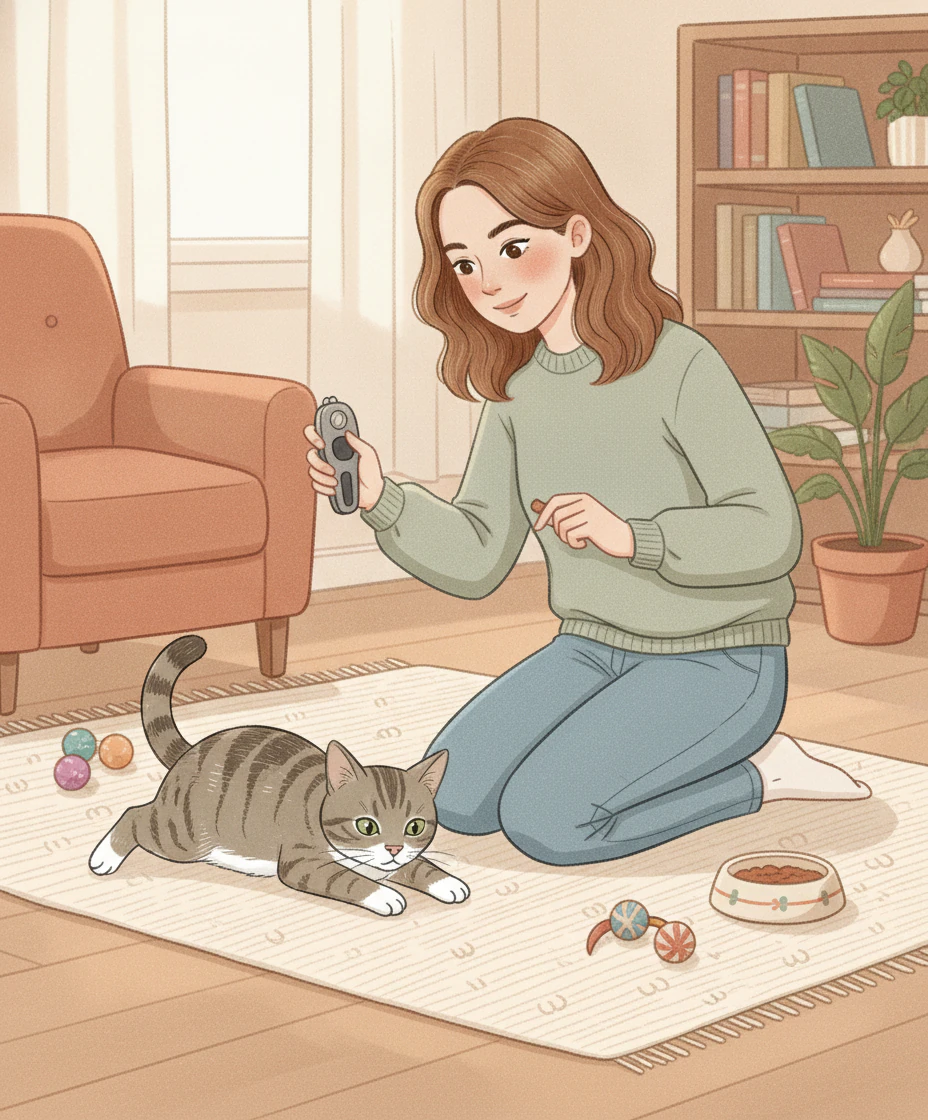
Start from a relaxed lie-down on a rug. Hold a soft treat at your cat’s nose and draw it slowly past their cheek toward the shoulder blade, then over the spine to the floor on the far side. Click as their legs flip past straight up, and jackpot. Then say “roll” before the lure and fade to an empty-hand circle. Allow one to four weeks of five-minute sessions.
What you need before you start
Four things: a clicker or a short spoken marker like “yes”, your cat’s very best treats, a soft surface, and a cat who already lies down when you ask. A lickable paste or tuna flakes work especially well, because the lure moves slowly and your cat can lick as they follow it. Cats Protection recommends treats that are quick to eat and need little chewing, and setting aside a small portion for the session so you stop when it runs out.
The surface matters more than people expect. Rolling across a hard floor is uncomfortable, so use carpet, a rug or a folded blanket from the first session.
The lie-down is the real prerequisite: roll over is a down that keeps going. If your cat doesn’t have one yet, teach that first. If they already play dead, you are halfway there, because the first half of a roll is the same flop onto the side.
Source: Cats Protection: Tips for clicker training a cat (August 11, 2025)
How to teach your cat to roll over: 6 steps
- Find the easy side. Ask for a lie-down on the rug and watch their hips. A square sphinx pose is braced; a lazy flop onto one hip is halfway to a roll. Hold a treat touching their nose and draw it slowly along their cheek toward the shoulder blade. Click the instant their weight tips onto a hip, then bring the treat back to their mouth. Do five to eight tries, both directions. Success: a hip tip with no standing up, and you know which side comes easier.
- Get the half roll. Warm up with two or three hip tips on the easy side, then trace a longer path: past the shoulder blade and up toward the spine. To keep following, their shoulder tips and they flop onto their side. Click the moment the shoulder commits, and feed them low, still on their side. Do four to six tries and jackpot the first clean flop. Success: they stay down to eat instead of popping up.
- Finish the circle. After two warm-up flops, carry the treat over the spine and down to the floor on the far side in one smooth arc. Don’t stop mid-air: a stalled lure is a stalled cat. Click as their legs flip past straight up, before they land, then jackpot with three or four treats fed one at a time where they land. Success: two to four full rolls, even clumsy ones. Stop at five; rolling is real physical work.
- Rest a day. Skip training. The roll often comes back smoother the day after.
- Add the word. Say “roll” once, brightly, pause a beat, then lure the roll as before. After four or five tries, say “roll” and trace the same circle with an empty hand at the same speed and height. Click, and treat from your other hand. Success: three or four rolls on the word and the empty-hand circle.
- Shrink the signal. Over the next sessions, make the circle a little smaller each time, down to a finger twirl, and mix in a couple of older tricks so it feels like a game. Success: “roll”, a small circle, no food in that hand, and your cat flows over and back up, mostly on the first ask.
Take one step per session, with a rest day after the first full roll. The counts and success marks come from Pounce’s Roll Over lesson, which runs this over about a week of five-minute sessions. Slower is normal.
How long does it take to teach a cat to roll over?
Most cats do a full roll following a treat within one to two weeks, and roll on cue within two to four. Cats Protection’s roll-over guide suggests up to three sessions a day of no more than three minutes each, and says some cats answer the cue within seven days while others take longer or never take to the trick at all.
Expect it to arrive in halves. Many cats spend a few sessions getting only as far as their side, and one direction nearly always comes much faster than the other. Perfect the easy side first and treat the other as a bonus project.
Source: Cats Protection: How to train your cat to roll over (December 10, 2018)
What if my cat won’t roll all the way over?
Something is too fast, too high or too big a jump. Find the symptom below.
**They stand up to chase the treat.** The lure is too high or moving too fast. Keep it touching their nose and move at a crawl.
**They twist their head but the body stays planted.** Slow down and let them lick as the treat moves. If they only twist at the shoulders, the treat is too far up the body; trace it lower along the side.
**They get stuck belly-up and bail.** Split the roll. Click and feed the belly-up position for a few tries, then ask for just the last quarter turn. Bailing more than twice in a row means you are asking for too much at once.
**They stare at your empty hand.** You emptied it too fast. Put the treat back for two tries, then go empty again.
**They slow down or start avoiding the rug.** That’s too many rolls. Cap sessions at three to five, fewer for heavy or senior cats, and end on a good one.
Can I just roll my cat over by hand?
No. Guide them with the treat and let their body follow their nose. Cats Protection’s guide is clear that a cat should never be physically forced into position and must always have the choice to stop. International Cat Care describes a cat rolling over in front of you as a friendly, relaxed greeting, but not an invitation to touch their belly.
That is why the lure works so well. Your cat can stop following at any point, and a cat who keeps going is choosing the position, which keeps your hands near their back and belly something they trust.
Source: International Cat Care: Handling and interactions (updated June 2, 2026)
Can kittens and older cats learn to roll over?
Yes. Cats Protection says cats can be clicker trained at any age, and that temperament matters more than age. Kittens learn quickly but lose focus fast, so keep their sessions to a minute or two.
For older or heavier cats, the trick is athletic. Give them a thicker rug, a slower lure, and two or three rolls a session at most, for life. If rolling looks like hard work, a spin or a nose touch is a kinder trick.
Source: Cats Protection: Tips for clicker training a cat (August 11, 2025)
When to call your vet
Cats Protection recommends a vet check before starting any training, since unwell cats struggle with it. Roll over also gives you a regular look at how easily your cat gets down, turns and gets back up.
Book a visit if a cat who used to roll easily now hesitates, suddenly refuses one side, seems stiff getting up, or is grumpier when you touch their back or hips. International Cat Care says arthritis is very common in older cats and often goes undiagnosed. It lists stiffness after rest, reluctance to jump, less grooming and irritability when handled among the signs, and suggests filming your cat moving at home to show the vet.
Source: International Cat Care: Arthritis in cats (updated September 26, 2025)
Practising roll over with Pounce
Pounce’s Roll Over lesson runs this trick as five short illustrated sessions and a rest day, from a lazy hip tip to the finished finger twirl, each with one goal and a note on what to watch for. Down is the recommended lesson before it, Meet the Clicker is where every Pounce trick starts, and Play Dead teaches the flop onto the side on its own.
A little guidance goes a long way.
Follow illustrated lessons, take the next small step, and keep track of your cat’s little wins in Pounce.
Explore Pounce for iOSSources & how this guide was written
Pounce curriculum: the Roll Over lesson for the steps, counts and timeline, with Down, Meet the Clicker and Play Dead as the lessons around it.
- Cats Protection: How to train your cat to roll over (December 10, 2018)
- Cats Protection: Tips for clicker training a cat (August 11, 2025)
- International Cat Care: Handling and interactions (updated June 2, 2026)
- International Cat Care: Arthritis in cats (updated September 26, 2025)
Sources checked November 3, 2026. This article is educational and has not been individually reviewed by a veterinarian. Our editorial policy explains our approach.