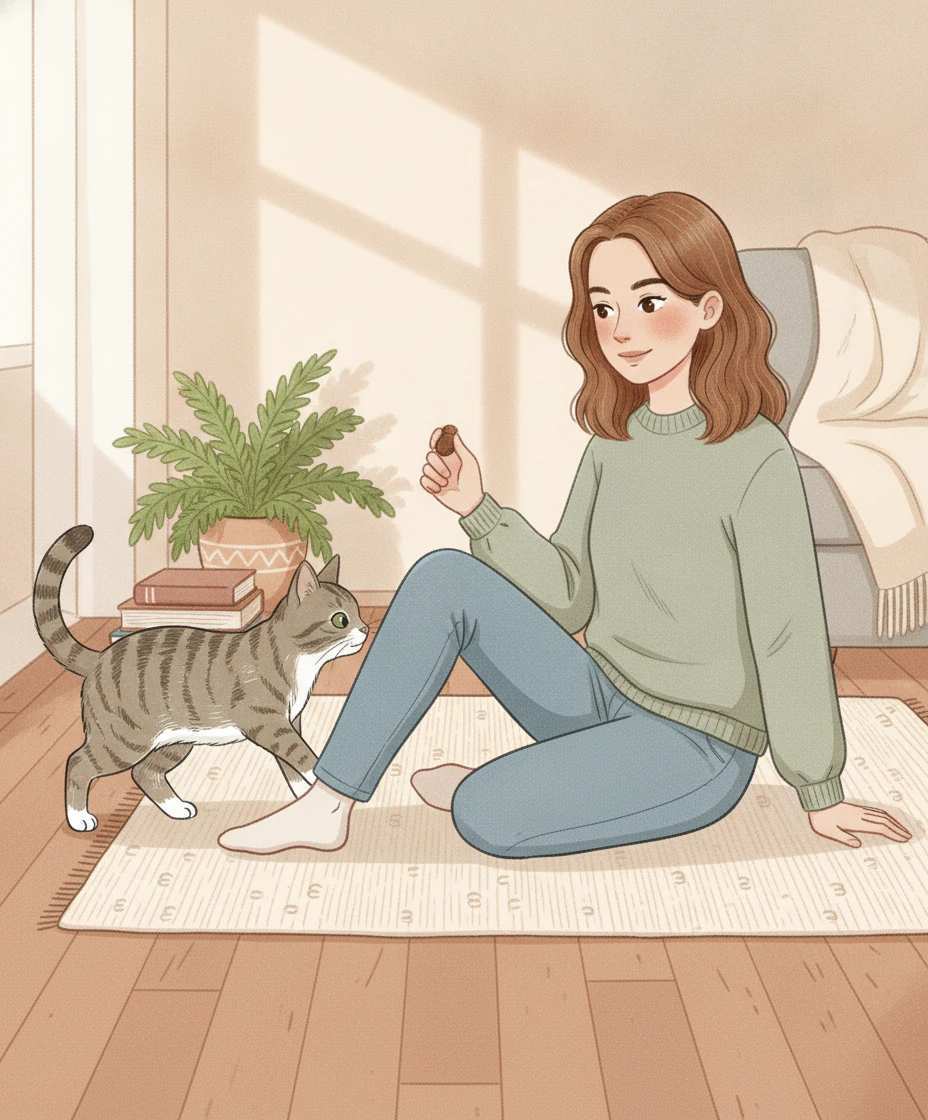
Sit on the floor with one knee raised. From a sit, draw a treat down and under your knee so your cat drops flat to follow. Click the moment their elbows and belly touch the floor, and feed them there. After a few sessions, lure straight down without the knee, then swap the treat for a flat palm sweeping to the floor and the word “down”. Keep sessions to about three minutes.
What you need before you start
A clicker or a short spoken marker like “yes”, a handful of soft treats your cat can eat quickly without much chewing, a quiet room, and a cat who already sits when you ask. A sit is the easiest place to start a down from, because the back end is already on the floor and only the front has to follow. If your cat doesn’t sit on cue yet, teach that first.
Pick a spot your cat already likes to rest: a rug, their bed, or a favourite blanket on the floor. Lying flat leaves a small predator exposed, and Vetstreet’s Mikkel Becker suggests teaching it where your cat already feels comfortable lying down. A cold, slippery floor makes every rep harder.
Cats Protection keeps lie-down sessions to three minutes at most, up to three times a day, with a break in between. Stop while your cat still wants more, and trim their meals to account for the treats.
Source: Cats Protection: How to train your cat to lie down on command (October 18, 2018)
How to teach your cat to lie down: 5 steps
- Lure under your knee. Sit on the floor and prop one knee up to make a low bridge. Hold a treat at your cat’s nose and lead them to the gap, then draw the treat down and under. To reach it, they have to drop flat. Click the instant their elbows and belly touch the floor, and feed them right there. If the front dips but the rear stays up, slide the treat back toward their chest. Success: four flat downs out of five tries, then end the session on that win.
- Take the knee away. Ask for a sit, then draw the treat straight down to the floor, keeping it slightly back toward their chest rather than out in front. A lure that drifts forward invites your cat to stand and walk after it. Click as the belly and elbows land, and treat on the floor. If they keep standing up, do a few more reps with the knee. Success: sit to down by following the treat, four times out of five.
- Rest a day. No session. A day off after the first two sessions is built into the lesson, and many cats come back with a quicker, smoother down.
- Add the hand signal and the word. Say “down”, then sweep a flat, empty palm to the floor along the same path the treat used to travel. Click when their belly touches down and feed from your other hand. If they won’t follow an empty hand, go back to a real treat for a few reps. Success: a smooth sit-to-down with no hunting for food in your hand.
- Do it standing up. Cats read your whole body, so a down learned while you crouch can disappear when you stand. Sit in a chair or stand a small step away, say “down” with the signal, and give them a moment. Click, then toss the treat a little way so they get up for the next rep. If they stall, move closer and lower yourself, then build back up. Success: a down on cue while you stand a few feet away.
One step per session, three minutes each. The order, counts and success marks come from Pounce’s Down lesson. Move on when your cat gets it right about four times out of five.
How long does it take to teach a cat to lie down?
Anywhere from a week to about a month. Cats Protection expects most cats to respond to the spoken cue within seven days of three short daily sessions, while warning that some take longer. Pounce’s Down lesson allows three to four weeks for a smooth down that works in several rooms, from a sit or a stand, with no knee and no lure.
Down usually comes slower than sit or a paw trick, for the same reason it needs a comfortable spot: a cat flat on the floor can’t bolt quickly. Short, frequent sessions beat one long one, because a down is more work than a sit and a tired cat quits.
Source: Cats Protection: How to train your cat to lie down on command (October 18, 2018)
What if my cat won’t lie down?
Match what you see to the fix.
**The front goes down but the rear pops up.** The treat is too far forward. Slide it back toward their chest, or go back to the knee or a low cardboard tunnel for a few reps.
**They stand up and walk after the treat.** Same cause, plus speed. Move your hand more slowly and keep it close to their body.
**They climb over your knee instead of going under.** Raise the bridge a little so going under is the easier route.
**They lose interest after a few reps.** The reward is too small for the effort. Use a tastier treat, train just before a meal, and stop sooner.
**They still won’t follow the lure.** Capture it instead. Every time your cat lies down on their own near you, click and drop a treat between their paws. Once they lie down hoping for it, say “down” just before they settle. Vetstreet also suggests holding the treat just below the edge of a perch or cat tree so your cat lies down to peer over it.
Whatever happens, keep your hands off their shoulders and hips. Cats brace against pressure, and Cats Protection warns that forcing a cat into position causes stress and can lead to behavioural or medical problems.
Source: Vetstreet, Mikkel Becker: Learn how to train your cat to lie down (January 20, 2016)
Should the cue be “down” or something else?
Any word works, as long as you use it only for this. Cats respond to the sound, not the meaning. If “down” already means “get off the counter” in your house, Cats Protection suggests picking a different word so the two don’t blur, and you’ll see guides use everything from “floor” to a silly word nobody says by accident.
Whatever you choose, say it once, a beat before the hand signal. Repeating it while your cat thinks teaches them that the first three “downs” don’t count.
Source: Cats Protection: How to train your cat to lie down on command (October 18, 2018)
What can I teach after lie down?
Down is a doorway to calmer behaviour and bigger tricks. Add a few seconds before the click and you have the start of a stay. Ask for it on a mat and you have a settle you can use at the vet or when guests arrive. From a relaxed down, a treat drawn back over one shoulder becomes play dead, and carried on, a full roll over.
Kittens learn it quickly but run out of focus fast, so cut sessions to a minute or two. Cats Protection says cats can learn clicker training at any age, with temperament mattering more than years. For older cats, use a soft surface and go slowly: lowering down and getting up is real work for stiff joints.
Source: Cats Protection: Tips for clicker training a cat (August 11, 2025)
When to call your vet
Cats Protection recommends a vet check before you start training, since an unwell cat will struggle. Down also gives you a regular look at how comfortably your cat lowers themselves and gets back up.
Book a visit if your cat used to lie down easily and now hesitates, seems stiff changing position, or lies in a tight, hunched loaf with squinted eyes rather than curled up loosely, which can point to belly or joint pain. International Cat Care lists stiffness after rest, resting in stiff positions, reluctance to jump, less grooming and grumpiness when handled among the signs of arthritis, which is very common in older cats. Because cats often hide pain at the clinic, it suggests filming your cat moving at home to show the vet.
Source: International Cat Care: Arthritis in cats (updated September 26, 2025)
Practising lie down with Pounce
Pounce’s Down lesson runs these five steps as short illustrated sessions, from the knee bridge to a down while you stand, each with one goal and a note on what to watch for. Sit on Cue is the lesson before it, Target Touch helps a cat follow a lure smoothly, and Meet the Clicker is where every Pounce trick starts.
Once the down is solid, Go to Mat / Place and Roll Over both build on it.
A little guidance goes a long way.
Follow illustrated lessons, take the next small step, and keep track of your cat’s little wins in Pounce.
Explore Pounce for iOSSources & how this guide was written
Pounce curriculum: the Down lesson for the steps, counts and timeline, with Sit on Cue, Target Touch and Meet the Clicker before it and Go to Mat / Place and Roll Over after it.
- Cats Protection: How to train your cat to lie down on command (October 18, 2018)
- Vetstreet, Mikkel Becker: Learn how to train your cat to lie down (January 20, 2016)
- Cats Protection: Tips for clicker training a cat (August 11, 2025)
- International Cat Care: Arthritis in cats (updated September 26, 2025)
Sources checked October 31, 2026. This article is educational and has not been individually reviewed by a veterinarian. Our editorial policy explains our approach.