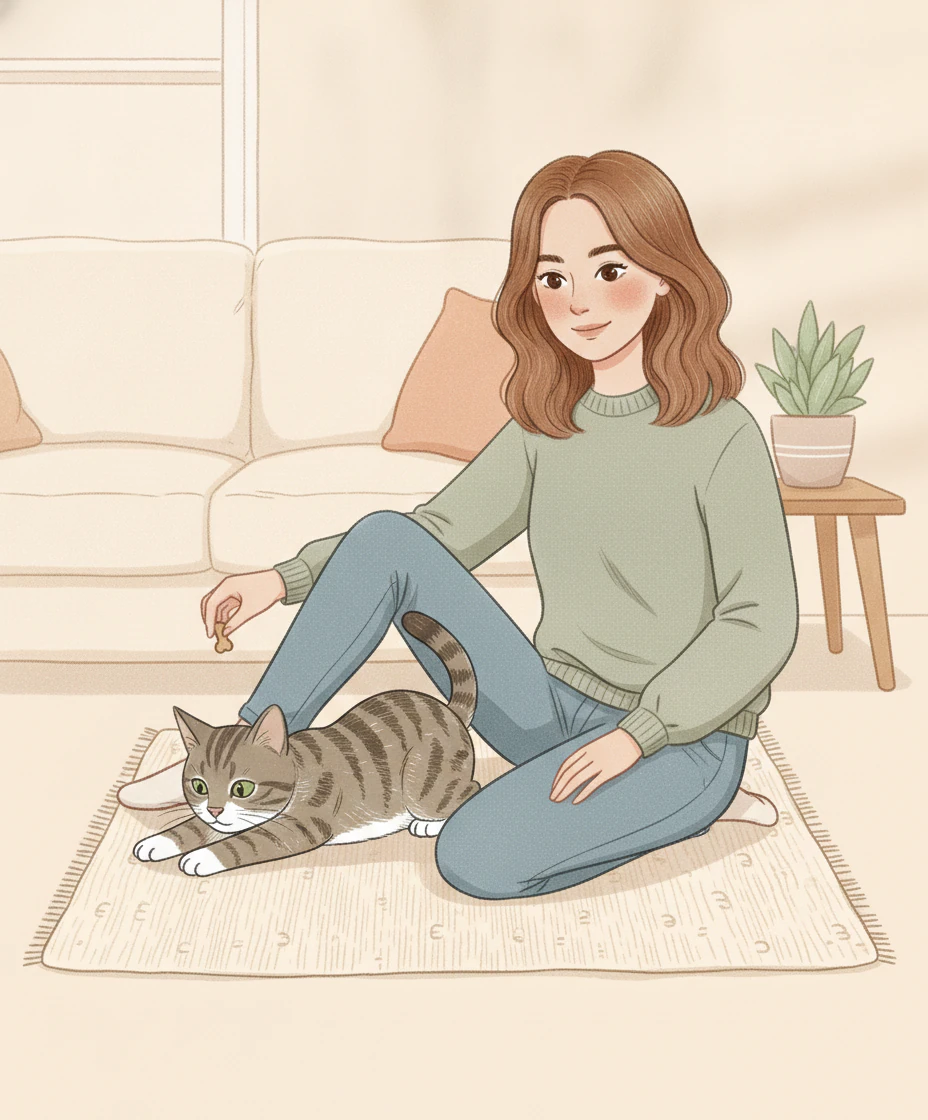
Start from a relaxed lie-down on a rug. Hold a treat at your cat’s nose and draw it slowly back over one shoulder. Click as their weight tips onto a hip, then only when their shoulder touches the floor, and feed them lying down. Once the flop is easy, say “bang!” a beat before the lure, then fade the lure. Allow two to three weeks of five-minute sessions.
What you need before you start
Four things: a clicker or a short spoken marker like “yes”, soft pea-sized treats plus a few extra-special ones for the big moments, a rug or a folded blanket, and a cat who already lies down when you ask. The soft surface matters. Most cats will not tip onto their side on a cold, hard floor, however good the treat.
The lie-down is the real prerequisite, because play dead is a down that keeps going. If your cat does not have one yet, teach it first: sit on the floor with one knee raised into a low bridge and lure them under it, so they drop flat to fit. Pounce’s Down lesson works through that over three to four weeks, and a sit on cue makes it much easier to lure from.
If the marker is new, charge it before anything else. Cats Protection advises clicking at a short distance, treating straight after every click, and muffling the clicker in a pocket or behind a cushion if the sound startles your cat. Set aside a small pile of treats for the session, stop when it runs out, and trim the rest of the day’s food to match.
Source: Cats Protection: Tips for clicker training a cat (August 11, 2025)
How to teach your cat to play dead: 6 steps
- Warm up the down. On the rug, ask for five or six quick lie-downs and click the instant their elbows touch. Feed each treat low, between the front paws, so their head stays down and their weight settles. Success: fast, relaxed downs with no popping straight back up to eat.
- Tip onto a hip. From the down, hold a treat at your cat’s nose and draw it slowly along their side toward the shoulder, then up and back toward the spine. To follow it, their head turns and their weight rolls onto one hip. Click that shift, even a small one, and pay right there. Success: three loose, relaxed hip tips in a session.
- Go all the way over. Use the same lure with a longer arc: carry the treat back over the shoulder toward the floor behind them. The moment their shoulder touches the floor, click and jackpot — three or four treats fed one at a time while they stay on their side. Reward half flops on the way. Success: one full flop is a win; two or three is a big day.
- Rest a day. Skip the session. Many cats come back the day after with a flop that is quicker and looser than the last one you saw.
- Add “bang!”. Point a finger gun, say “bang!”, wait a beat, then lure the flop exactly as before. Cue first, lure second: that gap is what attaches the word to the movement. Do eight to ten flops this way. Success: your cat starts to tip at “bang!” before your lure hand moves.
- Fade the lure and add the hold. Say “bang!” with your lure hand empty and still, and give your cat a full three seconds to think. Click the flop and pay from your other hand. Then delay the click by one second, then two, feeding on the floor by their cheek so staying flat is what pays. Finish each rep with a release word such as “okay!”, and once it is solid, give the cue standing up from a step or two away. Success: “bang!”, a flop, a two-second hold, release.
Work through these in order, one step per session or two. The step counts and success marks come from Pounce’s Play Dead lesson, which runs a version of this over about a week of five-minute sessions.
How long does it take to teach a cat to play dead?
Plan on two to three weeks of short daily sessions for a reliable flop on cue. That is slower than paw tricks like the high five, because lying flat on the side is an exposed position for a small predator, and most cats take time to offer it to anyone.
Cats Protection puts clicker-trained behaviours in general at anywhere from a few days to a few months, and the spread depends more on how often you practise than on the cat. Two or three five-minute sessions a day, stopped while your cat still wants more, will move faster than one long one at the weekend.
Expect it to come in halves. Many cats offer a hip tip for several sessions before the shoulder commits, and one side usually comes much more easily than the other. Train the easy side first.
Source: Cats Protection: Tips for clicker training a cat (August 11, 2025)
What if my cat won’t roll onto their side?
Something in the setup is too big, too fast or too hard. Work through these in order.
**They stand up or scoot away.** The lure is moving too fast or too far. Slow your hand right down and click earlier, at the first turn of the head.
**They pop up the instant they land.** The click is coming late, or the treat is arriving above their head. Click as the shoulder touches, and feed on the floor, in position.
**They only ever tip onto a hip.** Pay the hip tip, then hold out for a little more roll each try instead of waiting for the whole flop.
**They won’t tip at all.** Check the surface first — move to a thicker rug or their bed. Then check the treat: a lure-based trick runs on food your cat really wants. Training just before a meal helps.
**They flop on their own all evening, but not for you.** Capture it. When your cat sprawls on their side near you, click and toss a treat. The position becomes familiar before you ever ask for it.
Can I just push my cat over gently?
No, and this is where most play-dead guides go wrong: several of the top results tell you to press on your cat’s back or nudge them into a roll. Lying on the side is a position cats choose when they feel safe. Cats Protection lists rolling over among a happy cat’s signs, and International Cat Care adds that a roll is a sign of relaxation, not an invitation for a belly rub.
A cat who is pushed into that position learns that your hands take the choice away, which is the opposite of what the trick is built on. Luring keeps them in charge: they can stop following the treat at any moment, and the ones who keep going are the ones who mean it.
Source: International Cat Care: Handling and interactions (updated June 2, 2026)
Can kittens and older cats learn to play dead?
Yes. Cats Protection says cats can be clicker trained at any age, with younger cats often quicker but older ones getting there too, and temperament mattering more than age. Kittens learn fast but with a very short attention span, so cut sessions to a minute or two.
Older cats are a body question, not a brain one. Lowering onto one side and getting back up uses the hips, shoulders and spine, and International Cat Care describes arthritis as very common in older cats and often missed, because cats hide pain. With a senior cat, a soft surface and a slower lure matter even more, and a nose touch or a spin may be the kinder trick.
Source: International Cat Care: Arthritis in cats (updated September 26, 2025)
When to call your vet
Cats Protection recommends a vet check before you start any training, since a cat who is unwell will struggle with it. Play dead also gives you a regular look at how easily your cat lies down and gets up again.
Book a visit if your cat used to flop easily and now hesitates, always refuses one side, seems stiff getting up after lying down, or reacts when you touch their back or hips. International Cat Care lists reluctance to jump up or down, stiffness after rest, less grooming and more irritability when handled among the signs of arthritis, and suggests filming your cat moving to show the vet.
Source: International Cat Care: Arthritis in cats (updated September 26, 2025)
Practising play dead with Pounce
Pounce’s Play Dead lesson runs this trick as a week of short illustrated sessions, from quick, happy lie-downs to the standing “bang!”, each with one goal and a note on what to watch for. Down is the recommended lesson before it, and Meet the Clicker is where every Pounce trick starts.
Once your cat flops on cue, Roll Over is the natural next step: the same lure, carried on into a full roll on one small circle of your hand.
A little guidance goes a long way.
Follow illustrated lessons, take the next small step, and keep track of your cat’s little wins in Pounce.
Explore Pounce for iOSSources & how this guide was written
Pounce curriculum: the Play Dead lesson for the steps, counts and timeline, with Down, Meet the Clicker and Roll Over as the lessons before and after it.
- Cats Protection: Tips for clicker training a cat (August 11, 2025)
- Cats Protection: Cat body language
- International Cat Care: Handling and interactions (updated June 2, 2026)
- International Cat Care: Arthritis in cats (updated September 26, 2025)
Sources checked October 31, 2026. This article is educational and has not been individually reviewed by a veterinarian. Our editorial policy explains our approach.