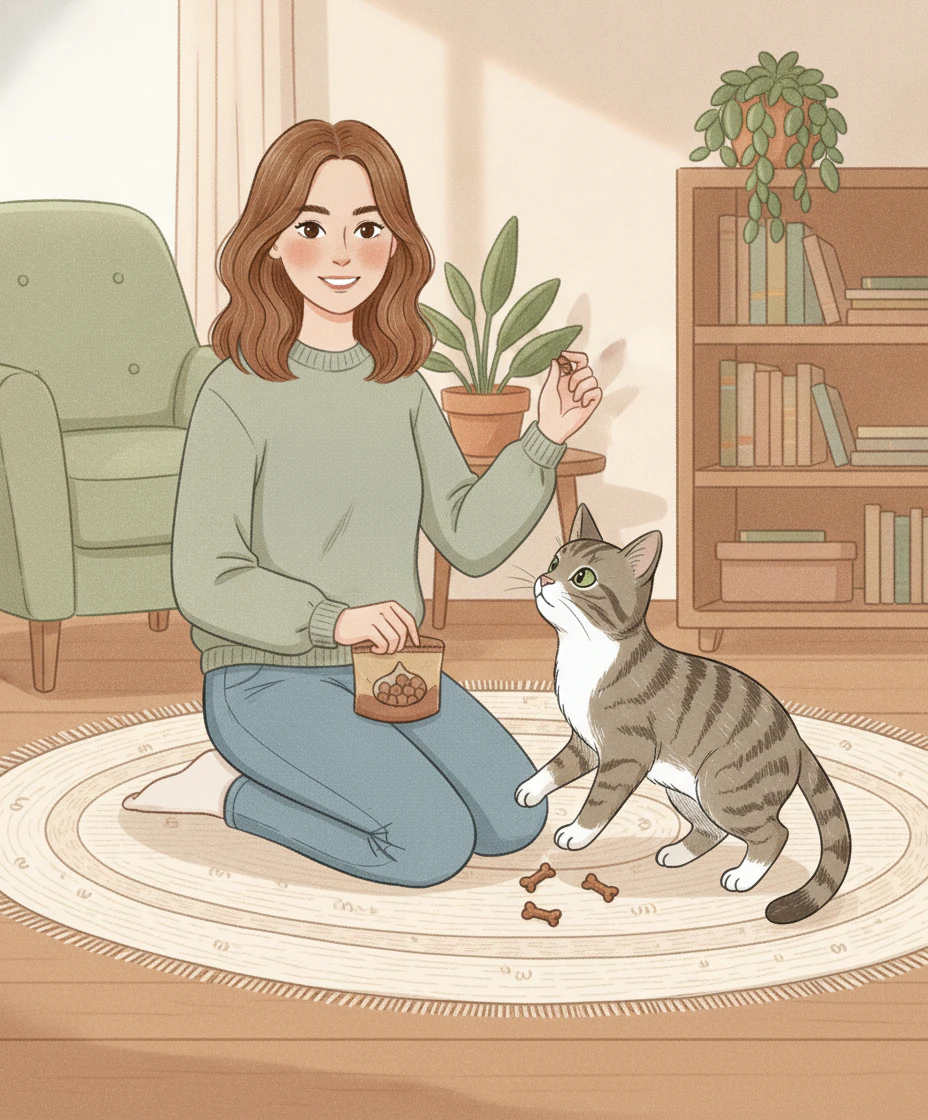
Hold a smelly treat at your cat’s nose, level with the floor, and draw it slowly in a tight circle toward their tail. Click and treat at a half turn at first, then only for a full circle. Next, guide the same circle with an empty hand, say “spin” a second before it, and shrink the motion to a finger twirl. Keep sessions to two or three minutes.
What you need before you start
A clicker or a short spoken marker like “yes”, and a treat with a strong smell that your cat can lick or nibble as it moves: puree on a spoon, a flake of tuna or a piece of freeze-dried meat. Cats Protection suggests treats that are quick to eat and need little chewing, and setting aside a small portion so the session ends when they run out.
Train on a rug or carpet so your cat’s feet don’t slip as they turn, and start with your cat standing, not sitting. A cat who already follows a target, a fingertip or a chopstick, is easier still: Pounce’s Spin lesson lists Target Touch as the recommended lesson before it, because a targeting cat can be steered around the circle without a treat pressed to their nose.
Keep it short. Pounce’s spin sessions run two to three minutes, and Vetstreet’s Mikkel Becker suggests anywhere from 30 seconds to five minutes, a few times a day. Training just before a meal makes the treats worth more.
Source: Cats Protection: Tips for clicker training a cat (August 11, 2025)
How to teach your cat to spin: 6 steps
- Pay a half turn (2 minutes). With your cat standing, hold the treat at their nose, level with the floor. Slowly lead it toward their shoulder, then back toward their tail, in a tight circle. Their nose follows and their feet step around to keep up. Click at a quarter or half turn and give them the treat. Success: the back end shifts and the front paws step around to follow, for a smooth half circle.
- Go all the way round (3 minutes). Same lure, but keep going until their face comes back around to you, and click at that moment. Keep the treat low and close to their body the whole way. Success: a few clean full circles without stopping or sitting down.
- Rest a day. No session. A day off after the first two sessions is built into the lesson, and many cats come back with a smoother turn.
- Follow an empty hand (3 minutes). Pinch your fingers as if you were still holding a treat and trace the same circle. Click when the circle is done, then pay from your other hand. Your guiding hand becomes a signal, not a bribe. If your cat won’t follow it, do two more sessions with a real treat before trying again. Success: full circles following empty, pinched fingers.
- Add the word (3 minutes, week two). Say “spin”, wait a full second, then guide the circle with your empty hand. The pause lets the word start to predict the turn, and keeping word and hand separate is what makes the word stick. Success: your cat starts turning on the word, before your hand moves.
- Shrink the signal (3 minutes). After the word, twirl just your index finger instead of sweeping your hand around their nose. Over the next sessions, make the twirl smaller still. Success: a smooth, willing circle on “spin” and a small finger twirl, which is the finished trick.
One step per session. The order and timings come from Pounce’s Spin lesson. Move on when the current step flows smoothly three or four times in a row.
How long does it take to teach a cat to spin?
Expect two to three weeks to a spin on cue, with a full circle following the treat often in the first week. Pounce’s Spin lesson allows two to three weeks and names fading the lure as the part owners find slowest.
Spin is also one of the tricks cats learn most readily. In a 2017 study in the journal Animals, 100 shelter cats had 15 five-minute clicker sessions over two weeks. Sixty per cent fully mastered the spin afterwards, meaning a turn of roughly 270 to 360 degrees, up from about 26 per cent at the start. That beat the sit, which 27 per cent mastered, and the high five, at 31 per cent. Only the nose touch did better, at 79 per cent.
What if my cat won’t spin?
Match what you see to the fix.
**They sit down or back up instead of turning.** The treat is too high. Keep it at nose level, parallel to the floor, the most common fix of all.
**They stop halfway round.** The lure is moving too fast and they lost the scent. Slow down so their nose stays glued to the treat.
**The neck stretches but the feet stay put.** Move the treat closer to their body and more slowly, and pay quarter turns again for a session.
**They lose interest.** Use a tastier treat and break the circle into quarter turns over one-minute sessions, so rewards come often. A cat who prefers play may follow a wand toy dragged in a tight circle, with a pounce on the toy as the reward.
**It worked yesterday and fell apart today.** You probably faded the food too quickly. Go back to a real treat for a few days, then empty the hand again.
**They spin before you ask.** That is a cat who likes the trick. Simply don’t reward spins you didn’t cue, and they’ll settle into waiting for the word.
Which way should my cat spin?
Pick one direction and stick with it until the trick is finished. Many cats find one side easier, so if the first circle feels sticky, try the other way. Once your cat spins smoothly one way on cue, teach the other direction from step one. It goes much faster the second time, and Pounce’s Spin lesson counts the trick as mastered when your cat turns a smooth circle on the word and a small twirl, in either direction, in several rooms.
Some guides, Vetstreet’s among them, teach a version where the cat rises onto their back legs and turns. Start with all four feet on the floor. It is easier on the body, and a cat who already knows the Stand trick can add the upright version later.
Source: Vetstreet, Mikkel Becker: Step-by-step guide to teaching a cat to spin (May 24, 2016)
Can kittens and older cats learn to spin?
Yes. Kittens pick up spin quickly but lose focus fast, so keep their sessions to a minute or two and stop while they still want more. The circle burns a little energy in a small space, which makes it a handy indoor game.
Spin is one of the kinder tricks for an older cat, because all four feet stay on the floor and nothing has to fold or stretch far. Use a rug for grip, make the circle a little wider and go slowly. If your senior cat turns stiffly or only one way, that is worth a vet’s opinion rather than more repetitions.
When to call your vet
Pause the training and book a check if your cat is reluctant to bend, growls during the turn or loses their balance. Pounce’s Spin lesson flags these as possible signs of arthritis or an inner-ear (vestibular) problem. International Cat Care lists stiffness after rest, reluctance to jump, less grooming and irritability when handled among the signs of arthritis, which is very common in older cats.
A cat who circles on their own, without a cue, is a different thing from the trick. Cornell’s Feline Health Center lists circling or falling to one side, a pronounced head tilt and rapid flicking eye movements as the most common signs of vestibular syndrome, and because the same signs can come from a more serious problem, it advises seeing a vet straight away.
Practising spin with Pounce
Pounce’s Spin lesson runs these six steps as short illustrated sessions, from a half turn to a finger twirl, each with one goal and a note on what to watch for. Meet the Clicker is where every Pounce trick starts, and Target Touch makes the circle easier to guide.
Once your cat spins on cue, Wave, High Five and Stand are good next tricks.
A little guidance goes a long way.
Follow illustrated lessons, take the next small step, and keep track of your cat’s little wins in Pounce.
Explore Pounce for iOSSources & how this guide was written
Pounce curriculum: the Spin lesson for the steps, timings, troubleshooting and vet flags, with Meet the Clicker and Target Touch before it and Wave, High Five and Stand after it.
- Kogan, Kolus and Schoenfeld-Tacher: Assessment of Clicker Training for Shelter Cats, Animals (2017)
- Vetstreet, Mikkel Becker: Step-by-step guide to teaching a cat to spin (May 24, 2016)
- Cats Protection: Tips for clicker training a cat (August 11, 2025)
- Cornell Feline Health Center: Vestibular syndrome
- International Cat Care: Arthritis in cats (updated September 26, 2025)
Sources checked November 1, 2026. This article is educational and has not been individually reviewed by a veterinarian. Our editorial policy explains our approach.