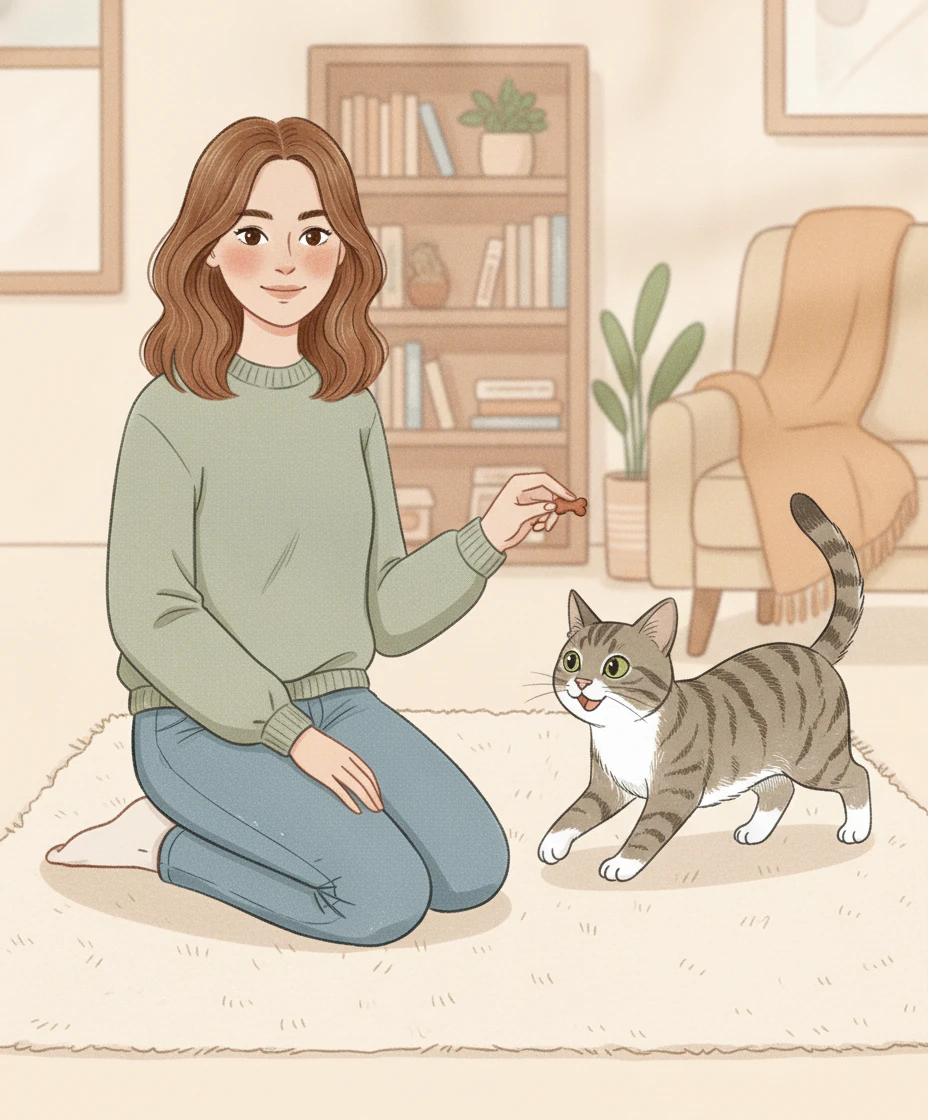
Sit your cat on a sofa arm or counter and brace your forearm level with their chest, a few inches away. Click and treat when both front paws land on it. Then kneel by the bed with your forearms held like a shelf just above the mattress and pay tiny hops. Add a cue like “Hup!” and raise the height one notch at a time over one to two weeks.
What you need before you start
**Long sleeves.** A hoodie or thick long-sleeved top that covers your forearms and shoulders. Your cat will grip with claws when they land, and the fabric keeps it comfortable, so you never flinch. A steady arm is what this whole trick is built on.
**A soft landing zone.** A bed, sofa or folded duvet under every early jump. Pounce’s Jump Into My Arms lesson keeps all the first jumps over something soft until your cat lands like a pro.
**Treats saved for this trick.** Pea-sized, soft and special: a jump into your arms is a big ask, so the pay has to match. Cats Protection suggests a treat your cat finds irresistible that is quick to eat and needs little chewing. Set aside a small portion before you start, stop when it runs out, and trim the day’s other food to match.
**A clicker your cat already knows**, or a short spoken marker such as “yes”. Pounce recommends teaching Target Touch first, so your cat already knows that following your hand pays.
**A calm, healthy cat and a steady adult.** This is a trick for adults who are sure on their feet. Pick a quiet time when your cat is awake and a little hungry, not wound up from play.
Source: Cats Protection: Tips for clicker training a cat (August 11, 2025)
How to teach your cat to jump into your arms: 6 steps
- Paws on your arm (5 minutes). Put your cat on a raised surface such as the sofa arm or a counter. Stand beside them and brace your forearm against your body, level with their chest and a few inches away. Hold a treat just past your arm so they have to reach over it, and click the instant both front paws land on your forearm. Feed while the paws are still on you, then let them step back. Aim for 5 to 8 tries. Success: both front paws come onto your arm without hesitating.
- The first tiny hop (5 minutes). Kneel beside the bed and hold your forearms together like a shelf, almost touching the mattress, clicker in one hand. Rest a treat on your forearm where your cat should land, or pinch it in your top hand. Click as the paws land and feed right there. Keep your arms firm but never squeeze: staying is their choice. After the treat, lower your cat gently back onto the bed yourself. Aim for 3 to 5 relaxed tries. Success: soft, casual landings with all four paws.
- Rest a day. No session. The lesson builds a day off in here so the idea that your arms are safe can sink in. If your cat hops up uninvited, a cuddle is fine, but no treat.
- Add the cue (5 minutes). Pick a word your cat never hears otherwise, such as “Hup!”, plus two pats on your forearm. Say the word, pat twice, then offer your arms: cue first, position second, so the word carries meaning. Run the step 2 setup by the bed. Now and then, kneel nearby without cueing. If your cat jumps anyway, turn slightly so they land on the bed, with no click and no treat. Alternate a few cued tries with short no-cue pauses. Success: your cat watches your face and waits for “Hup!”.
- Raise the height (7 minutes). Go up in small, boring notches, always over the bed: kneel taller, then half-stand, then stand with knees bent. Move up one notch every few clean tries. Watch the takeoff as well as the landing: a long stare or a scrabbly landing means drop back a notch. Success: a crouch, a little wiggle and a confident spring into your arms at half-standing height.
- Put it all together (7 minutes). In a quiet room, with the same spot, height and soft landing zone, run the whole trick: “Hup!” with the arm pat, the jump, click, treat in your arms, then lower your cat calmly down. Finish with a jackpot of 3 or 4 treats fed one by one while they sit in your arms. Success: a jump on cue and a calm exit. From here, a few cued jumps a week, each one paid, keep it sharp.
One step per session, in this order. The times, repetitions and success marks come from Pounce’s Jump Into My Arms lesson. Move on when the current step looks easy, and end each session while your cat still wants more.
How long does it take to teach a cat to jump into your arms?
Plan on one to two weeks of five- to seven-minute sessions. Pounce’s lesson covers the trick in six sessions, including the rest day, and slower is fine: the height is the part to take slowly.
Cats Protection puts the general range for clicker training a new behaviour at anywhere from a few days to a few months, and notes that temperament matters more than age. A bold cat who already climbs on you may fly through the first two steps. A cautious cat may need several sessions of paws-on-the-arm before the first hop, and that time pays off: one bad landing can cost a week of trust.
Source: Cats Protection: Tips for clicker training a cat (August 11, 2025)
What if my cat won’t jump into my arms?
Match what you see to the fix.
**They put a paw on your arm and pull it back.** Your arm is moving. A wobbly arm is the most common reason cats refuse this trick, so brace your elbow against your side and lower your arm until it is level with the surface.
**The front paws come up but the back legs stay behind.** Shrink the gap to nothing and click paws-up for a session, as in step 1. The back legs follow once the front half feels safe.
**They scramble, or land with claws out.** The jump is too far or too high. Close the gap and go back to the last height where landings looked casual.
**They jump in and straight back out.** The treat is arriving too late. Feed while your cat is in your arms, never after they leave, so your arms are where the good things happen.
**They launch at you without the cue.** Uncued jumps quietly earn nothing. Turn so they land on the bed, stay neutral, and finish on one easy cued try. Over-excitement usually means the session ran long, so try again tomorrow with a calmer cat.
**It falls apart in a new room or on camera.** Drop back to a low, easy jump, pay it well and end there. A new place is a harder version of the trick, so rebuild the height there one notch at a time.
How do I hold my cat and put them down safely?
Hold your cat close to your chest with their back end supported in the crook of your elbow, so their back legs don’t dangle. That is the hold Cats Protection describes for any lift, and it is the shape your arms should make as your cat lands. Keep the hold loose: a cat who can leave whenever they like is a cat who comes back.
For the exit, lower your cat until all four paws touch the bed or floor, then let go. Cats Protection advises against letting cats jump down out of your arms, partly because they may scratch you on the way, and notes that most cats are only comfortable being held for a minute or two. Wriggling, a tense body, hissing or growling means put them down now, and keep the next session shorter.
Agree on the cue with everyone at home. A cat who only jumps on “Hup!” won’t use a guest, an older relative or a toddler as a landing pad, and the cue is for steady adults only.
Source: Cats Protection: How do you pick a cat up? (February 22, 2024)
Can my cat learn to jump onto my shoulder next?
Yes, and jumping into your arms is the right place to start. Once your cat flies into your arms at half-standing height, the lesson adds the shoulder: cradle them on one arm, hold a treat just above your other shoulder and let them step up on their own. Click when their weight settles, feed up there, and stand still while they find their balance. To get down, lower yourself beside the bed and let them step off.
If you want a cat who jumps straight from the counter to your shoulder, Pounce’s Jump to Shoulder lesson picks up from here with a gap that grows an inch at a time.
When to call your vet
Stop the jumping and book a check if your cat lands stiffly, limps after a session, or starts refusing jumps they used to make easily.
International Cat Care lists reluctance or hesitance to jump up or down, jumping less often, stiffness after resting and grumpiness when handled among the signs of arthritis, which is very common in older cats and often goes unnoticed. ICC names the shoulders, hips, elbows, knees, spine and ankles as the joints it most often affects. Because cats may show few signs at the clinic, ICC suggests filming your cat jumping down from a chair or climbing stairs to show your vet. Never give a cat human painkillers: many, including paracetamol (acetaminophen), are toxic to cats.
Source: International Cat Care: Arthritis in cats (updated September 26, 2025)
Practising Jump Into My Arms with Pounce
Pounce’s Jump Into My Arms lesson runs these six sessions as short illustrated steps, from paws on your forearm to a filmed jump on cue, each with one goal and a note on what to watch for. Meet the Clicker and Target Touch come first, and Jump to Shoulder follows when you are both ready.
The trick is finished when your cat waits for “Hup!” and the arm pat, jumps from standing height into your arms, and comes down calmly, while arms that didn’t cue them get ignored.
A little guidance goes a long way.
Follow illustrated lessons, take the next small step, and keep track of your cat’s little wins in Pounce.
Explore Pounce for iOSSources & how this guide was written
Pounce curriculum: the Jump Into My Arms lesson for the gear, steps, repetitions, cue, troubleshooting and shoulder perch, with Meet the Clicker and Target Touch before it and Jump to Shoulder after it.
- Cats Protection: Tips for clicker training a cat (August 11, 2025)
- Cats Protection: How do you pick a cat up? (February 22, 2024)
- International Cat Care: Arthritis in cats (updated September 26, 2025)
Sources checked November 4, 2026. This article is educational and has not been individually reviewed by a veterinarian. Our editorial policy explains our approach.