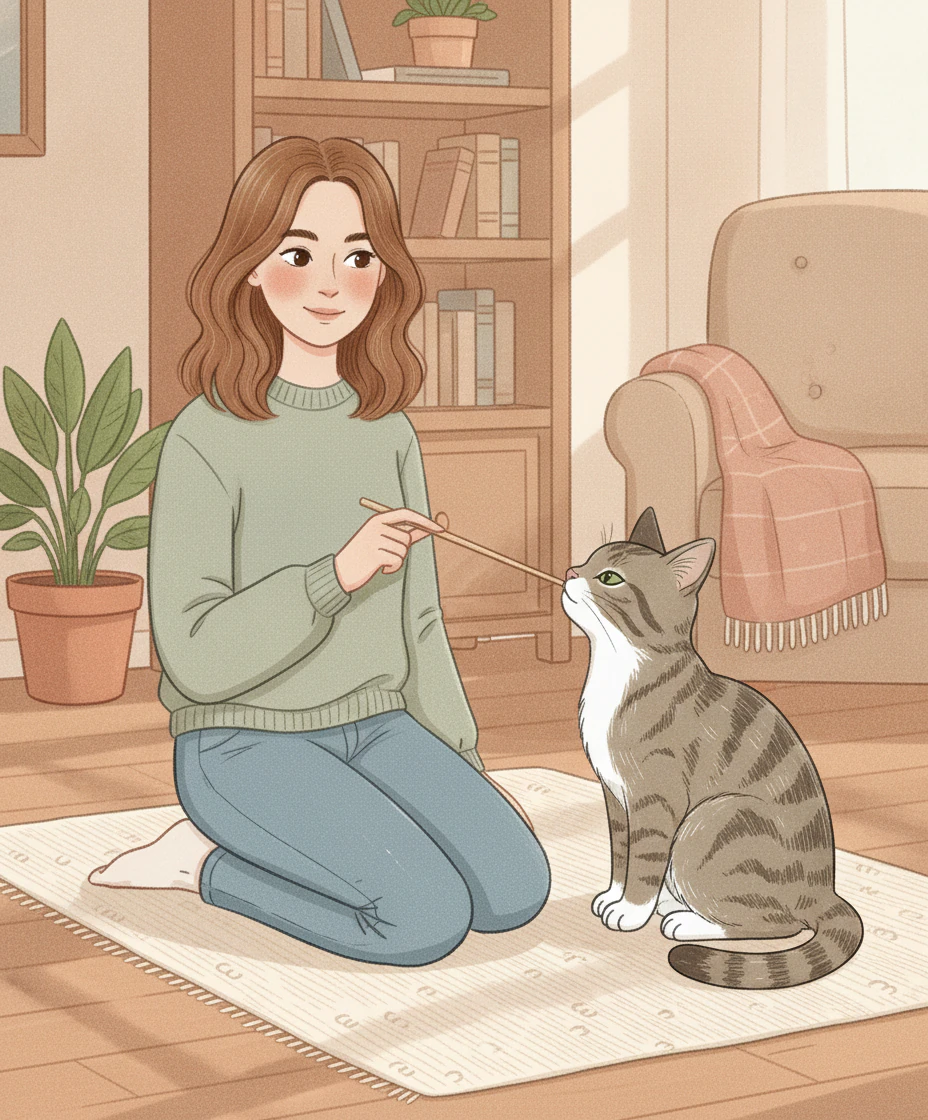
Hold a smelly treat just above your cat’s nose. Raise it slowly, straight up, and click the instant both front paws leave the floor, then feed the treat up high. Do five to eight rises a session. Next, say “up” before your hand moves, add a one-second hold, and switch to an empty raised hand. Most cats learn it in one to three sessions.
What you need before you start
A clicker or a short spoken marker such as “yes”, and pea-sized soft treats with a strong smell. Soft matters here: your cat eats while balancing, so a treat that needs chewing pulls them back down. Cats Protection recommends treats your cat loves that are quick to eat, and setting aside a small portion so the session ends when they run out.
Train on a rug or carpet so back feet don’t slip, and sit on the floor so your hand starts at your cat’s eye level. Keep it short: Cats Protection’s guide to teaching the sit suggests sessions of three minutes at most, about three times a day, and Pounce’s Stand lesson runs two to three minutes. Training a little before a meal makes the treats worth more.
If your cat has never heard a clicker, spend a day or two teaching that the click means a treat first. Pounce lists Meet the Clicker as the lesson before Stand, because the click is what tells your cat the exact moment both paws left the floor.
Source: Cats Protection: Tips for clicker training a cat (August 11, 2025)
How to teach your cat to stand: 5 steps
- Lure the first rise (2 minutes, 5 to 8 reps). With your cat facing you, hold the treat just above their nose, close enough to smell but not to grab. Raise it slowly, straight up. The nose follows, the front paws lighten, and your cat comes up. Click the instant both front paws leave the floor, then feed the treat high, right where their nose is. Success: both front paws off the floor, even a little.
- Wait for a taller rise (same session). Once small lifts come easily, raise the treat a little higher and click only the taller rises. Keep your hand close above their head: a treat held far above them gets a jump instead of a stand. Stop on a good tall one. Success: your cat rises onto their back legs with their body upright.
- Add the word “up” (3 minutes, about 6 reps). Warm up with two easy lured rises. Then say “up” once, brightly, and only after that start raising your hand. Word first, hand second, every time, so the word starts to predict the rise. Success: your cat begins to lift as soon as they hear it.
- Add a one-second hold (same session). When your cat is up, count “one banana”, about a second, before you click, then feed up high while they are still standing. If they drop early, give no click, reset and ask for a shorter hold. Success: a steady beat at the top, finished on a held rep.
- Switch to an empty hand, then move rooms (3 minutes, 5 reps). Say “up”, then raise an empty hand with fingers pinched as if holding a treat. Click the rise and pay from your other hand. Then try it from a chair and in a second room, because cats tie tricks to places. If it falls apart somewhere new, lure once with a real treat, then go empty again. Success: your cat stands on the word and your empty hand in more than one room.
The order and counts come from Pounce’s Stand lesson. Steps 1 and 2 often happen in the first session; steps 3 to 5 usually take one or two more. Move on when the current step works four times out of five.
How long does it take to teach a cat to stand?
Usually one to three sessions. Following a treat upward comes naturally to cats, and Pounce’s Stand lesson notes that the first rise usually arrives within a minute, which makes it the fastest trick in the app and a good first one for a new trainer.
The word cue takes a little longer than the movement. For the sit, Cats Protection says most cats respond to a spoken cue within about seven days, and that some take longer. Expect something similar here, and keep using the hand signal alongside the word until your cat answers the word reliably on its own.
Source: Cats Protection: How to train your cat to sit on command (October 9, 2018)
What if my cat jumps, swats or won’t stand up?
Match what you see to the fix.
**They jump at the treat.** Your hand is too high or moving too fast. Hold it still, a whisker above their nose, and raise it slowly.
**They paw or swat at your hand.** The treat is close enough to grab. Lift it a little higher and keep it straight above their head, not in front of their face.
**They sit back on their haunches instead.** The treat drifted back over their head. Raise it straight up; a lure that slides backward teaches sit pretty, a different trick.
**They drop down before the click.** You waited too long. Click sooner for a session, then add the hold back in half-second steps.
**They only stand when they can see food.** The treat has become the cue. Keep treats behind your back or in a bowl, raise an empty hand, and pay after the click.
**They lose interest.** Use a tastier treat and stop after three or four rises. Cats Protection advises taking a break and coming back later rather than pushing on. A cat who prefers play can rise to swat a wand toy held up high instead.
Is standing the same as sit pretty or begging?
No, and the difference is where the treat goes. For stand, your cat rises onto their back feet with the body upright, reaching up to a treat held just above their head. For sit pretty, the meerkat pose, your cat stays seated on their haunches and lifts and tucks their front paws, with the treat only an inch above the nose. Pounce teaches them as separate lessons, Stand and Sit Pretty.
Stand is the easier of the two, and it builds the balance and reach that High Five, Sit Pretty and Wave borrow later. Teaching it first gives your cat a quick win, and gives you practice clicking at exactly the right moment.
Is it bad for cats to stand on their hind legs?
Not for a healthy cat in short bursts. Cats rise onto their back legs on their own to sniff a counter, peer out of a window or bat at a toy, and the trick asks for the same movement for a second or two at a time. Keep holds short and reps to a handful, and let your cat choose to come down.
Kittens pick it up fast but lose focus quickly, so keep their sessions to a minute or two. Older, heavier or stiff cats can still try it with fewer reps and a one-second hold at most; if rising looks like effort, switch to a trick that keeps all four paws on the floor, such as spin or the nose touch.
When to call your vet
Stop the trick and book a check if your cat wobbles badly, cries, or won’t put weight on their back legs. Pounce’s Stand lesson treats those as signs to ask about hips and knees before any more standing or jumping.
Also watch for slower changes. International Cat Care lists reluctance to jump up or down, stiffness after resting, trouble with stairs, less grooming and irritability when handled among the signs of arthritis, which it describes as very common in older cats. Cats hide pain, so a short video of your cat at home, rising or jumping down, helps your vet see what the clinic visit may not show.
Source: International Cat Care: Arthritis in cats (updated September 26, 2025)
Practising stand with Pounce
Pounce’s Stand lesson runs these steps as three short illustrated sessions, from the first lured rise to standing on “up” and an empty hand in a new room, each with one goal and a note on what to watch for. Meet the Clicker comes before it.
Once your cat stands on cue, High Five, Sit Pretty and Wave are natural next tricks, since each one starts with the same upward reach.
A little guidance goes a long way.
Follow illustrated lessons, take the next small step, and keep track of your cat’s little wins in Pounce.
Explore Pounce for iOSSources & how this guide was written
Pounce curriculum: the Stand lesson for the steps, counts, fixes and vet flag, with Meet the Clicker before it and the Sit Pretty lesson for the difference between the two poses.
- Cats Protection: Tips for clicker training a cat (August 11, 2025)
- Cats Protection: How to train your cat to sit on command (October 9, 2018)
- International Cat Care: Arthritis in cats (updated September 26, 2025)
Sources checked November 7, 2026. This article is educational and has not been individually reviewed by a veterinarian. Our editorial policy explains our approach.