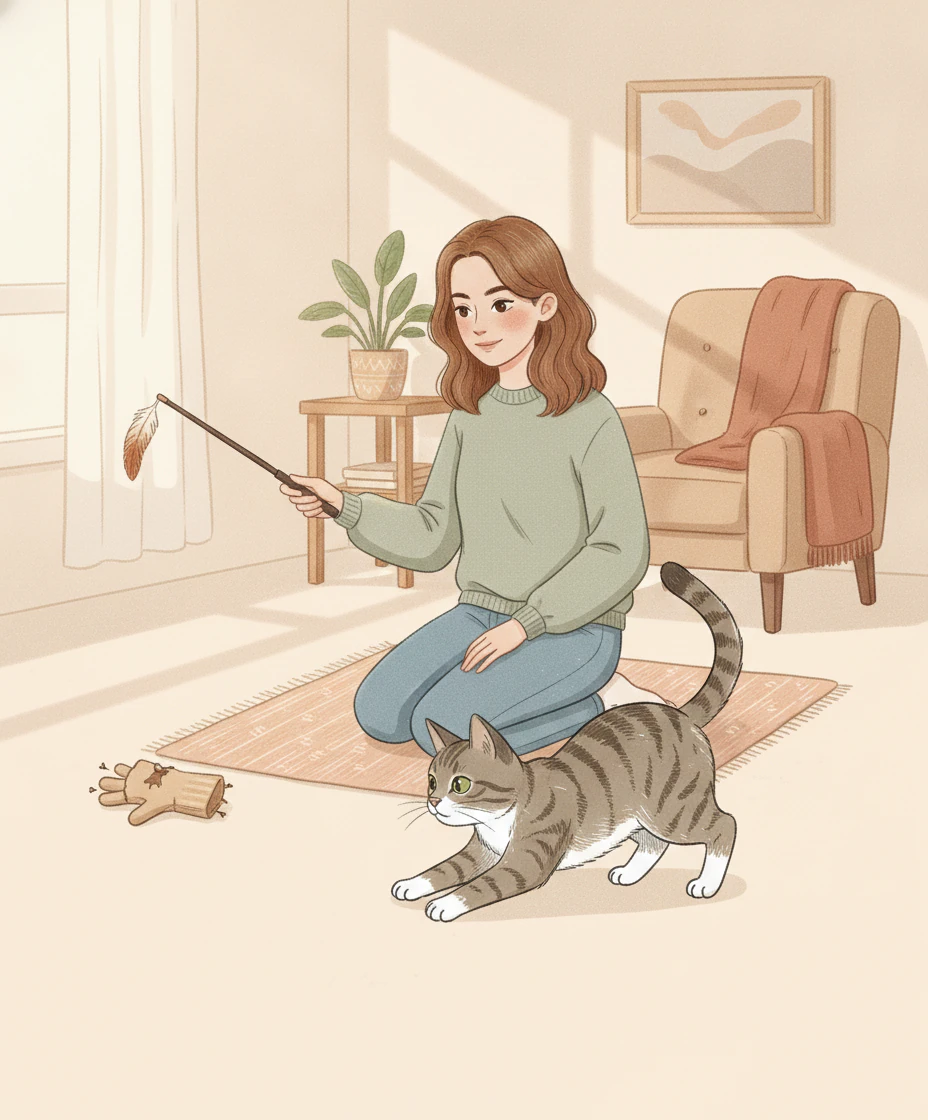
To discipline a cat, skip punishment and change what pays. Work out what the habit earns and remove it, give your cat a better outlet, and calmly redirect them the moment it starts. Reward the right choice within three seconds, every time for the first week. Add two play sessions a day, and expect three to six weeks.
Can you discipline a cat?
Yes, if discipline means teaching your cat what to do. Cats learn quickly from consequences, but the consequences that change their behavior are a reward they want and a payoff that stops arriving. FelineVMA, the veterinary association for cats, advises swapping punishment for rewards aimed at the behavior you want to see.
Most of what owners want to punish is ordinary cat behavior in the wrong place. Cats Protection points out that a cat who seems to be misbehaving may simply be acting like a cat, and that punishment only adds stress. Scratching, climbing, hunting your ankles and shouting for breakfast are needs or learned habits. None of them is revenge, and all of them can change.
How to discipline a cat: 7 steps
- Find the payoff. For three days, jot down each time the habit happens and what came straight after: food, a chase, your voice, you getting up. The American Veterinary Society of Animal Behavior (AVSAB) says owners often reward the very thing they are trying to stop. Success: you can finish the sentence “my cat does this because it gets ___.”
- Remove the payoff. Clear the counters, stop serving breakfast on demand at dawn, and keep hands and feet out of play. Give the habit nothing for a full day. Success: the behavior no longer earns food, attention or a chase.
- Give the need a better outlet. Put a tall, sturdy post beside the scratched couch, a perch at the edge of the kitchen, or a food puzzle where your cat begs. Schedule play too: FelineVMA recommends at least two sessions a day, and Pounce’s biting lesson uses two 15-minute wand hunts. Success: your cat uses the new option at least once in a day.
- Reward the right choice within three seconds. That is FelineVMA’s limit, so keep pea-sized treats or a clicker within reach and mark the moment your cat picks the post, the perch or four paws on the floor. In week 1, reward every time. Success: your cat starts offering the choice without being asked.
- Redirect calmly the moment the habit starts. Toss a treat or toy away from the problem spot, or offer a target stick for your cat to follow, then reward them in the right place. For a bite, go limp and quietly leave for two minutes. Success: the moment ends without shouting and your cat ends up somewhere better.
- Keep everyone in the house on the same plan for seven days. The person who sneaks a scrap or gets up at 4 a.m. teaches your cat that persistence pays. AVSAB compares this to a slot machine: an occasional win keeps an animal trying. Success: everyone gives the same response all week.
- Thin the rewards. Treat about half the good choices in week 2 and about a quarter by week 4, with praise every time and the odd surprise jackpot. Success: the new habit holds with fewer treats, and you are counting fewer attempts than in week 1.
Pick one habit and work through these in order. They are the pattern behind Pounce’s behavior lessons, from Counter Surfing to Door Dashing.
Why doesn’t punishment work on cats?
Because it is almost impossible to do well. AVSAB’s position statement says punishment has to land within about a second of the behavior, and every single time it happens. Miss one and your cat still got the payoff, which can make the habit stronger. Most owners find the scratched couch an hour later, when the cat has no way to connect the two.
It also costs you something. FelineVMA warns that squirt bottles and yelling can build fear, bring on more unwanted behavior and wear down your relationship with your cat. Pounce’s counter lesson sees the same pattern: a spray bottle mostly teaches a cat to wait until you have left the room. ASPCA says painful punishment fails to change how cats behave and can provoke aggression. Never hit or physically correct a cat.
And it teaches nothing. A cat told off for scratching the couch still needs to scratch, and still has no idea where to do it. Show them the post and reward it, and the need has somewhere to go.
How do I discipline a cat for biting, scratching or jumping on counters?
Match the fix to what the habit earns. Each row is the short version of a full Pounce lesson, and the timeline is that lesson’s realistic estimate.
If one cat is attacking another, the answer is separation and a slow re-introduction, moving from scent to sight to contact. Pounce’s Multi-Cat Introductions lesson plans two to six weeks for most pairs, and longer after a real fight.
| Habit | What it usually earns | What to do instead | Timeline |
|---|---|---|---|
| Biting hands or ankles | Hunting practice; moving hands and feet act like prey | Two 15-minute wand hunts a day. On a bite, go limp, then leave for two minutes | 3 to 5 weeks |
| Scratching the couch | A stretch and a mark in the room where you spend your time | A tall, sturdy post beside the couch, tape on the couch, a reward for every post use | 3 to 5 weeks |
| Jumping on counters | Food, height and being near you | Bare counters, a perch at the kitchen’s edge, the best treats only there | 3 to 4 weeks |
| Waking you at 4 a.m. | Breakfast or attention | Evening play, then a full meal; a timed feeder for dawn; no response to night demands | 4 to 6 weeks |
| Begging at meals | Scraps | No scraps at all, and a food puzzle for your cat while you eat | 3 to 5 weeks |
| Dashing out the door | The outdoors itself | A station 6 to 10 feet from the door; reward running to it | 4 to 6 weeks |
| Peeing outside the box | Nothing: it is a distress signal, not spite | A vet check first, then fix the setup behind it | 2 to 4 weeks |
How do you tell a cat no?
By giving them something else to do. A sharp “no” says nothing about what you want instead, and AVSAB lists shouting it among the seemingly mild forms of punishment. FelineVMA says verbal punishment can raise fear too.
A better “no” is a cue your cat already likes. Teach Target Touch and a target stick can draw them off the table without anyone touching them. Teach Go to Mat / Place and you have a word that means “go here instead.” Name Response gives you a way to call them away from trouble. Those few cues replace a lot of shooing.
Source: FelineVMA (formerly AAFP): Positive reinforcement of cats position statement (2012)
How long does it take, and what if it gets worse first?
Expect early signs within days and a new habit in three to six weeks, depending on the habit. Counter Surfing plans three to four weeks; Door Dashing plans four to six, with the first sign, a look toward the station when the handle jiggles, usually coming within a week.
A habit that has paid for months often gets louder just before it stops, especially when attention was the prize. Pounce’s night lesson warns of a last big protest around the second or third night, because the old tactic has stopped working and your cat is trying harder. That is the moment to hold steady, because giving in then teaches your cat that more noise works.
Keep a tally of attempts in week 1 and compare it with each week after. A downward trend with the odd relapse is the pattern you want.
When to call your vet
Call your vet before you start if the behavior is new, sudden or out of character, or if your cat is older. FelineVMA recommends a medical assessment for behavior changes, house soiling, biting and ongoing anxiety, and Cats Protection says the vet should be your first call. Pounce’s night lesson asks for four checks on a cat who suddenly starts yowling at night: thyroid, blood pressure, arthritis pain and age-related cognitive decline.
Ask for a referral to a qualified behaviorist if your cat is injuring people or other pets, or shows fear that doesn’t ease. ASPCA advises keeping clear of a cat in a defensive posture until they have calmed down, and it warns against stepping in to break up a fight.
Teach your cat with Pounce
Pounce turns each of these fixes into short daily steps with illustrations. Start with Meet the Clicker and Target Touch, then pick your habit: Couch and Furniture Scratching, Counter Surfing, Play Biting and Overstimulation, 4am Yowling and Night Activity, Begging at the Table, Door Dashing or Litter Box Troubleshooting.
A little guidance goes a long way.
Follow illustrated lessons, take the next small step, and keep track of your cat’s little wins in Pounce.
Explore Pounce for iOSSources & how this guide was written
Pounce curriculum: Meet the Clicker, Target Touch, Name Response, Go to Mat / Place, Couch and Furniture Scratching, Counter Surfing, Play Biting and Overstimulation, 4am Yowling and Night Activity, Begging at the Table, Door Dashing, Litter Box Troubleshooting and Multi-Cat Introductions.
- FelineVMA: Training techniques for addressing undesirable behaviors (Positive Reinforcement Training toolkit)
- FelineVMA (formerly AAFP): Positive reinforcement of cats position statement (2012)
- American Veterinary Society of Animal Behavior: Position statement on the use of punishment (2007)
- ASPCA: Aggression in cats
- Cats Protection: Managing cat behaviour
Sources checked November 8, 2026. This article is educational and has not been individually reviewed by a veterinarian. Our editorial policy explains our approach.