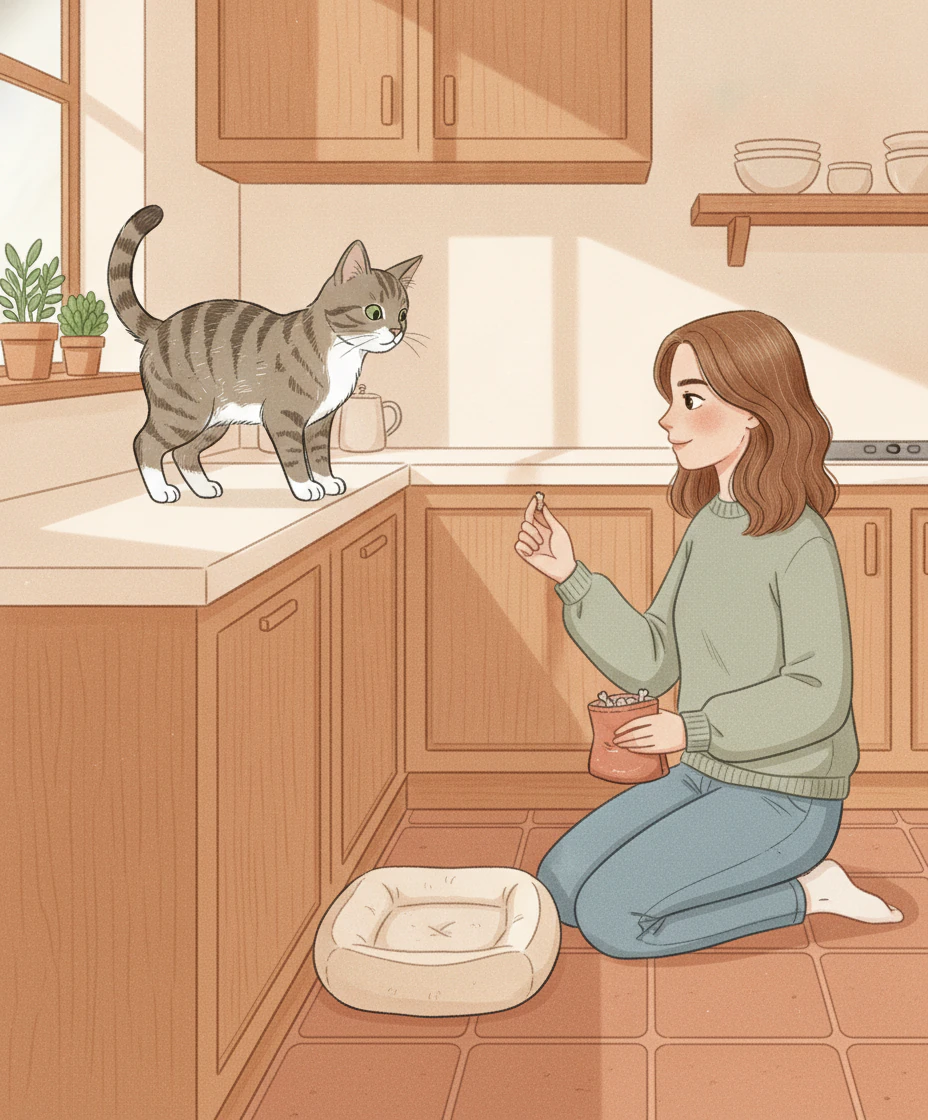
To stop a cat jumping on counters, take away the payoff and offer a better seat. Clear every crumb and food smell, put a tall perch at the kitchen’s edge, and give the best treats only there. When your cat jumps up, calmly toss a treat to the floor and steer them to the perch. Plan on three to four weeks.
Why does my cat jump on the counter?
Because it pays. FelineVMA, the veterinary association for cats, says cats go back to counters because food turns up there and because they want to be close to their people, often with no good perch nearby. A crumb, a warm patch or a scrap of chicken rewards the jump instantly, which is why a cat you shoo off at breakfast is back by lunch.
Height is the other half of it. International Cat Care says cats need high places to rest and watch from, because up high is where they feel safe. A counter offers height, a view of you and food all in one spot. A good plan beats it on all three.
Source: FelineVMA: Training techniques for addressing undesirable behaviors (2026 toolkit)
How to stop your cat jumping on counters: 7 steps
- Clear the counters completely. Put all food in bins or sealed containers, get dishes into the sink or dishwasher, and wipe away food smells. Success: there is nothing to eat or lick on any counter, even for five minutes.
- Set up a perch at the edge of the kitchen. Use a tall cat tree, a barstool or a wall shelf with a non-slip top. FelineVMA’s rule is that your cat should be able to watch you work from it but not jump from it to the counter. Success: from your usual spot at the counter, you can look over and see your cat’s perch.
- Pay the perch on day 1. For about three minutes, before your cat can jump up, lure or target them onto the perch, then click and give a jackpot of several favorite treats. Keep those treats for the perch and nowhere else. Success: your cat hops up expecting something good.
- Redirect every jump calmly, starting on day 2. Toss a treat to the floor or offer the target to bring your cat down without touching them, then ask them onto the perch and click and treat there. Success: jumps happen without drama and end on the perch.
- Catch free choices on days 3 to 5. Whenever your cat picks the perch on their own, click and jackpot right away. Aim for one caught visit on day 3 and two on day 4. Success: your cat heads for the perch when they walk into the kitchen.
- Thin out the treats. In week 2, treat about half of the visits your cat chooses and praise all of them. In week 4, treat about a quarter, with an occasional surprise jackpot. Success: your cat keeps choosing the perch with fewer treats.
- Practice while you work at the counter in week 3. Start with cold food prep. Toss a treat to the perch for every 30 seconds your cat watches calmly. If they move toward the counter, redirect them and go back to easier, faster treats for that session. Success: your cat stays settled on the perch through a whole prep session.
These follow Pounce’s Counter Surfing lesson. Steps 1 and 2 are a single setup session; steps 3 to 7 run over the next three to four weeks. If you can already guide your cat with a target stick, step 3 will be easy.
Source: FelineVMA: Training techniques for addressing undesirable behaviors (2026 toolkit)
How long does it take to stop a cat jumping on counters?
Pounce’s lesson plans three to four weeks, and the first perch visit your cat makes unprompted often comes within a day or two. At the end of week 1, count perch visits against counter attempts: perch up and counter down is the pattern you want, and counter attempts down by half or more is a strong start.
The lesson’s finish line is a cat who heads for the perch about 90% of the times they walk into the kitchen, with one counter jump a week or fewer. Keep the clean counters and the occasional treat after that. Those two habits are what hold the result in place.
What if my cat keeps jumping on the counter?
Look at the counter first. A cat who jumps straight back up has usually found something worth having, and one forgotten dish or stick of butter can set you back weeks. Then check the perch. One in the living room won’t get used, because your cat wants to supervise the kitchen, so move it closer and upgrade the treats.
Match the reward to your cat. Food lovers get their favorite treats on the perch only. Players do better with a toy tossed up there. For a cat who doesn’t care much about either, a perch at counter height often works on curiosity alone. A cat who hangs around at mealtimes may also need the plan for begging, since the two habits feed each other.
How do I keep my cat off counters when I’m not home?
Bare counters do that job. Training changes what your cat does when you are there; an empty surface is what makes the counter dull when you aren’t. Do a last sweep before you leave and before bed, because cats patrol and one jackpot reopens the habit.
Leave your cat something better to do. A food puzzle on the floor or on the perch gives them a reason to stay down, and an evening play session helps if the counter patrols happen at night. Where the layout allows, you can also close the kitchen door, as long as your cat has water, a litter tray and somewhere to rest on their side of it, and stays relaxed about it.
Do foil, tape or a spray bottle work?
Spray bottles and scat mats are a poor bet. FelineVMA says a cat will keep jumping up despite yelling, a squirt of water or a scat mat because the food is worth more than the unpleasant moment, and those methods are likely to cause fear and new problem behavior. The lesson adds that a spray bottle mainly teaches a cat to wait until you have left the room.
Foil, tape and cookie-sheet noise traps fill the search results, but FelineVMA’s counter advice rests on perches and clear surfaces instead, and a rigged crash is just another scare. Spend the effort on the perch. A cat with a better place to be doesn’t need to be kept off the counter.
Source: FelineVMA: Training techniques for addressing undesirable behaviors (2026 toolkit)
When to call your vet
Call your vet if your cat’s hunger turns frantic or they start raiding counters all of a sudden. Pounce’s lesson flags hyperthyroidism and diabetes as possible causes, and VCA notes that the most common sign of hyperthyroidism is weight loss despite a bigger appetite, usually in cats around 12 years old. A cat who suddenly stops jumping up deserves a check too.
Get help at once if your cat eats something dangerous or burns a paw. ASPCA lists onions, garlic, chives, chocolate, alcohol and xylitol among the foods to keep away from pets, and says cats are especially susceptible to the onion family; its Animal Poison Control line is (888) 426-4435. Until your cat is reliable on the perch, keep them out of the kitchen while the stove is on. Cats Protection also advises keeping pan handles out of reach in homes with cats who walk on the worktops.
If your cat growls, hisses or swats when you come near stolen food, leave the item alone and ask your vet about a behaviorist.
Keep your cat off the counters with Pounce
Pounce’s Counter Surfing lesson turns this plan into a setup day and short daily steps over about four weeks: clearing the counters, rewarding the perch, redirecting jumps, catching free choices, and finally cooking with your cat watching from the perch. Start with Target Touch, which the lesson builds on, and add Go to Mat / Place if you want a second spot to send your cat to. If stolen food is a problem, Drop It / Trade teaches your cat to give it up for something better.
A little guidance goes a long way.
Follow illustrated lessons, take the next small step, and keep track of your cat’s little wins in Pounce.
Explore Pounce for iOSSources & how this guide was written
Pounce curriculum: Counter Surfing, with Target Touch, Go to Mat / Place and Drop It / Trade.
- FelineVMA: Training techniques for addressing undesirable behaviors (2026 toolkit)
- International Cat Care: Making your home cat friendly (updated September 26, 2025)
- VCA Animal Hospitals: Hyperthyroidism in cats
- ASPCA: People foods to avoid feeding your pets
- Cats Protection: Feline fire safety advice (June 24, 2016)
Sources checked November 8, 2026. This article is educational and has not been individually reviewed by a veterinarian. Our editorial policy explains our approach.