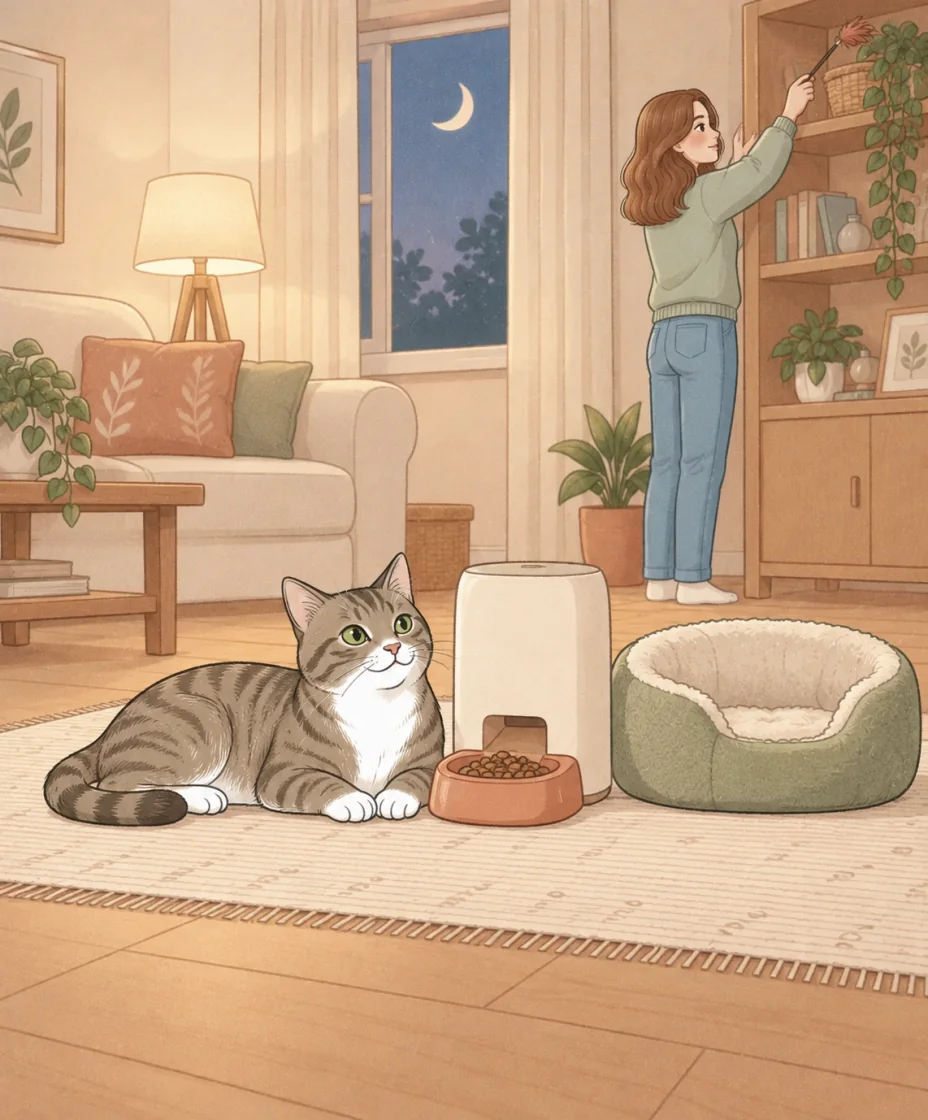
If your cat regularly wakes you early, begin with a health check and a plan for the hours before bed: comfortable play, suitable meals and accessible overnight resources. For a familiar food-seeking pattern, a timed feeder may help separate breakfast from waking you. New or increased crying, distress or other changes need veterinary attention, not a stricter ignoring routine.
First ask whether this is the usual pattern
Cats are often active around dawn and dusk, but that does not explain every early wake-up. Cats Protection recommends ruling out medical causes when a cat cries, seems restless or becomes disoriented at night. Start there if the behavior is new or changing.
Excessive vocalization can accompany pain or illness. Cat Friendly Homes recommends a veterinary examination and, when appropriate, a behavioral assessment. Tell the team when the noise happens and about changes in eating, drinking, movement or litter-box use. An older cat becoming confused or unusually vocal should not be put through a home training experiment first.
Write down what actually wakes you
Once health concerns have been addressed, make a brief note in the morning. Separate the first event, your response and what happened next. You do not need to stay awake watching or provoke the behavior to collect information.
For example: “5:10: pawed the duvet. I got up and filled the bowl. Ate, then settled.” Another note might say: “4:40: called from the hallway; food was available; kept pacing.” Those are different observations to discuss, not proof of hunger in the first case or a diagnosis in the second.
| Record | Useful detail |
|---|---|
| Before bed | When play and food were offered; whether your cat chose to join. |
| First disturbance | Approximate time, location and action: meowing, pawing, running or pacing. |
| Your response | Fed, played, checked a resource, moved away or sought help. |
| What followed | Settled, ate, continued calling or showed something unusual. |
Give the evening a repeatable shape
- Choose an evening moment when you can pay attention. Invite a short game with a familiar, suitable toy; let your cat pause or leave. Do not turn the session into a test of endurance.
- If a meal fits afterward, use part of the normal food plan. Do not add a large extra meal or change a prescribed diet to try to induce sleep.
- Put wand and string toys safely away. Check that water, litter facilities and comfortable resting places remain accessible overnight.
- Prepare any familiar, safe independent activity before bed. Test new equipment while you are awake rather than discovering at 4 a.m. that your cat cannot use it.
- Agree on the plan with other people in the home. Put the next morning’s note somewhere easy to find so you can review the setup without relying on a tired memory.
Pounce’s 4am Yowling & Night Activity curriculum includes evening play, planned feeding and reviewing wake-ups. This practical version starts with preparation you can repeat; it is not an exercise target or a promise of uninterrupted sleep.
Cat Friendly Homes favors several short play opportunities and predictable positive interaction. Fit those opportunities into ordinary awake periods. Cats Protection cautions against keeping a cat awake during the day to change nighttime activity: preserve their naps.
Could breakfast happen without waking you?
For a familiar food-seeking pattern, Cat Friendly Homes suggests a timed feeder that opens before the usual wake-up. Feeding immediately after being woken can reinforce that sequence. A scheduled portion offers another arrangement; it is not a treatment for every kind of crying.
Check the practical details while awake: does the mechanism worry your cat, can they reach the food, and does the portion fit their existing diet? Follow the device’s food-storage and cleaning instructions. In a shared home, check which cat actually gets the meal. Do not assume an empty compartment means the intended cat ate.
You do not need to buy a feeder before discussing the pattern with your veterinary team. If meals are linked to medication or a medical diet, agree any timing change with them. Keep enough suitable food in the plan rather than withholding it to make a training point.
Consistency still leaves room to respond to a problem
Avoid turning a familiar, assessed wake-up request into an unplanned toy game or extra breakfast. Offer attention and play at planned awake times, and notice comfortable, quiet interactions then. Do not shout, spray water or chase your cat.
That does not mean ignoring every sound or action. Check possible injury, distress, a blocked resource or a failed feeder. If your cat is biting, panicking at a closed door or knocking dangerous objects down, make the situation safe and ask for individual help. Do not wait for a louder or more hazardous night to prove that a plan is working.
A separate sleeping area is only useful if your cat can be comfortable there with their resources. Abruptly shutting a distressed cat away is not the exercise this guide recommends. Persistent sleep disruption is a reason to revisit the cause with your vet and a qualified cat behavior professional.
Review one change at a time
Use the log to compare ordinary nights. If the feeder stayed closed, fix the equipment; if another cat took the portion, change access; if the pattern changed or your cat seemed unwell, contact your veterinary team. A single quiet night does not establish the cause or promise a lasting result.
We make Pounce, which includes guided night-activity routines. This article adds an observation log and preparation checks, using sources and curriculum checked September 23, 2026. It was prepared with AI assistance and has not been individually reviewed by a veterinarian. There is no fixed completion date for a cat or household.
A little guidance goes a long way.
Follow illustrated lessons, take the next small step, and keep track of your cat’s little wins in Pounce.
Explore Pounce for iOSSources & how this guide was written
Pounce curriculum: 4am Yowling & Night Activity. The guide uses its health-first preparation, evening routine and review themes, with an original wake-up log and equipment checks. It does not reproduce fixed timelines, guaranteed results or instructions to ignore distress.
- Cats Protection: Cats at Night
- Cat Friendly Homes: Preventing Unwanted Behaviors
- Cat Friendly Homes: Howling and Vocalization (August 19, 2021)
- Cats Protection: Cats and Sleep
Sources checked September 23, 2026. This article is educational and has not been individually reviewed by a veterinarian. Our editorial policy explains our approach.