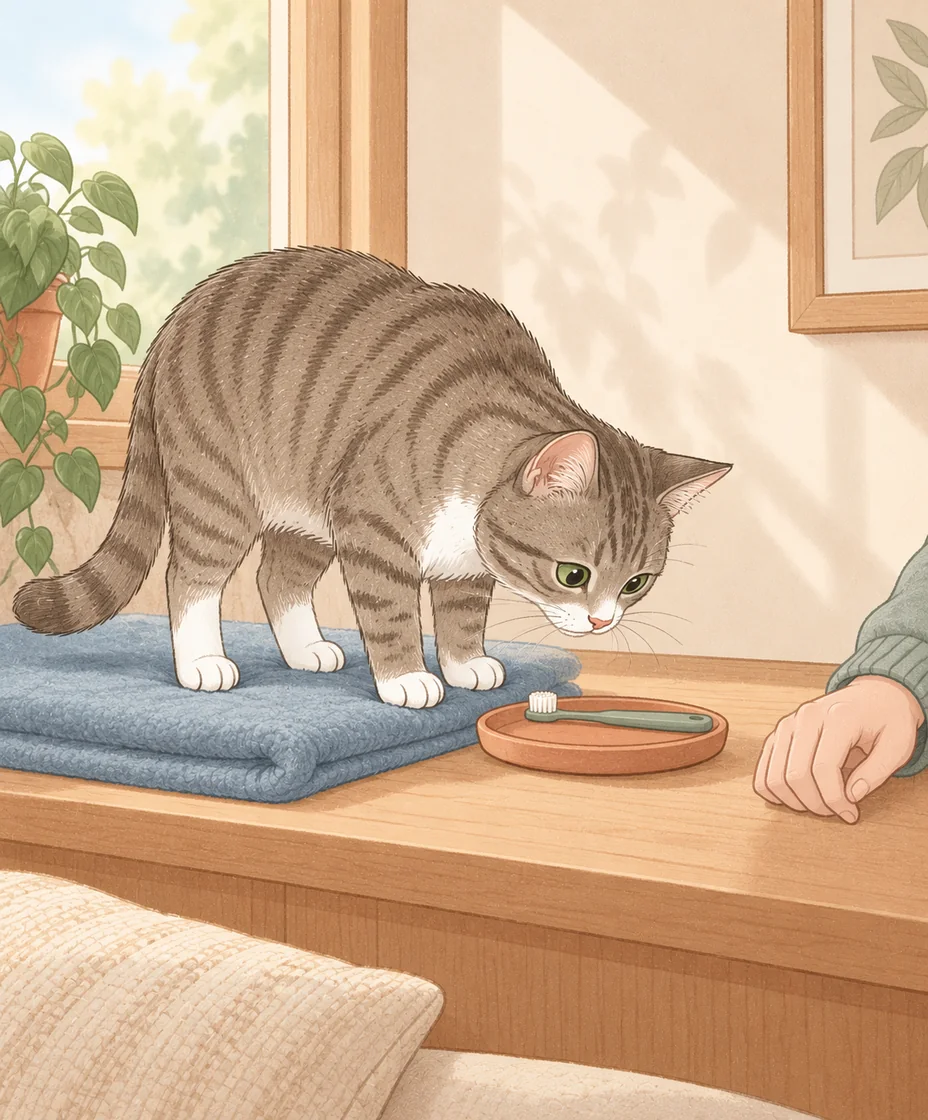
If your cat pulls away from toothbrushing, stop the contact and separate learning to accept the tool from learning to accept mouth handling. Ask your vet whether the mouth is comfortable before practicing. Liking toothpaste does not establish readiness for brushing, and training should not delay dental care your cat needs now.
Check comfort before asking for more access
AAHA’s dental guidelines caution that brushing inflamed gums can cause pain and aversion. Tell your veterinary team about a new reaction to face handling, mouth concerns or a change in eating, and ask whether home brushing is appropriate now. Do not keep touching a sensitive area to show the problem.
Eating does not rule out oral pain: AAHA’s 2026 discussion of feline pain notes that cats may continue eating despite severe dental disease. Taking a treat during practice is therefore not a health clearance. If dental treatment is needed, agree that plan first.
Source: AAHA 2019 Dental Care Guidelines: Home oral hygiene (May 6, 2019)
Keep three separate lines in your progress note
“Likes the toothbrush” can hide several different experiences. Our preparation record separates equipment, handling and cleaning. Write what actually happened on each line; “not tried” is useful information, not a failure.
For example: “Brush on saucer: approached freely. Hand beside cheek: stayed loose. Lip lift and tooth contact: not tried.” That note gives you a starting point without assuming the next task will be welcome.
| Part of the task | What to record |
|---|---|
| Equipment | Was the brush resting nearby or moving in your hand? Record toothpaste tasting separately from either. |
| Handling | Which side of the face did you approach? Was it a cheek touch or a lip lift? Note withdrawal without repeating it to confirm. |
| Cleaning | Only after veterinary guidance: which outer tooth surface received brief bristle contact? Distinguish contact from a brushing stroke. |
Make the first handling practice very small
- Begin with the brush put away. Invite your awake cat to join you; do not catch or corner them.
- Offer one brief cheek touch if that is already welcome, then remove your hand and reward. If the head moves away, stop the touch immediately.
- Pause with your hands away. Let your cat choose whether to approach again. Food should not hold a reluctant cat in position.
- When this remains comfortable, practice the brief lip lift your vet showed you, then release and reward. Do not force the jaw open or reach deep into the mouth.
- End while the task is still manageable. Record the side and movement you tried. Do not add brush contact just because one lip lift went well.
For a cat cleared for practice and comfortable with ordinary face touch, use a familiar spot with an open route away. Pounce’s Start Button Behavior lessons pair a ready posture with stopping when the cat leaves it. A cat can also withdraw their head while staying on the mat; that is a reason to stop.
The early lip-handling work in Pounce’s Vet-Visit Cooperative Care sequence can inform preparation. Ask your veterinary team to demonstrate the small lip movement appropriate for your cat before adding it.
Introduce the dental tools on their own
FelineVMA recommends a soft cat toothbrush and toothpaste made for cats, rather than human toothpaste. Ask your vet to help choose suitable supplies. Let the brush be present without using it, and offer a small taste of the cat toothpaste separately. Do not push either toward a retreating cat.
Once the separate parts are comfortable, use the technique your veterinary team demonstrated to build toward brief contact with the outside of the teeth. Increase gradually, stopping for resistance. Being able to taste paste or touch one accessible tooth does not mean the back teeth are ready for the same step.
If handling becomes less welcome across attempts, put the brush away and discuss the change with your vet. Repeating the difficult part more often is not a substitute for checking comfort.
Agree a care plan while practice catches up
AAHA recommends daily brushing for plaque control once it is feasible. Brushing does not remove existing calculus and does not replace veterinary dental assessment and treatment. Ask your vet what to do during the learning period, including whether an appropriate Veterinary Oral Health Council accepted product could be part of the plan. Do not scrape teeth yourself.
Keep two questions on your appointment note: “What dental care is needed now?” and “What is the smallest comfortable practice we can do at home?” A short successful practice answers only the second.
We make Pounce, which includes Start Button Behavior and Vet-Visit Cooperative Care. This guide adds the three-part preparation record and dental-source guidance. Sources and curriculum checked October 23, 2026. Prepared with AI assistance; not individually reviewed by a veterinarian.
Source: AAHA 2019 Dental Care Guidelines: Home oral hygiene (May 6, 2019)
A little guidance goes a long way.
Follow illustrated lessons, take the next small step, and keep track of your cat’s little wins in Pounce.
Explore Pounce for iOSSources & how this guide was written
Start Button Behavior and Vet-Visit Cooperative Care checked against the actual curriculum, including lip-handling sessions. Conservative brief contact and immediate withdrawal honored; no fixed duration, completion timeline, dedicated toothbrushing-course claim or efficacy claim. Original three-part preparation record distinguishes equipment, handling and cleaning. Dental guidance comes from the named external sources.
- FelineVMA / Cat Friendly Homes: How to Brush Your Cat’s Teeth (page timestamp January 6, 2026)
- AAHA 2019 Dental Care Guidelines: Home oral hygiene (May 6, 2019)
- AAHA: Recognizing pain in cats (February 27, 2026)
Sources checked October 23, 2026. This article is educational and has not been individually reviewed by a veterinarian. Our editorial policy explains our approach.