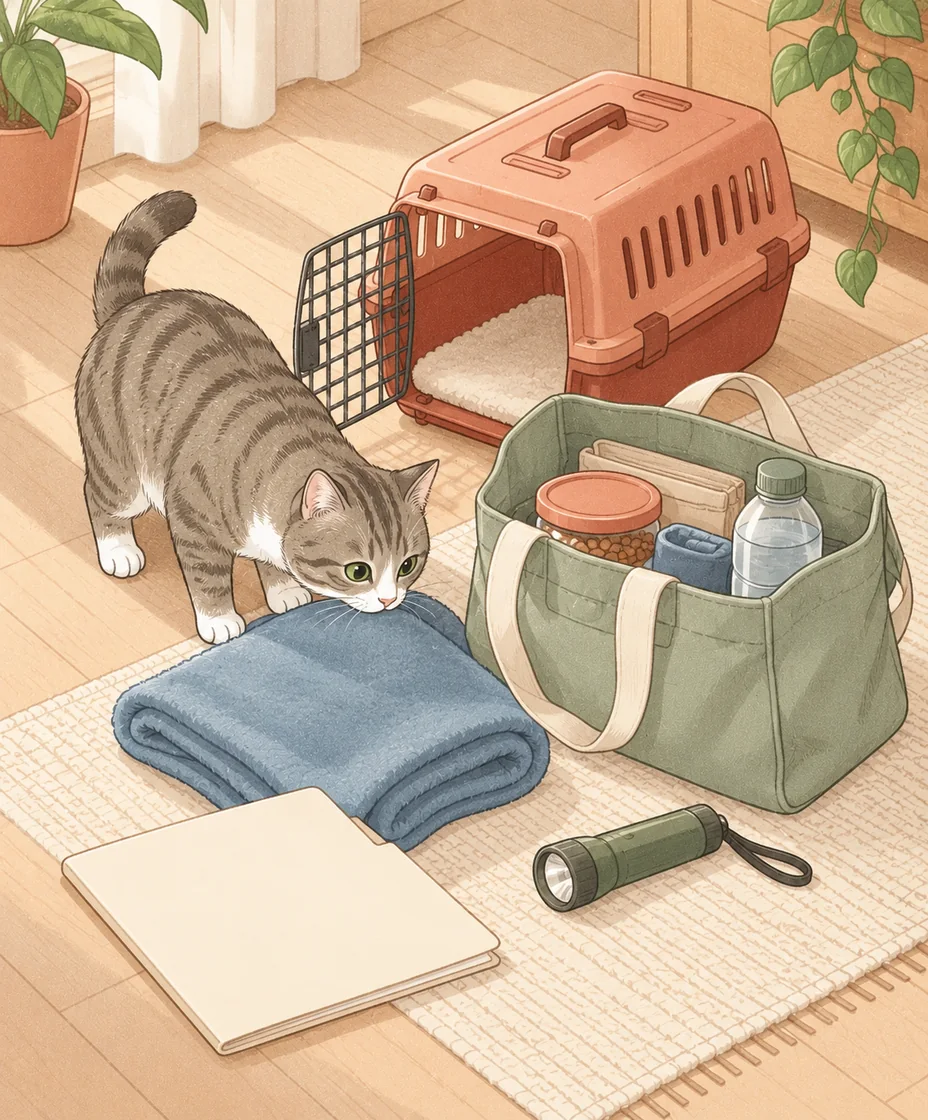
Prepare for a cat emergency before there is an alarm: keep a carrier accessible for each cat, pack essential supplies, record contacts and arrange somewhere you can stay together. Practice equipment handling separately from gentle carrier training. In a real fire, follow your fire service’s instructions: never delay escape, put yourself at risk or re-enter to retrieve a pet. A calm practice does not prove a cat will respond during an emergency.
An active fire is not a training session
If there is a fire now, stop reading and follow your local emergency instructions. Toronto Fire Services says to leave immediately, not stop for possessions or pets, call 9-1-1 once outside and stay out. Tell responders about animals still inside and their last known location. Rescue decisions belong to the emergency crews.
The American Red Cross recommends including pets in evacuation planning, while explicitly warning against delaying escape or endangering people to rescue them. Do not turn a preparedness checklist into tasks you must finish before leaving. In an apartment, learn your building’s fire safety plan in advance from management. This article covers preparation, not a building-specific evacuation procedure.
Source: Toronto Fire Services: Home fire escape planning (modified February 27, 2024)
Write a plan someone else can use
Copy this card into your household emergency plan and fill it in together. It is our practical organizing aid, not a tested rescue protocol. Include a pet sitter or trusted backup caregiver in the conversation; a plan stored only in your own memory is hard to hand over.
| Write down | Make the answer specific |
|---|---|
| People | Who coordinates the pet supplies and records? Who is the backup when that person is away? |
| Equipment | Where is each cat’s assembled carrier? Can everyone operate its latch without searching for parts? |
| Pet information | Which cats live here, where do they usually hide, and where are their current photos and identification details? |
| Contacts | List the veterinarian, emergency veterinary clinic and backup caregiver, with working phone numbers. |
| Temporary home | Who has confirmed they can accommodate you and your cats? Record a second option. |
| Next review | Choose a date to check supplies and contacts; update the card whenever household or care arrangements change. |
Pack for being away, not just reaching the door
ASPCA’s September 2026 guidance recommends food and water for seven to ten days, bowls, medical information, litter supplies, familiar bedding and a carrier for each pet. Discuss an appropriate medication reserve with your veterinarian; keep it according to its storage instructions. Check expiry dates when reviewing your kit.
Keep the bag accessible without blocking an exit. Label carriers with contact details and keep microchip registration information current. Confirm a pet-friendly place to stay beforehand: do not assume an emergency shelter accepts animals. A bag and a carrier do different jobs; the supply bag is not a substitute for a secure cat carrier.
Source: ASPCA: Disaster preparedness for pets (September 1, 2026)
Rehearse the human jobs with empty carriers
- Ask another household member to locate the carriers, bag and planning card without being coached. Note anything they cannot find.
- With carriers empty, check assembly and practice opening and securing each latch. Replace damaged equipment before it is needed.
- Discuss the plan for a day when the usual caregiver is absent. Check that the backup knows the agreed arrangements.
- Fix one practical problem you found, such as a carrier buried in a cupboard or an outdated phone number. Write down the correction.
These quiet equipment checks are an extra preparation exercise alongside your official household fire plan, not a replacement for required alarm tests or building drills. Keep smoke alarms working and follow their testing instructions.
Source: Toronto Fire Services: Alarmed for Life home escape plan
Give the cat ordinary, comfortable practice
FelineVMA advises leaving the carrier in the cat’s everyday environment with familiar bedding, encouraging positive experiences and avoiding a last-minute chase. Work on voluntary entry, door movement and being carried in separate sessions. During carrying or transport, the carrier must be correctly assembled and securely closed; support it underneath.
Do not create a frightening mock emergency to test the cat. Keep this carrier practice quiet and separate from the household drill. If the cat retreats or becomes distressed, stop the practice and return to an easier step another time. Ask your veterinary team in advance for an individual transport plan if loading is consistently difficult.
Recall can be a useful everyday skill, but neither responding to a cue nor entering a carrier in the living room establishes reliability during smoke, noise or panic. Do not wait for a training course to be completed before making the household plan.
Source: FelineVMA: Getting your cat to the veterinarian (page timestamp December 1, 2025)
Address fire hazards directly
The Red Cross highlights pets reaching stove controls and open flames. Ask the appliance manufacturer about suitable control protection, and use flameless alternatives to candles. Training a cat to stay off a counter is not a substitute for managing these hazards. Keep any pet-alert notice accurate and tell responders when pets have already been evacuated; a notice cannot guarantee a rescue.
We make Pounce. Its Carrier Confidence and Come When Called lessons support everyday practice; it is not an emergency-response service. The planning card and equipment rehearsal are original additions to this guide. Sources and curriculum checked October 18, 2026. Prepared with AI assistance; not individually reviewed by a veterinarian or fire-safety professional.
A little guidance goes a long way.
Follow illustrated lessons, take the next small step, and keep track of your cat’s little wins in Pounce.
Explore Pounce for iOSSources & how this guide was written
Pounce’s Carrier Confidence and Come When Called lessons inform the everyday practice links. The household planning card and empty-carrier rehearsal are original organizing aids, with no promised emergency response or rescue outcome.
- Toronto Fire Services: Home fire escape planning (modified February 27, 2024)
- Toronto Fire Services: Alarmed for Life home escape plan
- American Red Cross: Pet fire safety
- ASPCA: Disaster preparedness for pets (September 1, 2026)
- FelineVMA: Getting your cat to the veterinarian (page timestamp December 1, 2025)
Sources checked October 18, 2026. This article is educational and has not been individually reviewed by a veterinarian. Our editorial policy explains our approach.