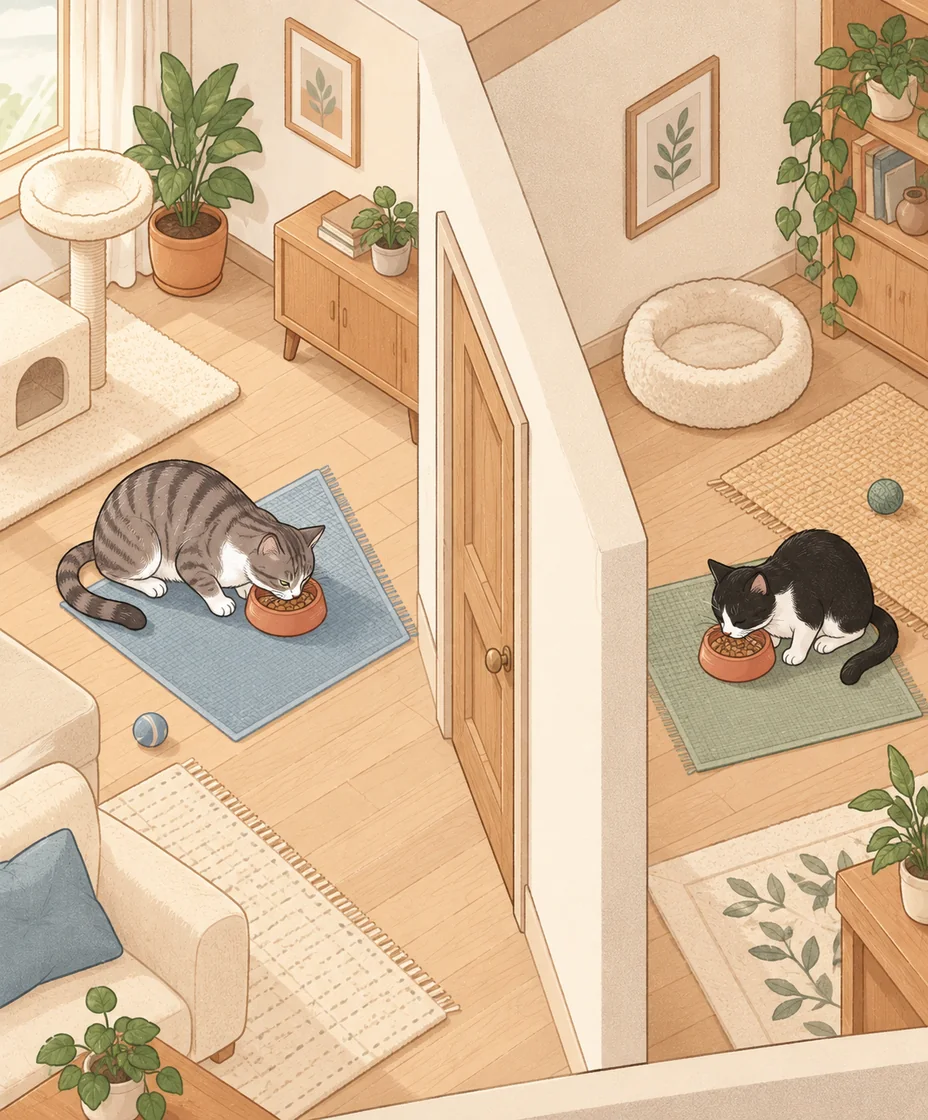
If your cats keep eating each other’s food, arrange comfortable separate feeding areas and control access for the whole meal, including leftovers. Check what each cat actually eats. Different diets may require separate rooms or a suitable selective-access feeder; a mat cue alone cannot protect a portion. Keep each cat’s appropriate food available through a plan that also works for the slower eater.
Confirm which food belongs to which cat
Write down each cat’s food and veterinary feeding instructions before rearranging the bowls. VCA explains that individual needs can differ within one household, including between kittens and adults. Ask your veterinary team whether sharing is appropriate; do not resolve the problem by mixing the foods or changing a prescribed diet on your own.
Bowl swapping does not tell you whether either cat is hungry, getting enough food or enjoying the other cat’s company. Your first useful observation is simpler: can each cat eat their intended food without the other taking over?
Source: VCA Canada: Feeding Multiple Pets (updated May 22, 2026)
Separate locations and separate access solve different problems
The AAFP feeding consensus recommends feeding locations where cats feel safe, with distance and visual separation in multi-cat homes. Place food away from litter boxes and check that one cat is not guarding another’s access.
For bowl swapping, also trace the route between the portions. A screen can hide a bowl while leaving an easy walk around it. This comparison is our practical way to check a layout; it is not a ranking of feeding products.
| Arrangement | What to check before relying on it |
|---|---|
| Different comfortable rooms with a closed door | Can both cats settle and eat there? Who handles the door, and where will unfinished food go before it opens? |
| Bowls farther apart or behind a visual screen | This changes what the cats see. If either can still reach the other portion, it does not prevent swapping. |
| A feeder that limits access to a particular cat | Check the actual model’s access function and food compatibility. Watch both cats use the arrangement before relying on it; a timer alone does not identify the eater. |
Plan the end of the meal before putting bowls down
- Prepare the intended portions and identify the bowls. Agree which person will feed each cat so two people do not accidentally serve the same meal twice.
- Invite each cat into their familiar eating area. Set up the agreed separation before offering food, without chasing or repeatedly picking up a cat to return them to a bowl.
- Check both cats. Notice whether they eat, pause comfortably or leave the food untouched. A bowl placed behind a door is not proof of a meal eaten.
- When the first cat finishes, keep the other portion protected. Do not open the route between bowls simply because one cat is ready to leave.
- Before restoring shared access, either protect the unfinished food in its intended setup or put it away according to the food’s storage instructions and arrange the next appropriate opportunity for its owner to eat. Tell the next caregiver what remains to be offered.
The awkward moment often comes when the fast eater finishes first. Decide who will do these steps before that cat starts visiting the other bowl. This household sequence puts the access plan into practice.
A grazer still needs a workable food plan
If one cat eats gradually, a short supervised meal may not fit. Do not copy the fast eater’s timetable or impose a fixed bowl-removal deadline. Discuss suitable feeding opportunities with your veterinary team; consider whether a comfortable protected area or properly introduced selective feeder can preserve access.
Review the arrangement if a cat repeatedly leaves without eating, waits outside the other feeding space or becomes distressed behind the door. Do not wait for hunger or prolonged crying to make the system work. Change the setup and seek veterinary or qualified behavior help when comfortable separation is difficult. Feeding separation is not a plan to confine either cat indefinitely.
Source: VCA Canada: Feeding Multiple Pets (updated May 22, 2026)
Practice a destination separately, and notice appetite changes
A voluntary mat visit can make the trip to an eating area more familiar. Practice each cat separately when the situation is easy: reward approaching or stepping onto their mat, then end before frustration. At actual meals, use the access arrangement even if both cats know the cue.
If a cat stops eating, contact your veterinarian immediately rather than treating it as refusal to cooperate. Cornell’s guidance on anorexia emphasizes prompt veterinary assessment. Do not force food into a reluctant cat’s mouth. Bring notes about what was offered, what was eaten and any other changes.
We make Pounce, which includes Go to Mat / Place. The app supports gradual training practice; it does not prescribe diets or guarantee that a cat will leave another bowl alone. This article adds a meal-access comparison and household sequence. Sources and curriculum checked October 21, 2026. Prepared with AI assistance; not individually reviewed by a veterinarian.
A little guidance goes a long way.
Follow illustrated lessons, take the next small step, and keep track of your cat’s little wins in Pounce.
Explore Pounce for iOSSources & how this guide was written
Go to Mat / Place in content/modules.json checked in full. Product claim limited to gradual voluntary mat practice; no dietary prescription or guaranteed meal-access control. Original layout comparison and whole-meal household sequence.
- VCA Canada: Feeding Multiple Pets (updated May 22, 2026)
- AAFP consensus: Feline feeding programs (2018)
- AAFP caregiver brochure: How to Feed a Cat (2018)
- Cornell Feline Health Center: Anorexia
Sources checked October 21, 2026. This article is educational and has not been individually reviewed by a veterinarian. Our editorial policy explains our approach.