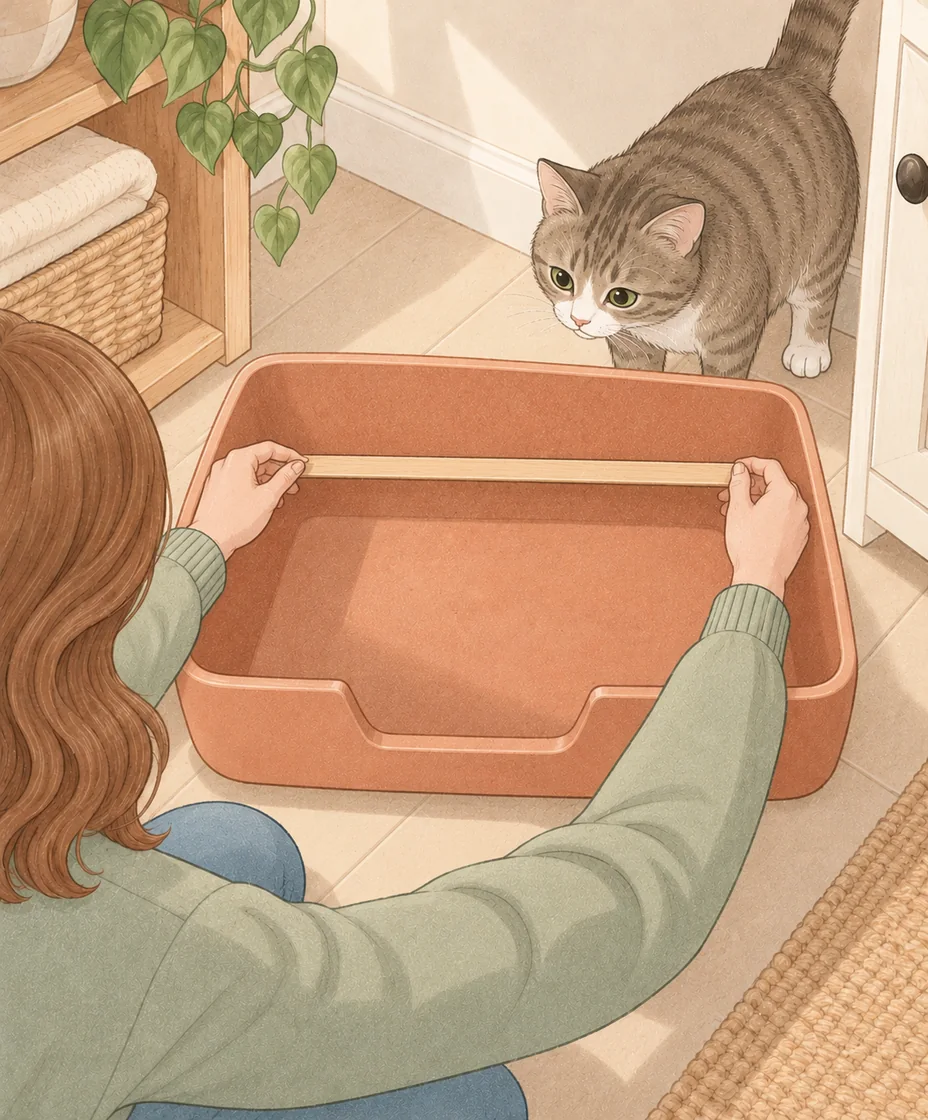
If your cat enters the litter box but poops over the edge, check the usable space and how comfortably they enter and turn, and tell your vet about the pattern. All four paws being inside does not mean the whole body fits comfortably. Hard stool, difficulty passing it or a change in toileting needs veterinary attention; a taller wall is not a diagnosis or a guaranteed solution.
Describe the miss before choosing a fix
There is a useful difference between seeing a cat stand in the tray with their rear over its edge and simply finding stool nearby. In the second case, you may not know how it arrived there or which cat produced it. Keep that uncertainty in your note.
If you happen to observe normal toileting from a distance, notice the entry, the cat’s position and where the stool lands. Do not hover, interrupt, turn the cat around or hold them farther inside. A photo of the empty tray and its surroundings can show your vet the layout without disturbing the cat.
Write a plain observation such as ‘front paws near the back wall, rear over the entrance’ rather than ‘doesn’t understand the box.’ That gives you something specific to discuss without assigning a cause.
Hard stool is a separate concern
Cornell describes constipation as infrequent or difficult passage of hard, dry stool. Tell your veterinarian about hard stool, repeated effort, discomfort or a new change, even if some stool is still passing. Do not start laxatives, enemas or dietary supplements from an online suggestion; ask for an individual plan.
Repeated straining with little or no urine can indicate a blockage and requires emergency veterinary attention now. If you cannot tell whether a straining cat is trying to pee or poop, call an emergency veterinarian rather than assuming constipation. Do not wait for a tray experiment.
Source: Cornell Feline Health Center: Constipation (updated 2021)
Check floor space before adding height
FelineVMA recommends a tray about one and a half times the cat’s length from nose to tail base, with a low entrance for older cats. Use comfortable observation to estimate your cat’s length; do not stretch or restrain them to measure. Check the tray when it is empty and the cat is elsewhere.
Our fit checklist separates room inside the tray from the height of its walls. It helps you compare options without assuming a product marked ‘large’ will suit your cat.
| Detail | Practical check |
|---|---|
| Usable interior | Measure inside the tray, not just across the outer rim. Note any inward slope or insert that reduces the floor area. |
| Turning space | Compare the interior with the cat’s ordinary standing body length. Record if the cat appears crowded against an edge; do not make them perform a test turn. |
| Entrance | Note the step-over height separately from the other walls. A higher entrance adds a different movement requirement, even when the tray is wider. |
| Position in the room | Sketch which way the entrance faces and what sits immediately beside it. Check whether the approach and departure are clear. |
Source: FelineVMA / Cat Friendly Homes: Not Using the Litter Box (page timestamp March 13, 2026)
Larger trays are worth considering, with limits
A 2025 study by Iwabuchi-Inoue and colleagues compared tray sizes in three cat-café rooms housing 78 cats. Overall use favored the larger test trays, but the separate analysis of defecation did not find a statistically significant size effect. It did not specifically test cats whose rear hangs over the entrance.
A later part of that study changed both the tray and litter for 20 selected household cats with toileting problems. Improvements cannot establish that size alone caused the change. The lead author was affiliated with a pet-products company. These findings support considering the environment; they do not prove that one tray size will stop your cat missing the edge.
Source: Iwabuchi-Inoue and colleagues: Litter box size and litter type preference (2025)
Make the next change easy to interpret
Agree the next step with your vet, especially if movement or stool has changed. A taller-sided tray may contain some misses, but check the entrance and usable interior before choosing one. A covered or top-entry model changes more than the wall height. Do not buy a design that requires a movement your cat struggles to make.
For an agreed comparison, keep a familiar usable option available. Write down exactly what changed: for example, ‘added a wider open tray; kept the same litter.’ If size, litter, location and cleaning routine all change together, the result will be harder to interpret. Avoid turning the whole home into a succession of unfamiliar trays.
Note ordinary use as well as misses. Review comfort and stool concerns alongside cleanup: catching the stool inside is not enough to establish that discomfort has resolved. If the pattern persists, return to the veterinary plan rather than repeatedly escalating wall height.
Keep this separate from an obedience lesson
Do not punish a miss or require a cue before your cat can use the tray. FelineVMA cautions against punishment and against experiences that trap or startle cats around toileting areas.
We make Pounce, which includes Litter Box Troubleshooting with setup, maintenance and observation tasks. This guide adds the tray-fit comparison; the app cannot diagnose constipation, pain or urinary disease. Sources and curriculum checked October 22, 2026. Prepared with AI assistance; not individually reviewed by a veterinarian.
Source: FelineVMA / Cat Friendly Homes: Not Using the Litter Box (page timestamp March 13, 2026)
A little guidance goes a long way.
Follow illustrated lessons, take the next small step, and keep track of your cat’s little wins in Pounce.
Explore Pounce for iOSSources & how this guide was written
Complete Litter Box Troubleshooting curriculum checked. Only setup, maintenance and observation product facts used. No fixed cure period, universal equipment preference, diagnosis from box use or waiting period for urinary symptoms. Original fit checklist; evidence limitations explicit.
- FelineVMA / Cat Friendly Homes: Not Using the Litter Box (page timestamp March 13, 2026)
- Iwabuchi-Inoue and colleagues: Litter box size and litter type preference (2025)
- Cornell Feline Health Center: Constipation (updated 2021)
- Cornell Feline Health Center: Feline Lower Urinary Tract Disease (updated October 2016)
Sources checked October 22, 2026. This article is educational and has not been individually reviewed by a veterinarian. Our editorial policy explains our approach.