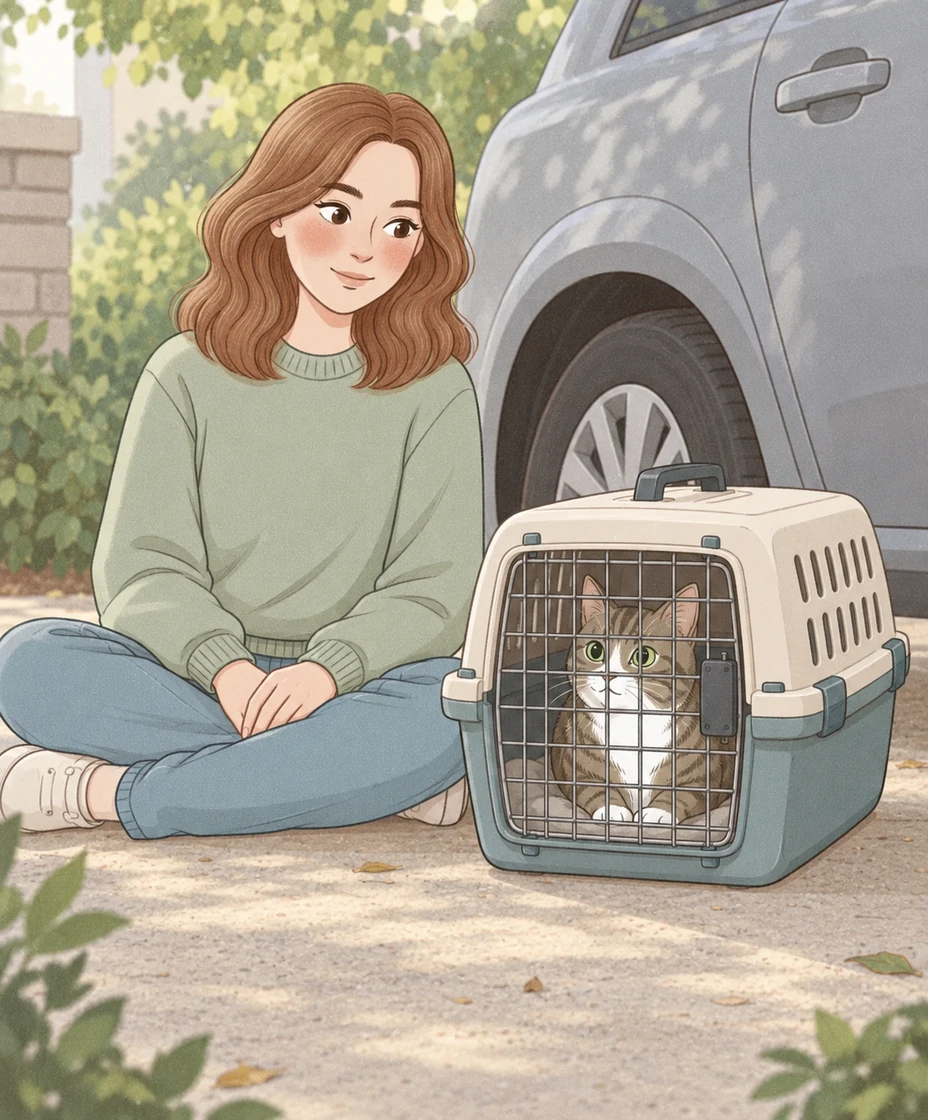
Begin car-travel practice after your cat is comfortable entering, remaining in and being carried in a secure carrier at home. Introduce the parked car with the engine off, then engine sound, then a very short journey on separate occasions. Keep the carrier closed and secured. Distress is a reason to stop and seek help, not extend the trip until your cat goes quiet.
Separate the carrier from the journey
A cat who naps in an open carrier has learned something useful, but that does not tell you how they feel about its door closing, being lifted or a moving vehicle. Name the part you are preparing before adding the next one. If enclosure or carrying is still difficult, return to our carrier guide and discuss necessary travel with your veterinary team.
Pounce’s Carrier Confidence program includes an engine-off visit to the car after home practice. Its travel curriculum separates the parked vehicle, engine and short drives. This guide focuses on that transition, with an observation plan for deciding what to repeat. It does not teach camping or certify readiness for a long road trip.
Set up the vehicle before bringing your cat
Choose a quiet opportunity when you can return home promptly. Check the carrier’s assembly and latches, the route to the car and the vehicle’s temperature first. Use familiar bedding without blocking ventilation. Stay with your cat throughout; Cats Protection advises never leaving a cat unattended in a car.
Keep the carrier closed outside your secure indoor space. FelineVMA advises secure placement in the vehicle and warns against opening the carrier during travel, even when a cat meows. Follow the carrier and vehicle instructions for an appropriate restraint arrangement; ask your veterinary team if the fit is unclear. A carrier on someone’s lap is not a substitute.
Keep noise low and temperature comfortable. For any later engine-on practice, park outdoors, away from enclosed spaces and exhaust hazards. Arrange a helper if you need someone to observe while another person operates the vehicle. The driver’s attention belongs on driving.
Change one part of the journey at a time
VCA’s travel-training guidance separates visiting the vehicle, hearing it run and taking a short drive. The sequence below also draws on Pounce’s early travel lessons. Each row is a different practice opportunity, not a checklist to finish today.
For the first visit, carry the securely closed carrier with its base supported, place and secure it in the prepared vehicle, and keep the engine off. Stay nearby briefly, then return indoors. Open the carrier only once you are back in a secure room. An ordinary suitable reward can follow; do not withhold meals to make the car more appealing.
| Current comfortable step | One possible later change | Keep the rest familiar |
|---|---|---|
| Being carried at home | A brief visit to the parked car, engine off | Same carrier and bedding; no drive or unfamiliar destination. |
| Settling comfortably in the parked car | A brief engine start while the vehicle stays parked | Same secure placement; no increase in visit length. |
| Remaining comfortable with the engine running | A very short, smooth journey with an easy return home | Same equipment; no added errand or longer outing. |
Record what changed before planning more
Use four fields: stage, new event, response and next decision. For example: “Parked car; passenger door closed; body became tense; returned indoors, no engine practice.” That tells you which event to discuss or make smaller. “Did ten minutes” tells you only how long the visit lasted.
Notice the return home too. Does your cat resume their usual comfortable activity, or keep hiding? Do not use silence, immobility or taking a treat alone as permission to add another challenge. You can repeat an easy stage without making it longer.
VCA advises ending training when anxiety appears and contacting a veterinarian for persistent difficulty. Drooling, vomiting, frantic escape attempts or unusual behavior need assessment; they do not tell you the cause by themselves. Stop a practice drive at a safe place as soon as you can, keep the cat securely contained and contact your veterinary team as appropriate. Do not open the carrier at the roadside to offer reassurance.
A necessary journey needs its own plan
If an appointment or move is approaching, contact your veterinary team before the day. Explain the stage your cat manages and any previous travel reactions. Ask about transport, feeding, comfort and whether prescribed support is appropriate. Do not give another animal’s medicine or improvise a dose, and do not postpone needed care until training is finished.
For an optional long trip, consider whether your cat needs to come. Cats Protection recommends limiting travel to necessary journeys. A comfortable short ride does not establish comfort over several hours or in an unfamiliar destination; those require separate welfare and practical decisions.
We make Pounce, which includes Carrier Confidence and travel lessons. The stage-by-stage planning table and example record are our educational adaptations. Sources and curriculum were checked October 2, 2026. This guide was prepared with AI assistance and has not been individually reviewed by a veterinarian. No completion time or guaranteed calm journey is promised.
A little guidance goes a long way.
Follow illustrated lessons, take the next small step, and keep track of your cat’s little wins in Pounce.
Explore Pounce for iOSSources & how this guide was written
Pounce curriculum: Carrier Confidence and Cafés, Travel and Camping. Only the parked-car, engine and short-drive staging is adapted, with secure carrier containment throughout. Original stage/event/response/decision record. No fixed durations, unsupported licking/heart-rate claims, lap travel, blanket medication or fasting advice, or guarantee of long-trip suitability. Sources checked October 2, 2026.
- FelineVMA: Visiting Your Veterinarian (copyright 2024)
- VCA: Crate and travel training tips for cat owners
- VCA: Motion Sickness in Cats
- Cats Protection: Travelling with your cat
Sources checked October 2, 2026. This article is educational and has not been individually reviewed by a veterinarian. Our editorial policy explains our approach.